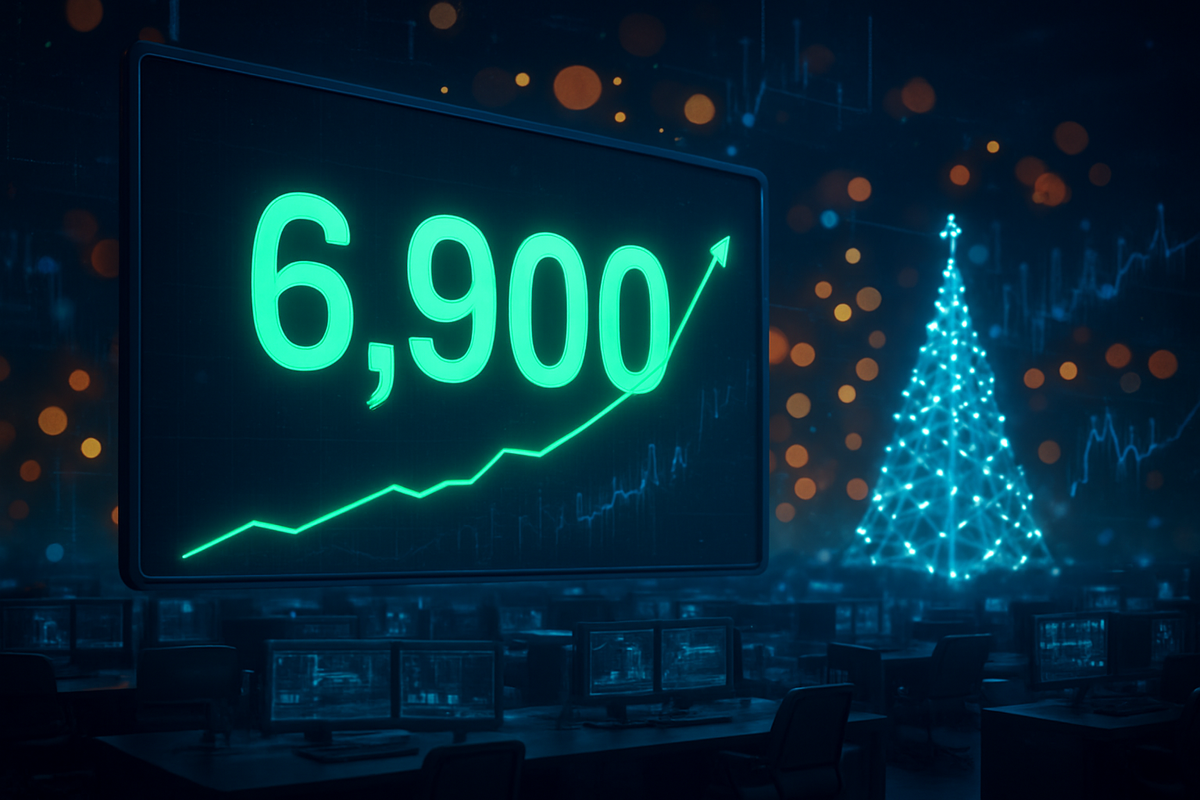
As Wall Street winds down for the Christmas holiday, investors have received the ultimate gift: a record-shattering close for the benchmark S&P 500 index. On the final full trading day before the break, the S&P 500 (INDEXSP: .INX) officially breached the psychological 6,900 barrier, closing at an all-time high of 6,909.79. This milestone marks the culmination of a relentless year-end surge, often referred to as a "Santa Claus Rally," which has seen the index defy skeptics and valuation concerns to post its third consecutive year of double-digit gains.
The immediate implications of this breakout are profound. By crossing 6,900, the index has validated the "soft landing" narrative that dominated 2025, signaling a high level of investor confidence in the Federal Reserve's ability to manage inflation without triggering a recession. With the market now trading at approximately 24 times forward earnings, the push into uncharted territory suggests that the appetite for growth—specifically within the artificial intelligence (AI) and semiconductor sectors—remains the primary engine of the global economy heading into 2026.
A Year of Resilience and Rate Relief
The journey to 6,900 was anything but a straight line. The year began with cautious optimism, as major institutions like JPMorgan (NYSE: JPM) and Morgan Stanley (NYSE: MS) initially set year-end targets between 6,500 and 6,800. However, the market's momentum was supercharged by a series of strategic pivots from the Federal Reserve. After holding rates steady for much of the first half of the year, the Fed executed three consecutive 25-basis-point rate cuts in September, October, and December, bringing the federal funds rate range down to 3.50%–3.75%. This "neutral" policy shift provided the necessary liquidity to sustain high equity valuations even as the labor market showed signs of cooling.
The timeline of 2025 was also punctuated by significant volatility. In April, a "Tariff Shock" briefly sent the market into a 10% tailspin after effective trade rates rose to 27%, and a prolonged government shutdown from October to mid-November created a "data void" that left investors flying blind. Yet, each dip was met with aggressive buying. The final push in December was catalyzed by a stellar Q3 GDP report showing 4.3% growth, alongside a late-month realization that corporate AI capital expenditures are on track to exceed $1.4 trillion over the next two years.
The Great Bifurcation: Winners and Losers of 2025
The 2025 rally was defined by a massive performance gap between the "AI Haves" and the "Traditional Have-Nots." The clear winners were the semiconductor and hyperscale cloud providers. NVIDIA (NASDAQ: NVDA) continued its legendary run, gaining 36.8% for the year and becoming the first company in history to reach a $5 trillion market capitalization. Micron Technology (NASDAQ: MU) emerged as the year's standout performer, skyrocketing 229% as demand for high-bandwidth memory (HBM) reached a fever pitch. Other tech titans like Alphabet (NASDAQ: GOOGL) and Broadcom (NASDAQ: AVGO) saw gains of 64% and 47%, respectively, as they successfully integrated generative AI into their core business models.
Conversely, the year was punishing for defensive and consumer-facing sectors. Consumer Staples was the "lone loser" of 2025, with giants like Procter & Gamble (NYSE: PG) and Colgate-Palmolive (NYSE: CL) dropping 12% and 13% as inflationary pressures and the rise of GLP-1 weight-loss drugs disrupted traditional snack and beverage demand. The retail sector also saw high-profile casualties; Nike (NYSE: NKE) struggled with structural issues, falling nearly 30%, while companies like Spirit Airlines (NYSE: SAVE) and Rite Aid were forced into bankruptcy filings. This "bifurcation" highlights a market that is increasingly rewarding technological innovation while discarding legacy business models that fail to adapt.
AI Integration and the New Economic Reality
The significance of the S&P 500 hitting 6,900 extends beyond mere numbers; it represents a fundamental shift in how the market values productivity. In 2025, AI transitioned from a speculative "hype" phase into a tangible driver of industrial and material efficiency. We saw "Physical AI" and robotics begin to offset labor shortages in the Industrials sector, creating a broader base of support for the index beyond just the "Magnificent Seven." This trend mirrors the productivity boom of the late 1990s, though today’s market is backed by significantly higher cash flows and more robust balance sheets among the top-weighted companies.
However, this reliance on a few key players has created unprecedented market concentration. By late 2025, the top 30 AI-related stocks accounted for 44% of the S&P 500's total market cap. This concentration was put to the test in November during the "DeepSeek Shock," when a Chinese AI startup's cost-efficiency claims triggered a brief but violent sell-off in the Nasdaq (INDEXNASDAQ: .IXIC). The market's ability to recover from that shock and reach 6,900 by Christmas Eve suggests that investors currently view any AI-related volatility as a buying opportunity rather than a systemic risk.
Looking Ahead: The Road to 7,000 in 2026
As we look toward 2026, the primary question for investors is whether the S&P 500 can maintain this velocity. Short-term, the market is overbought, and a period of consolidation in early January is highly probable as institutional investors lock in gains from a stellar 2025. However, the long-term outlook remains bullish. Many analysts are already raising their 2026 targets, with JPMorgan suggesting the index could reach 7,500 or even 8,000 if the "neutral" interest rate environment persists and AI-driven earnings continue to beat expectations.
The challenges for the new year will include navigating potential "Tariff 2.0" implications and a labor market that, while stable, is no longer growing at the breakneck pace of the post-pandemic era. Strategic pivots will be required for companies in the Real Estate (NYSEARCA: XLRE) and Utilities (NYSEARCA: XLU) sectors, which underperformed in 2025. These sectors may find new life in 2026 if the Fed continues to lean into its dovish stance, potentially offering a "catch-up" trade for investors looking for value outside of the tech space.
Final Thoughts for the MarketMinute Audience
The S&P 500 closing above 6,900 on December 24, 2025, is a historic milestone that caps a year of extraordinary economic resilience. The key takeaway for investors is that the "AI Revolution" is no longer a future prospect—it is the current reality driving earnings, productivity, and market sentiment. While the 24x forward earnings multiple is high by historical standards, it is supported by a Federal Reserve that has successfully transitioned to a supportive policy stance and a corporate sector that is leaner and more efficient than ever before.
Moving forward, investors should keep a close eye on the "broadening out" of the rally. While NVIDIA and Micron led the charge in 2025, the sustainability of the 6,900 level will depend on whether the rest of the S&P 500 can begin to participate in the growth. Watch for the Q4 earnings season in January to provide the first real test of these record-high valuations. For now, Wall Street can head into the holiday weekend with the satisfaction of a job well done and a market that is firing on all cylinders.
This content is intended for informational purposes only and is not financial advice.