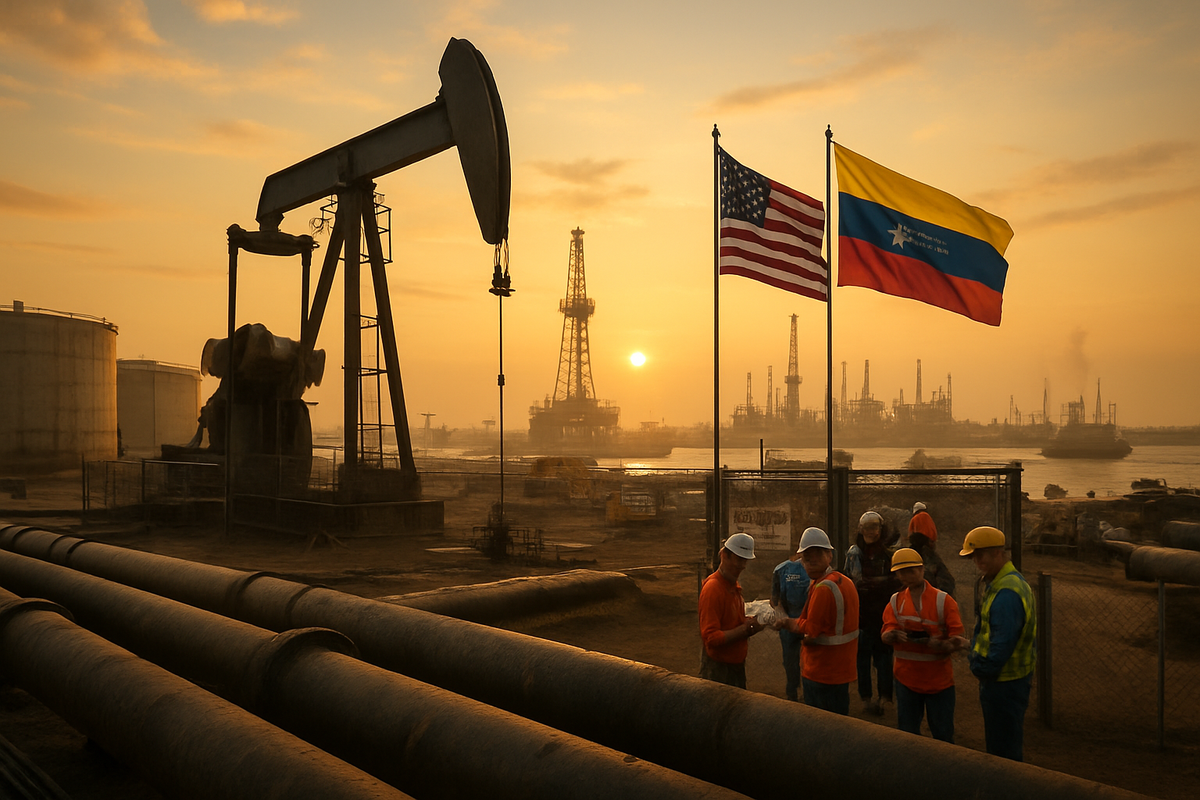
In a month that has fundamentally reshaped the geopolitical landscape of the Western Hemisphere, the Venezuelan oil sector is undergoing a seismic restructuring following a rapid US military intervention in early January 2026. The capture of Nicolás Maduro and the subsequent installation of an interim government have paved the way for a total overhaul of the nation’s energy policies. President Trump has wasted no time in pledging a "Marshall Plan" for Venezuelan energy, calling upon American oil majors to lead a multi-billion dollar effort to rebuild the country's decaying infrastructure and stabilize global energy prices.
The immediate implications for the market have been nothing short of transformative. As the interim administration in Caracas moves to dismantle the state monopoly held by PDVSA, the prospect of the world’s largest oil reserves—exceeding 300 billion barrels—returning to the global market has sent shockwaves through the industry. Investors are betting heavily on a new era of Western-led production, seeing this as a strategic move to break the influence of OPEC+ and secure a reliable, long-term supply of heavy crude for American refineries.
A Targeted Transition: Operation Absolute Resolve and the January 29 Decree
The catalyst for this shift was "Operation Absolute Resolve," a high-stakes US military mission launched on January 3, 2026. Targeted airstrikes and special operations forces successfully neutralized key defensive positions and apprehended Nicolás Maduro, who was swiftly extradited to the United States to face long-standing narcotrafficking charges. The transition of power to a transitional government led by Delcy Rodríguez was marked by immediate cooperation with Washington. On January 29, 2026, just one day ago, this cooperation culminated in the passage of the "Hydrocarbons Liberalization Act," a landmark law that officially permits foreign private companies to hold majority ownership in oil projects—a right previously reserved for the state-owned PDVSA.
This legislative breakthrough followed weeks of intense diplomatic and economic maneuvering. President Trump’s administration has positioned the intervention not as a war of conquest, but as a "restorative mission" aimed at reclaiming the $100 billion in lost value caused by decades of mismanagement and corruption. The timeline of events has moved with startling speed: from the initial strikes on January 3rd to Maduro's first court appearance in Manhattan on January 5th, and finally to the legislative overhaul this week. The market's reaction has been one of cautious optimism, with crude prices fluctuating as traders weigh the potential for a massive new supply glut against the reality of a years-long rebuilding process.
Key stakeholders, including the US State Department and major energy executives, have already begun high-level summits in Houston to coordinate the logistics of the "Rebuild Venezuela" initiative. The focus is not just on pumping oil, but on repairing the thousands of miles of pipelines and the massive Orinoco Belt upgraders that have fallen into ruin. While security concerns remain high due to lingering loyalist pockets, the presence of US military personnel at key installations has provided enough stability for technical teams to begin their initial assessments.
The Chevron Advantage: Winners and Losers in the New Caracas
Chevron Corporation (NYSE: CVX) has emerged as the clear frontrunner in this new landscape, with its stock price surging nearly 6% following the intervention and hitting an all-time high of $171.19 this week. Unlike its peers, Chevron maintained a persistent, albeit restricted, presence in Venezuela throughout the years of sanctions. This "first-mover" status has given them a decade of operational data and established relationships that are now being converted into lucrative long-term contracts. The company is already moving to ramp up its existing production in the Orinoco Belt, with plans to double its output to 500,000 barrels per day by the end of 2027.
Beyond Chevron, other US majors are eyeing the spoils of the restructuring. Exxon Mobil Corporation (NYSE: XOM) and ConocoPhillips (NYSE: COP), both of which have outstanding multibillion-dollar legal claims against the Venezuelan state for previous asset seizures, are in prime position to negotiate new exploration licenses as part of their compensation settlements. For these companies, the return to Venezuela represents a chance to book massive new reserves at a fraction of the cost of offshore deepwater drilling. On the service side, giants like SLB (NYSE: SLB) and Halliburton Company (NYSE: HAL) are expected to see a windfall of contracts as the technical work of reviving dormant wells begins in earnest.
However, the restructuring leaves several clear losers in its wake. PDVSA, the once-mighty state oil giant, is being systematically dismantled, its assets likely to be auctioned off or reorganized into smaller, private entities. Geopolitically, Russia’s Rosneft and various Chinese state enterprises, which held significant influence and debt-for-oil deals under the Maduro regime, now find their investments in legal limbo. The new Venezuelan government has signaled that all prior contracts will be "reviewed for corruption," a move widely seen as a precursor to freezing out Eastern interests in favor of Western partners.
Strategic Synergy: The Gulf Coast and the 304-Billion-Barrel Prize
The strategic significance of Venezuela’s 304 billion barrels of proven reserves cannot be overstated. While much of this is extra-heavy crude—a thick, tar-like substance that is difficult to extract—it is precisely the type of oil that the US refining system was built to handle. Over the last two decades, billions of dollars were invested into "coking" units at refineries along the US Gulf Coast to process heavy, sour crude. When Venezuelan supply was cut off due to sanctions and decay, these refineries were forced to import more expensive alternatives from the Middle East.
Valero Energy Corporation (NYSE: VLO) and other Gulf Coast refiners stand to benefit immensely from the restoration of a stable, "short-haul" supply of heavy crude. The "heavy-light spread"—the difference in price between high-quality light crude and lower-quality heavy crude—allows these complex refineries to generate significantly higher margins. By sourcing oil from a neighbor only a few days' sail away, rather than weeks across the Atlantic, these companies can drastically reduce transportation costs and supply chain volatility.
Furthermore, this event marks a pivot in global energy security. By integrating Venezuelan production back into the Western fold, the United States is effectively creating a "Hemispheric Energy Shield." This shift reduces the domestic market's sensitivity to disruptions in the Strait of Hormuz or the Suez Canal. For the broader industry, it signals a return to "traditional" oil and gas dominance, potentially slowing the transition to renewables as the market is flooded with affordable, albeit carbon-intensive, fossil fuels.
The Road to Recovery: Strategic Pivots and Long-Term Challenges
What comes next is a period of intense capital expenditure and logistical hurdles. Estimates suggest that it will take at least $100 billion to $150 billion in investment over the next decade to bring Venezuela back to its 1990s peak production of 3 million barrels per day. The short-term focus for Chevron and its peers will be "low-hanging fruit"—restarting wells that were recently shut in and repairing minor pipeline leaks. However, the long-term challenge lies in the massive Orinoco "upgraders," the complex industrial plants that turn extra-heavy oil into exportable synthetic crude.
Companies will need to navigate a complex regulatory environment as the interim government transitions toward permanent elections scheduled for late 2026. There is an inherent risk of political "snapback" if a future administration seeks to re-nationalize assets once the infrastructure has been rebuilt with American capital. Consequently, we should expect to see these new contracts protected by unprecedented legal safeguards and possibly US government-backed insurance. Strategic pivots will also be required from environmental standpoint, as Venezuelan heavy crude has a higher carbon footprint per barrel than lighter variants, potentially putting these companies at odds with ESG-focused institutional investors.
Market opportunities will emerge not just in extraction, but in the auxiliary sectors of power generation and water treatment, both of which are critical for oil production and are currently in a state of collapse across Venezuela. The potential for a "resource-led" economic miracle is high, but it depends entirely on the stability of the security environment and the continued commitment of the US administration to see the restructuring through to completion.
The Bottom Line: A New Era for Energy Investors
The restructuring of the Venezuelan oil sector following the events of early 2026 represents the most significant shift in global energy dynamics in a generation. By removing the Maduro administration and opening the world’s largest oil reserves to private American investment, the US has fundamentally altered the supply-demand equation for the foreseeable future. The early success of Chevron (NYSE: CVX) serves as a bellwether for what is likely to be a decade-long boom for the companies capable of navigating this complex, high-reward frontier.
Moving forward, the market will be watching for several key indicators: the successful holding of democratic elections in Venezuela, the pace of infrastructure repair in the Orinoco Belt, and the reaction of the OPEC+ bloc to a massive influx of non-aligned supply. For investors, the play is no longer just about the price of a barrel of oil, but about which companies have the technical expertise and political backing to secure a stake in the "new" Venezuela. While risks remain, the strategic alignment between Venezuelan resources and US refining capacity makes this a compelling narrative for the remainder of the decade.
This content is intended for informational purposes only and is not financial advice