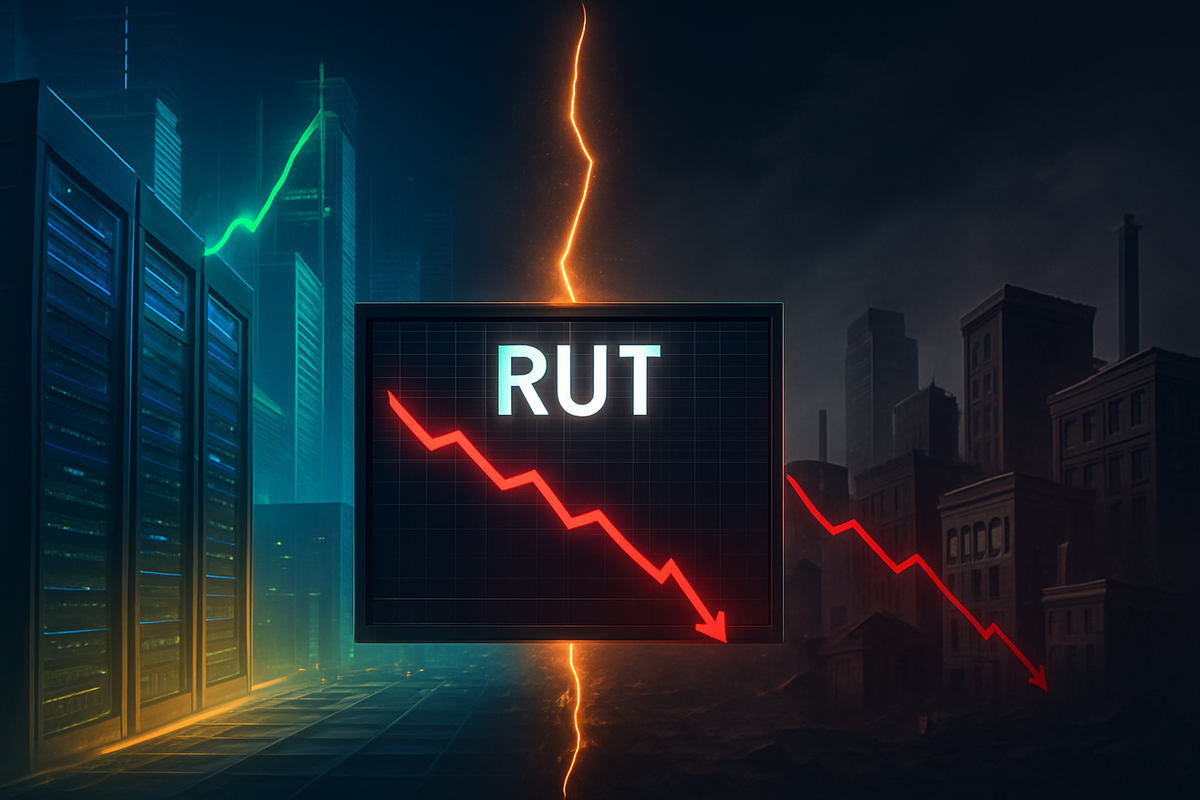
The Russell 2000 index, the primary benchmark for American small-cap stocks, suffered a significant sell-off on Wednesday, January 7, 2026, as a batch of conflicting economic data sparked fears that the Federal Reserve will remain hawkish well into the new year. While the blue-chip S&P 500 (INDEXSP: .INX) showed relative resilience, buoyed by the ongoing artificial intelligence infrastructure boom, the Russell 2000 (INDEXRUSSELL: RUT) plunged over 2.4% by midday, marking its worst single-day performance in months. The divergence highlights a growing rift in the equity markets: large-cap "fortress" companies are thriving under new fiscal incentives, while smaller, debt-burdened firms are buckling under the weight of persistent inflation and high borrowing costs.
The immediate implications of today’s move are clear: the "January Effect"—a historical tendency for small caps to outperform at the start of the year—has been derailed by a "macro reality check." Investors who had hoped for a series of aggressive interest rate cuts in 2026 are now recalibrating their portfolios. The "K-shaped" market trajectory is widening, as the cost of capital remains a punitive barrier for the nearly 40% of Russell 2000 companies that remain unprofitable. As the market digests today's volatility, the focus has shifted from growth potential to balance sheet survival.
Economic Crosscurrents and the January 7 Sell-Off
The catalyst for today’s tumble was a "double-whammy" of economic reports that painted a confusing yet cautionary picture of the U.S. economy. At 8:15 AM ET, the ADP Employment Change report for December showed a modest addition of only 41,000 jobs, missing consensus estimates and signaling a cooling labor market. However, any hopes that this weakness would prompt a dovish pivot from the Federal Reserve were quickly extinguished at 10:00 AM ET by the ISM Services PMI. The services sector, which accounts for two-thirds of the U.S. economy, came in stronger than expected at 54.4. More alarmingly, the "Prices Paid" component surged to 64.3, indicating that inflationary pressures in the service industry are far stickier than previously anticipated.
This "stagflationary" signal—weakening employment coupled with rising input costs—sent Treasury yields higher, with the 2-year note climbing back toward 4.2%. The release of the minutes from the December FOMC meeting further dampened spirits, revealing "deep divisions" among policymakers regarding the pace of rate normalization. The committee remains haunted by the 3% core inflation floor, making a rate cut at the upcoming January 28 meeting highly improbable. For small-cap stocks, which rely heavily on short-term floating-rate debt, the prospect of "higher-for-longer" is a direct threat to their bottom lines.
The timing of this downturn is particularly poignant as the market is still navigating the aftermath of the 43-day government shutdown that paralyzed Washington in late 2025. While the passage of the "One Big Beautiful Bill Act" (OBBBA) in July 2025 provided a massive fiscal cushion, the benefits are not being distributed equally. The Russell 2000's heavy concentration in regional banks and capital-intensive industries makes it uniquely vulnerable to the "refinancing wall" of 2026, where pandemic-era debt must be rolled over at significantly higher rates.
Winners and Losers: The Quality Divide
The divergence between the indices is best illustrated by the performance of individual constituents. Large-cap giants like Caterpillar Inc. (NYSE: CAT) and Quanta Services (NYSE: PWR) have remained largely insulated from today’s rout. These companies are the primary beneficiaries of the OBBBA’s massive infrastructure and defense spending, which has fueled a backlog of high-margin domestic projects. Similarly, the AI inference trade continues to provide a floor for tech leaders. SanDisk (NASDAQ: SNDK), which surged in early 2026 following a global NAND flash shortage, and Nvidia (NASDAQ: NVDA) have become "safe havens" for investors seeking growth that is decoupled from interest rate sensitivity.
Conversely, the "losers" list is dominated by the Russell 2000’s most sensitive sectors. Regional banks, such as Columbia Banking System (NASDAQ: COLB) and KeyCorp (NYSE: KEY), saw their shares slide as the inverted yield curve continues to squeeze Net Interest Margins (NIM). These institutions are also facing increased scrutiny over their exposure to the $1.5 trillion Commercial Real Estate (CRE) maturity wall hitting in 2026. Investors are fleeing these names in favor of "cash-rich" mega-caps that can self-fund their operations without relying on increasingly expensive bank credit.
The speculative biotech sector is also feeling the heat. Viking Therapeutics (NASDAQ: VKTX) and Atara Biotherapeutics (NASDAQ: ATRA) experienced sharp drawdowns today as the "risk-off" sentiment took hold. For unprofitable firms like Aquestive Therapeutics (NASDAQ: AQST), the inability to access cheap capital means they must either dilute shareholders through secondary offerings or face potential liquidation. The rise of activist funds like Concentra Biosciences, which have begun targeting "zombie" biotechs for their remaining cash, underscores the predatory environment facing small-cap laggards in 2026.
Broader Significance and Historical Precedents
Today’s market action fits into a broader trend of "fiscal dominance" that has defined the 2025-2026 era. The transition from the Inflation Reduction Act to the OBBBA has shifted the focus from green energy to "hard" infrastructure and AI-driven productivity. This shift has created a "winner-take-all" dynamic where companies with the scale to capture federal incentives are pulling away from the rest of the pack. The Russell 2000’s underperformance is a symptom of this structural shift; it is an index of the "old economy" and speculative "future economy" (unprofitable tech/biotech), both of which are struggling in a high-rate environment.
Historically, this divergence is reminiscent of the late 1990s, where a handful of large-cap tech stocks drove the indices higher while the broader market languished. However, the current situation is complicated by the 2026 "Refinancing Wall." Unlike previous cycles where small caps could "grow their way" out of debt, the current cost of capital is higher than the Return on Invested Capital (ROIC) for nearly half of the small-cap universe. This suggests that the current slump may not be a temporary dip but rather a necessary "cleansing" of the market, where weaker players are forced to consolidate or exit.
Furthermore, the regulatory landscape is shifting. The OBBBA’s reinstatement of 100% bonus depreciation and immediate R&D expensing has provided a massive tailwind for capital-intensive S&P 500 firms like Broadcom (NASDAQ: AVGO). Smaller firms, however, often lack the tax liability to fully utilize these incentives, leaving them at a competitive disadvantage. This policy-driven bifurcation is a new phenomenon that traditional market cycles did not account for, creating a "policy-protected" class of large-cap stocks.
What Comes Next: The Path to the Fed's January Meeting
In the short term, the market will be hyper-focused on the upcoming January 28 Federal Reserve meeting. If the Fed continues to emphasize "sticky" services inflation over cooling employment data, the Russell 2000 could see further technical damage, potentially testing its 2025 lows. Investors should watch for any signs of a "credit event" among regional banks or highly levered small-cap industrials, which could force the Fed’s hand. However, the most likely scenario is a continued "grind" where quality remains the only viable trade.
Strategic pivots are already underway. Small-cap managers are increasingly moving toward "SMID" (Small-Mid) cap strategies, focusing on companies that have managed to reach profitability and have "termed out" their debt beyond 2027. Market opportunities may emerge in the "E-Infrastructure" space, where mid-cap players like Sterling Infrastructure (NASDAQ: STRL) are capturing data center site development contracts. For the broader Russell 2000 to recover, a "Goldilocks" scenario is required: a definitive cooling of the ISM Services "Prices Paid" component without a total collapse in consumer spending.
Wrap-Up: A Market Divided
The events of January 7, 2026, serve as a stark reminder that the "easy money" era is a distant memory. The Russell 2000’s tumble is not just a daily fluctuation; it is a reflection of the harsh reality facing small-cap America. While the S&P 500 is being propelled by the twin engines of AI and massive fiscal stimulus from the OBBBA, the Russell 2000 is being anchored by debt, regional banking woes, and the "higher-for-longer" interest rate regime.
Moving forward, the market will likely remain bifurcated. Investors should prioritize "quality" and "cash flow" over "potential" and "growth at any cost." The key takeaways from today are the resilience of the services sector and the undeniable impact of fiscal policy on market leadership. In the coming months, the "Refinancing Wall" and the Fed's reaction to "sticky" inflation will be the primary drivers of volatility. For the Russell 2000, the road to recovery is paved with high interest rates, making the journey a treacherous one for all but the most financially sound companies.
This content is intended for informational purposes only and is not financial advice.