Cisco Systems (NASDAQ: CSCO) reported stellar second-quarter results for fiscal year 2026, delivering record-breaking revenue and earnings that comfortably cleared Wall Street’s hurdles. However, the victory was short-lived as the networking giant’s stock plummeted 7% in early trading on February 13, 2026. The sell-off was triggered by forward-looking guidance that many investors perceived as overly cautious, casting a shadow over what was otherwise a milestone quarter for the company’s pivot toward artificial intelligence infrastructure.
The disconnect between Cisco's current performance and its market valuation highlights the "high-wire act" facing legacy tech firms in the AI era. While Cisco proved it can successfully sell the "plumbing" for the AI revolution—evidenced by a massive surge in orders for its new Silicon One G300 chips—the market’s appetite for perfection has left little room for the rising costs associated with these advanced technologies. Investors are no longer just looking for growth; they are demanding a clear path to sustained profitability amidst a volatile supply chain for high-performance components.
A Tale of Two Realities: Record Beats vs. Cautious Horizons
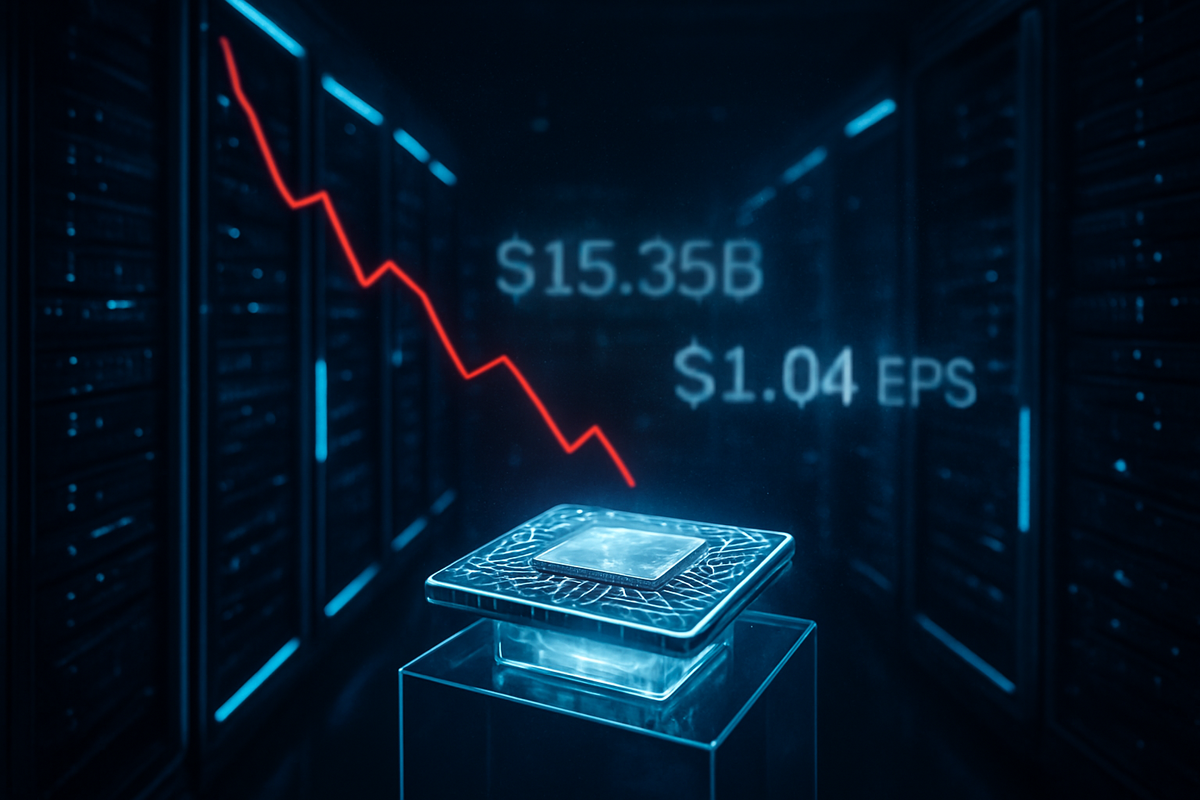
For the quarter ending in late January, Cisco reported revenue of $15.35 billion, a 9.7% increase year-over-year, beating consensus estimates of $15.11 billion. The bottom line was equally impressive, with non-GAAP earnings per share (EPS) coming in at $1.04, surpassing the expected $1.02. This performance was driven by an 18% jump in total product orders, with a staggering 65% surge in the Service Provider and Cloud segment—a clear indicator that the world’s largest data center operators are refreshing their hardware to support generative AI workloads.
Central to this growth was the debut of the Cisco Silicon One G300 chip, a 102.4 Tbps networking powerhouse launched during Cisco Live Amsterdam. Designed specifically for massive AI back-end clusters, the G300 is Cisco's answer to the high-performance networking dominance of Nvidia (NASDAQ: NVDA) and Broadcom (NASDAQ: AVGO). CEO Chuck Robbins highlighted that the company shipped its one-millionth Silicon One chip during the quarter, signaling that Cisco’s move into proprietary silicon is finally reaching a scale where it can compete at the hyperscale level. Furthermore, Cisco reported a whopping $2.1 billion in AI infrastructure orders for Q2 alone, nearly doubling the $1.3 billion seen in the previous quarter.
Despite these achievements, the 7% stock decline centered on the "commodity shock" hidden within the guidance. CFO Mark Patterson warned that the cost of High Bandwidth Memory (HBM)—a critical component for AI networking gear—had skyrocketed by nearly 400% over the last year. This led Cisco to project Q3 gross margins between 65.5% and 66.5%, a noticeable dip from the 68% previously anticipated by analysts. The message to the market was clear: while the demand for AI is insatiable, the cost of building the infrastructure is eating into the profits of the providers.
The AI Winners and Losers: A Shifting Competitive Landscape
The immediate reaction to Cisco’s earnings has ripple effects across the networking and semiconductor sectors. Arista Networks (NYSE: ANET), Cisco's primary rival in the high-speed switching market, saw its shares trade sideways as investors weighed whether Arista would face similar margin pressures from HBM costs. Historically, Arista has maintained higher margins through software-led networking, but Cisco’s aggressive push with the G300 chip suggests a more direct hardware confrontation in the "AI back-end" space than ever before.
Meanwhile, the "winners" in this scenario appear to be the component suppliers and the hyperscalers themselves. Companies like Meta Platforms (NASDAQ: META) and Alphabet (NASDAQ: GOOGL) are the primary beneficiaries of the "Ethernet vs. InfiniBand" war. As Cisco leans heavily into Ethernet-based AI fabrics with its G300 silicon, these hyperscalers gain more leverage and choice, potentially driving down their own infrastructure costs at the expense of Cisco’s margins. On the other hand, Nvidia remains the benchmark; while Cisco is making inroads, the sheer integration of Nvidia’s software and hardware stack continues to set a high bar that traditional networking firms are struggling to reach without sacrificing profitability.
Broader Significance: The "AI Tax" on Hardware Providers
Cisco’s predicament reflects a broader industry trend where the "AI Tax"—the escalating cost of specialized components—is beginning to bite. For years, the market assumed that the AI boom would be a "rising tide lifts all boats" scenario. However, the 2026 fiscal cycle is proving that hardware manufacturers are facing a brutal reality: the scarcity of HBM and advanced foundry capacity at companies like TSMC is creating a bottleneck. This is not just a Cisco problem; it is a structural challenge for any company attempting to build the physical foundation of the AI economy.
Historically, this mirrors the early 2000s fiber-optic boom, where the demand for bandwidth was real, but the capital expenditure required to meet that demand led to a "margin squeeze" for the equipment providers. By guiding cautiously, Cisco is attempting to manage expectations for a future where top-line AI revenue is a certainty, but bottom-line stability is not. This event also signals a regulatory and policy shift, as governments begin to look at the concentration of the AI supply chain, potentially leading to interventions that could further complicate the cost structures for legacy giants like Cisco.
What Comes Next: Integration and Infrastructure Evolution
Looking ahead, Cisco’s path to redemption lies in its ability to offset hardware margin pressure with high-margin software and services. The integration of Splunk, which Cisco acquired to bolster its security and observability capabilities, will be the primary focus for the remainder of 2026. If Cisco can successfully cross-sell Splunk’s data analytics tools to the customers currently buying G300-powered switches, it could decouple its stock price from the volatile costs of the semiconductor supply chain.
In the short term, investors should watch for the "AI order-to-revenue" conversion rate. While $2.1 billion in orders is a significant "headline number," the timing of when those orders are delivered and paid for will determine if Cisco can raise its full-year guidance later this summer. The company has already raised its annual AI order target to over $5 billion, but the market will remain skeptical until the "margin floor" is established. Strategically, Cisco may need to pivot its procurement strategy, perhaps through long-term supply agreements for HBM, to insulate itself from further price shocks.
Final Assessment: A High Bar for a High-Tech World
Cisco’s second-quarter earnings serve as a cautionary tale for the AI era: growth alone is no longer enough. The company’s ability to beat revenue expectations by hundreds of millions of dollars while launching cutting-edge silicon was not sufficient to overcome a slightly dimmed margin outlook. This suggests that the "AI premium" once enjoyed by any company mentioning the technology is being replaced by a more rigorous "earnings quality" standard.
Moving forward, the market will be hyper-focused on how Cisco balances its role as a hardware provider with its aspirations as a software-centric security firm. For investors, the coming months will be a period of "watch and wait" to see if the Silicon One G300 can gain enough market share to justify the higher cost of production. The significance of Cisco's 7% drop is not that the company is failing, but that the market’s expectations for the AI revolution have reached a fever pitch, where even a record-breaking performance can feel like a disappointment if the future isn't flawlessly bright.
This content is intended for informational purposes only and is not financial advice