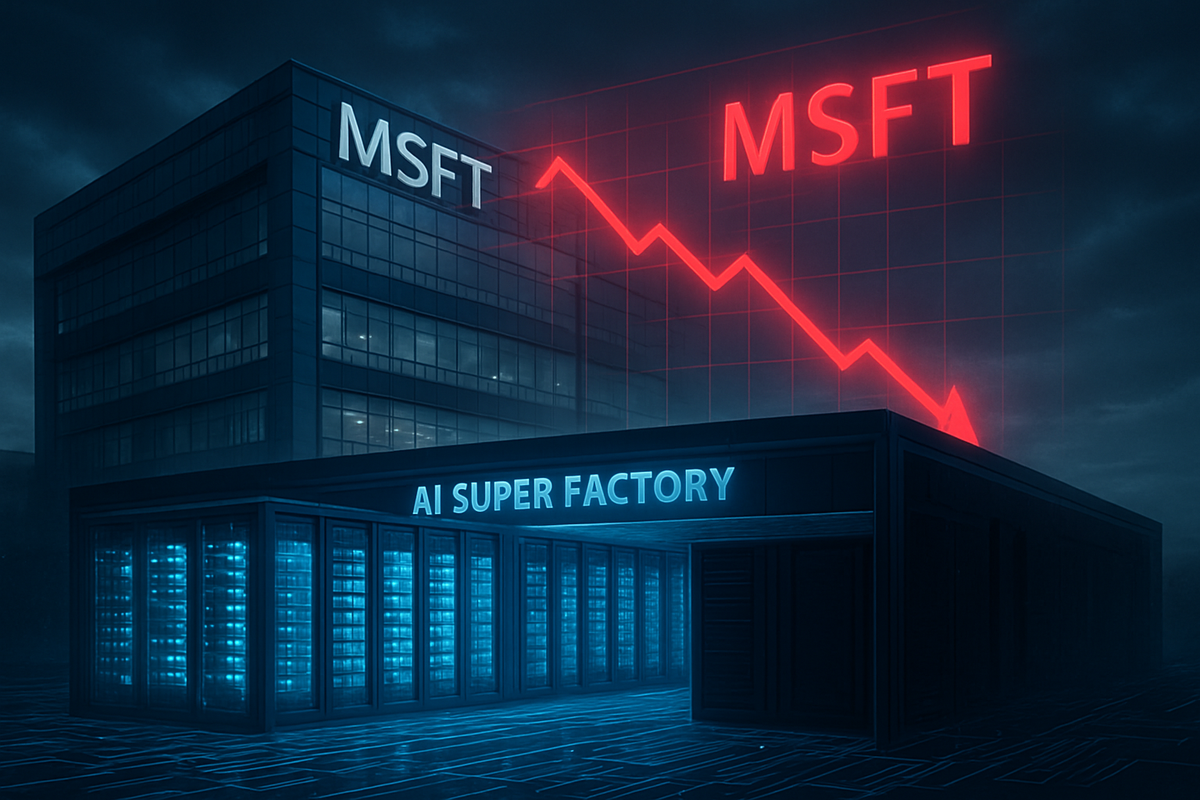
REDMOND, WA — In a stark reminder that even the titans of the "Magnificent Seven" are not immune to the gravity of market expectations, Microsoft Corp. (NASDAQ: MSFT) saw its shares plummet 10.1% on January 29, 2026. The sell-off, which erased approximately $357 billion in market capitalization in a single trading session, followed a fiscal second-quarter earnings report that laid bare the growing tension between the company’s massive artificial intelligence investments and the immediate pace of cloud revenue growth.
The decline represents Microsoft’s worst single-day performance since the early days of the 2020 pandemic. While the company technically beat top and bottom-line analyst estimates, the "whisper numbers" on Wall Street for Azure—the company’s flagship cloud platform—proved too high to reach. Investors, increasingly wary of an "open-ended" investment cycle that has seen capital expenditures (CapEx) balloon to record levels, are now demanding a clearer path to profitability for the billions being funneled into AI hardware.
The Cost of the "AI Super Factory"
The January 28, 2026, earnings report was a tale of two realities. On paper, Microsoft appeared robust, reporting total revenue of $81.3 billion—a 17% increase year-over-year—and earnings per share of $4.14, comfortably ahead of the $3.91 consensus. However, the optimism quickly evaporated when CFO Amy Hood revealed that Azure and other cloud services grew by 39%. While strong by historical standards, it was a slight deceleration from the previous quarter and missed the "buy-side" expectation of nearly 40%.
The most polarizing figure in the report was the quarterly CapEx, which surged to a staggering $37.5 billion—a 66% increase from the same period in 2025. During the post-earnings call, Hood was pressed by analysts to justify this capital outlay. She described the company’s massive data center construction as building "AI Super Factories," arguing that the investments are a competitive necessity for the next decade of computing. Perhaps most concerning to investors was Hood’s admission that Azure's growth was currently being "capped" by hardware and power bottlenecks rather than a lack of customer interest, stating bluntly, "Our customer demand continues to exceed our supply."
A Divergent Market: Winners and Losers
The fallout from Microsoft’s report sent shockwaves through the broader technology sector, but the reaction was far from uniform. Meta Platforms (NASDAQ: META) emerged as a notable winner, with its shares surging 9% as it successfully demonstrated that its AI investments were already driving tangible ROI in its core advertising business. Alphabet Inc. (NASDAQ: GOOGL) also saw its shares tick up 1.6% as Google Cloud’s 34% growth was perceived as more "organic" and less reliant on a single partner.
Conversely, NVIDIA Corp. (NASDAQ: NVDA) faced a significant correction, falling 11% as investors fretted over reports that thousands of high-end GPUs were sitting idle in warehouses because Microsoft and other hyperscalers could not secure enough power from the U.S. electrical grid to plug them in. Amazon.com Inc. (NASDAQ: AMZN) shares remained relatively stable, as analysts at firms like Bernstein noted that AWS was "regaining the lead in net new dollars added," suggesting that Amazon’s more conservative capacity management might be paying off.
The Infrastructure Wall and Historical Precedents
The current AI spending cycle has reignited a fierce debate among market historians. Many are drawing parallels to the fiber optic build-out of the late 1990s, where companies laid thousands of miles of "dark fiber" that went unused for a decade. However, analysts at firms like SemiAnalysis point out a key difference: while the 1990s boom was fueled by high-interest debt and speculative startups, the 2026 AI cycle is funded by the massive free cash flow of the world’s most profitable corporations.
The "infrastructure wall" mentioned by Microsoft executives highlights a new regulatory and physical reality. Connection timelines to power grids in major data center hubs like Northern Virginia now exceed four years. This has forced Microsoft into a strategic pivot, including the development of its "Fairwater" superfactories—massive, integrated facilities designed to bypass traditional grid limits. Furthermore, the company faces intensifying regulatory scrutiny; the Federal Trade Commission (FTC) is currently investigating Microsoft’s $13 billion partnership with OpenAI, focusing on "circular spending" where Microsoft provides credits that are immediately paid back for Azure compute services.
What Comes Next for the Redmond Giant?
Looking ahead to the remainder of 2026, Microsoft faces a high-stakes balancing act. The company’s commercial remaining performance obligations (RPO) have surged to $625 billion, but a staggering 45% of that is tied to OpenAI, highlighting a significant concentration risk. Investors will be closely watching for the activation of the first Fairwater superfactories in Wisconsin and Atlanta, which are expected to lift the "supply cap" on Azure growth.
In the short term, Microsoft may need to prioritize Azure’s external customers over internal R&D to boost growth rates back above the 40% mark. While firms like UBS have maintained "Buy" ratings on the stock, they have notably lowered price targets toward the $600 range to account for the persistent margin pressure. The narrative for the second half of 2026 will likely shift from "how many chips can you buy?" to "how many chips can you actually turn on?"
Navigating the AI Correction
The 10% slump in Microsoft’s stock serves as a definitive end to the "hype phase" of the AI era. The market is no longer satisfied with promises of future dominance; it is now demanding quarterly proof of scalability and efficient capital allocation. For Microsoft, the challenge is to prove that its $37.5 billion-per-quarter spending habit will eventually translate into the same high-margin software returns that made it a $3 trillion company.
Moving forward, the primary metrics for investors will be Azure's growth acceleration and the impact of the Maia 200 custom chips on reducing reliance on expensive external hardware. While the long-term potential of AI remains undisputed, the road to 2027 appears to be paved with massive bills and complex power-grid negotiations. Investors should brace for continued volatility as the industry moves from building the "Super Factory" to actually selling its output.
This content is intended for informational purposes only and is not financial advice.