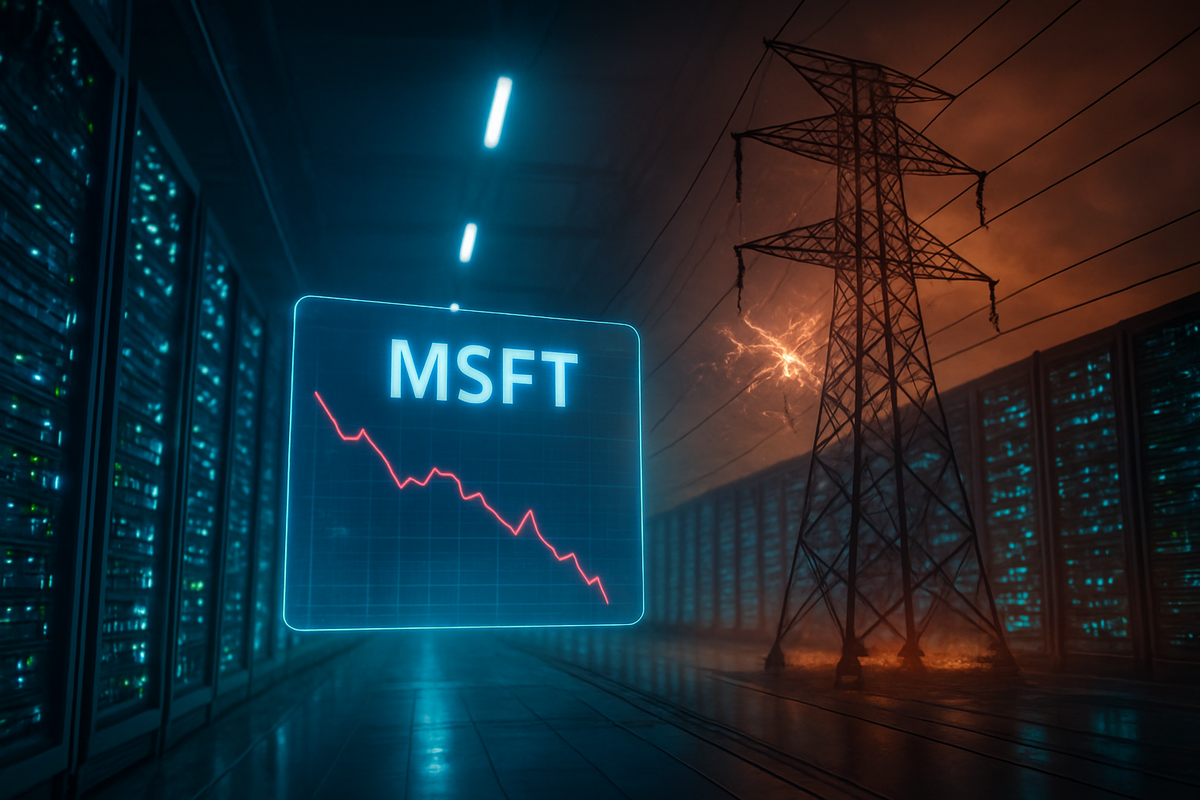
The honeymoon phase of the artificial intelligence revolution has officially ended, replaced by a cold, hard era of fiscal scrutiny. In its latest quarterly earnings report on January 28, 2026, Microsoft (NASDAQ: MSFT) stunned the market not with a lack of ambition, but with a record-shattering $37.5 billion in capital expenditure—a 66% year-over-year increase dedicated almost entirely to AI infrastructure. Yet, as the tech giant pours billions into the "factories of the future," a growing disconnect between massive spending and decelerating cloud growth has sent a tremor through Wall Street.
The immediate fallout was severe. Despite beating top and bottom-line estimates, Microsoft saw its market capitalization plummet by nearly $400 billion in the week following the announcement. Investors, once satisfied with promises of "AI potential," are now demanding a concrete timeline for return on investment (ROI). The core of the concern lies in Azure, Microsoft’s flagship cloud platform, which posted a 39% growth rate—a figure that, while robust, signaled a cooling trend and exposed a startling new bottleneck: a global power grid that can no longer keep up with the industry’s insatiable thirst for electricity.
The Decoupling of Spending and Scale
The January 28 report revealed a company operating at a scale few in history have matched. Microsoft (NASDAQ: MSFT) reported total revenue of $81.3 billion and adjusted earnings per share of $4.14, comfortably ahead of analyst consensus. However, the narrative shifted entirely to the "decoupling" of the company’s massive capital investments from its revenue acceleration. The $37.5 billion quarterly spend brought Microsoft's annual CapEx run rate to an unprecedented $150 billion, a figure that now exceeds the total market value of many S&P 500 companies.
The tension reached a boiling point during the earnings call when CFO Amy Hood and CEO Satya Nadella addressed the "Power Grid Wall." Microsoft revealed that it currently holds an $80 billion backlog in Azure orders—demand that it cannot fulfill because it literally cannot turn the power on. In key hubs like Northern Virginia and Texas, the regional electrical grids are struggling to provide the wattage required to activate the thousands of NVIDIA (NASDAQ: NVDA) GPUs already sitting in Microsoft’s warehouses. This physical limitation has forced Microsoft to prioritize its own first-party AI services, such as Microsoft 365 Copilot and GitHub Copilot, over third-party Azure customers, potentially capping the growth of its cloud rental business in the short term.
Initial industry reactions have been a mix of awe at the demand and fear of the costs. Analysts from firms like Morgan Stanley and Jefferies immediately shifted their tone, with some removing Microsoft from their "Top Pick" lists. The primary concern is no longer whether AI is "real," but whether the hardware being purchased today—which depreciates over a six-year cycle—will become obsolete or remain underutilized due to infrastructure constraints before it can pay for itself.
Winners and Losers in the Infrastructure Race
The sudden pivot in sentiment has created a stark divide among the "Magnificent Seven" and their peers. The clear winner in this high-stakes environment remains NVIDIA (NASDAQ: NVDA). While Microsoft struggles to power its chips, NVIDIA reported a record $57 billion in quarterly revenue, proving that as long as the hyperscalers are in an arms race, the "arms dealer" profits regardless of when the buyer manages to plug the equipment into the wall. However, even NVIDIA faces risks; if Microsoft and others cannot solve the power crisis, the blistering pace of new chip orders may eventually hit a ceiling.
Alphabet (NASDAQ: GOOGL) has emerged as a surprising victor in the early 2026 sentiment shift. Google Cloud reported a staggering 48% growth rate in its most recent quarter, significantly outperforming both Microsoft and Amazon (NASDAQ: AMZN). Investors have rewarded Alphabet for its "binary success"—showing that AI is simultaneously improving its core advertising margins and driving high-growth cloud adoption. Conversely, Amazon (NASDAQ: AMZN) has seen its AWS market share slip to 31%, as it faces the same crushing CapEx requirements as Microsoft but with a less clear "killer app" at the software layer.
The "losers" in this phase are the mid-tier cloud providers and AI startups that lack the balance sheets to build their own energy solutions. Companies that relied on "cheap" GPU rental from Azure or AWS are now finding themselves at the back of the line, as the tech giants prioritize their own internal AI products to maximize the thin margins allowed by current power constraints.
A Structural Shift in Global Computing
This event marks a significant evolution in broader industry trends, moving from the "Generative AI" hype of 2023–2024 to what Satya Nadella calls "AI Diffusion." This phase is characterized by AI becoming a structural utility, much like electricity itself in the early 20th century. The current crisis draws historical parallels to the fiber-optic boom of the late 1990s; while the initial overbuild led to a market crash, the infrastructure itself eventually enabled the entire modern internet economy.
The regulatory and policy implications are also mounting. As Microsoft and its rivals begin to explore private nuclear power and independent energy grids to bypass public utilities, they are entering a new realm of geopolitical influence. Governments are now viewing data center power consumption as a national security issue, leading to potential new regulations on "compute-to-energy" ratios. Furthermore, the concentration risk remains high; with nearly half of Microsoft’s $625 billion in remaining performance obligations tied to its partnership with OpenAI, the stability of that single relationship has become a systemic risk for the broader market.
The Road to Agentic AI and Energy Autonomy
Looking ahead, the next 12 to 24 months will likely be defined by a strategic pivot toward "Agentic AI." At CES 2026, NVIDIA (NASDAQ: NVDA) launched its Vera Rubin platform, featuring the R100 GPU designed specifically for complex reasoning and autonomous agents. Microsoft is expected to be a primary buyer of this architecture, hoping that the higher efficiency of these chips will allow for more "intelligence per watt," partially mitigating the power crisis.
In the short term, investors should expect Microsoft to engage in aggressive "energy M&A," potentially acquiring or partnering with small modular reactor (SMR) companies to secure dedicated power supplies. The long-term success of the stock will depend on whether Microsoft can successfully transition from being a "token factory" (selling raw AI compute) to a "productivity partner" (selling high-margin Copilot subscriptions). If Microsoft can prove that its software-driven AI margins can offset the staggering cost of the hardware, the current sell-off may be remembered as a generational buying opportunity.
Summary and Outlook
Microsoft’s Q2 FY2026 results have served as a reality check for the entire technology sector. The transition from AI experimentation to industrial-scale deployment is proving to be more capital-intensive and physically constrained than many anticipated. While the demand for AI services is undeniably real—evidenced by the $80 billion backlog—the "Power Grid Wall" has introduced a new variable into the ROI equation that cannot be solved by software alone.
Moving forward, the market will likely move away from rewarding companies based on their AI "vision" and toward those who can demonstrate "profitable scale." For Microsoft (NASDAQ: MSFT), the coming months will be a test of its ability to navigate physical infrastructure bottlenecks while maintaining the trust of a skeptical Wall Street. Investors should keep a close eye on Azure's capacity to clear its backlog and any signs that the massive $37.5 billion quarterly spend is beginning to yield the margin expansion that justifies its multi-trillion-dollar valuation. The AI revolution is still in its early chapters, but the cost of entry has never been higher.
This content is intended for informational purposes only and is not financial advice.