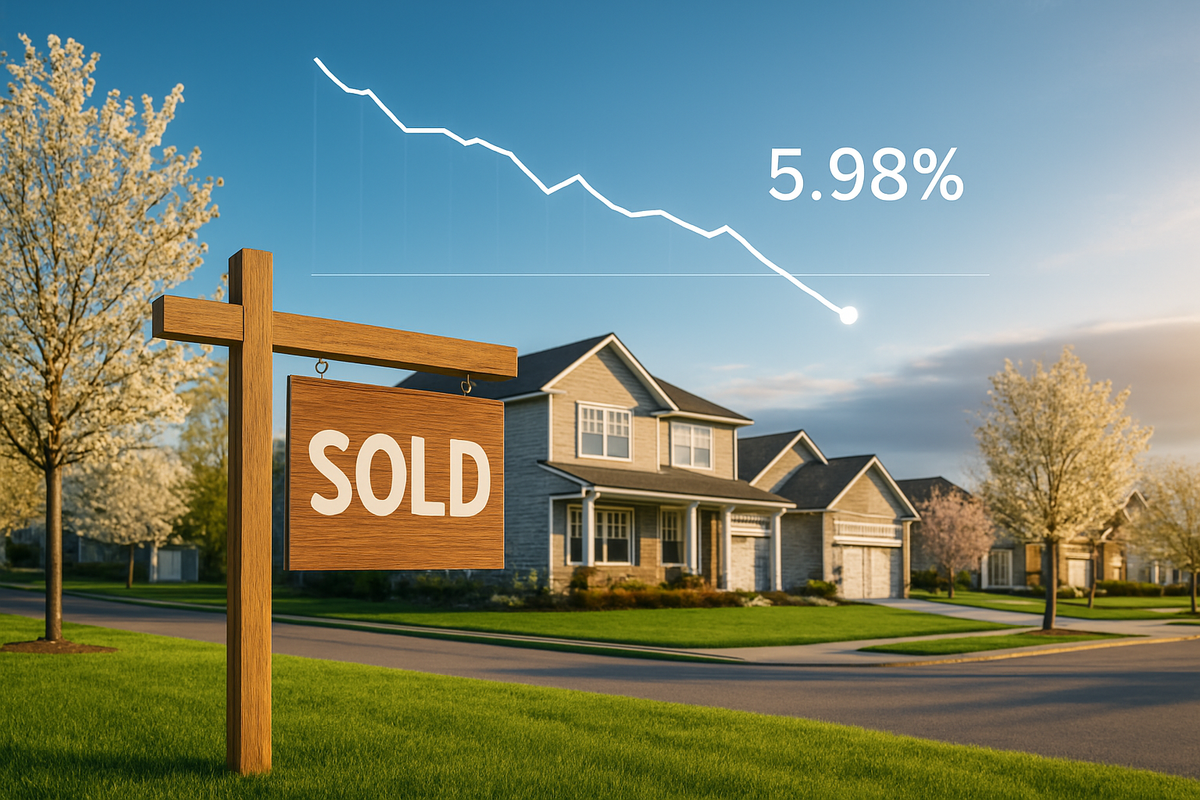
In a watershed moment for the American real estate sector, the average 30-year fixed mortgage rate officially dipped to 5.98% this week, marking its lowest level in over three and a half years. This retreat below the psychologically significant 6% threshold offers a long-awaited "relief valve" for a housing market that has been largely paralyzed by the highest borrowing costs in a generation. As of March 10, 2026, the shift is already triggering a surge in buyer activity, with industry leaders reporting a dramatic spike in mortgage applications and property tours across the nation.
The drop to 5.98% serves as a powerful counter-narrative to the broader economic instability currently rattling global markets. While escalating geopolitical tensions in the Middle East have pushed crude oil prices above $100 per barrel and injected fresh volatility into equities, the domestic housing market is showing unexpected resilience. For the average American household, this rate cut translates to approximately $30,000 in additional purchasing power compared to the 7% rates seen just a year ago, effectively thawing the "lock-in effect" that has kept inventory at record lows since 2023.
The Road to Sub-6%: Policy Shifts and Market Mechanics
The descent to 5.98% was not an overnight phenomenon but the culmination of a strategic pivot in both monetary and fiscal policy throughout late 2025 and early 2026. Following a series of three consecutive rate cuts by the Federal Reserve in the latter half of 2025, which brought the federal funds rate to a target range of 3.50% to 3.75%, the momentum for lower mortgage costs began to build. However, the final push below 6% was largely attributed to a historic executive directive in January 2026, which saw Fannie Mae and Freddie Mac authorized to purchase $200 billion in mortgage-backed securities (MBS). This move was specifically designed to compress the "spread" between 10-year Treasury yields and mortgage rates, which had remained stubbornly wide since the pandemic era.
The timeline leading up to this milestone was marked by a cooling of domestic inflation, which reached a manageable 2.4% in January 2026. This gave the bond market the confidence to rally, even as global headlines turned grim. On February 28, 2026, following the assassination of the Iranian Supreme Leader and subsequent military strikes, investors fled to the safety of U.S. Treasuries. Paradoxically, this "flight to quality" pushed bond yields lower, inadvertently accelerating the drop in mortgage rates. By March 9, 2026, Freddie Mac confirmed the national average had breached the floor, settling at 5.98%.
Winners and Losers: A Reshuffled Real Estate Landscape
The primary beneficiaries of this rate reprieve are the nation’s largest homebuilders, specifically D.R. Horton (NYSE: DHI) and Lennar Corporation (NYSE: LEN). For the past two years, these companies have been forced to offer expensive "rate buydowns"—often subsidizing mortgages down to 4.99% out of their own pockets—to maintain sales volume. With market rates now naturally sitting under 6%, these builders can significantly reduce those incentives, expanding their profit margins while still attracting a flood of new buyers. Both companies reported a double-digit uptick in new contract signings in the first week of March alone.
In the lending and services sector, the landscape has seen massive consolidation. Rocket Companies (NYSE: RKT), which recently finalized its high-profile acquisitions of Redfin and Mr. Cooper Group (NASDAQ: COOP), is positioned as a vertically integrated titan. By controlling the search platform, the mortgage origination, and the servicing rights, Rocket is capturing the lion's share of the "spring surge." Conversely, smaller regional lenders and independent mortgage brokers continue to struggle, as they lack the scale to compete with the technology-driven efficiencies of giants like United Wholesale Mortgage (NYSE: UWMC), which recently deployed an advanced AI assistant to manage its highest quarterly volume since 2021.
A Domestic Safe Harbor Amidst Global Volatility
The current strength of the U.S. housing market represents a significant departure from historical precedents where geopolitical crises typically dampened consumer sentiment across all sectors. This "housing as a safe harbor" trend fits into a broader industry shift toward domestic asset stability. In an era where international trade routes are increasingly threatened and global supply chains remain fragile, the American home has re-emerged as the ultimate "safe-haven" asset for both individuals and institutional investors.
This event also carries major regulatory implications. The successful use of an MBS purchase directive to force rates lower suggests a new era of "fiscal-led QE," where the executive branch plays a more direct role in housing affordability than the Federal Reserve. For competitors and partners in the real estate ecosystem, this means watching Washington just as closely as they watch the Fed's Board of Governors. Furthermore, Zillow Group (NASDAQ: Z) has noted that the narrowing gap between existing mortgage rates (the ones homeowners currently have) and new market rates is finally encouraging older homeowners to downsize, potentially solving the inventory crisis that has plagued the market for five years.
The Road Ahead: Inflation Risks and Refinance Booms
Looking toward the remainder of 2026, the short-term outlook is dominated by the potential for a massive refinance boom. Millions of homeowners who took out mortgages between 2023 and 2025 at rates above 7% are now "in the money" to refinance. This could provide a secondary stimulus to the economy as households lower their monthly payments, freeing up disposable income. However, the long-term sustainability of sub-6% rates remains tied to the volatile energy market. If the conflict in the Middle East continues to keep oil above $100, the resulting "imported inflation" could force the Federal Reserve to pause its easing cycle or even consider a terminal rate hike late in the year.
Strategic pivots are already underway. Real estate platforms are shifting their focus toward "fully digital purchase pre-approvals" to handle the high volume, while institutional investors in Real Estate Investment Trusts (REITs) are rotating back into residential assets. Analysts at major firms are projecting that REITs could deliver a 17% total return in 2026, driven by the narrowing valuation gap between public and private real estate markets. The challenge for the market will be managing this sudden influx of demand without reigniting the runaway home price appreciation seen during the pandemic.
Summary: A New Chapter for Homeownership
The fall of mortgage rates to 5.98% is more than just a data point; it is a signal that the U.S. housing market has finally entered a new phase of its post-inflationary recovery. By breaking the 6% barrier, the market has cleared a major psychological hurdle for buyers and sellers alike. While geopolitical tensions and high energy costs present ongoing risks to the global economy, the domestic real estate sector is currently acting as a stabilizer, providing a sense of tangible value and opportunity for the American public.
As we move forward into the spring buying season, investors should keep a close eye on the 10-year Treasury yield and the Federal Reserve's response to rising energy costs. The key takeaway for the market is that the "housing freeze" has officially ended, but the "Great Reset" is only just beginning. The coming months will determine if 5.98% is a permanent floor or a fleeting window of opportunity in an increasingly unpredictable world.
This content is intended for informational purposes only and is not financial advice