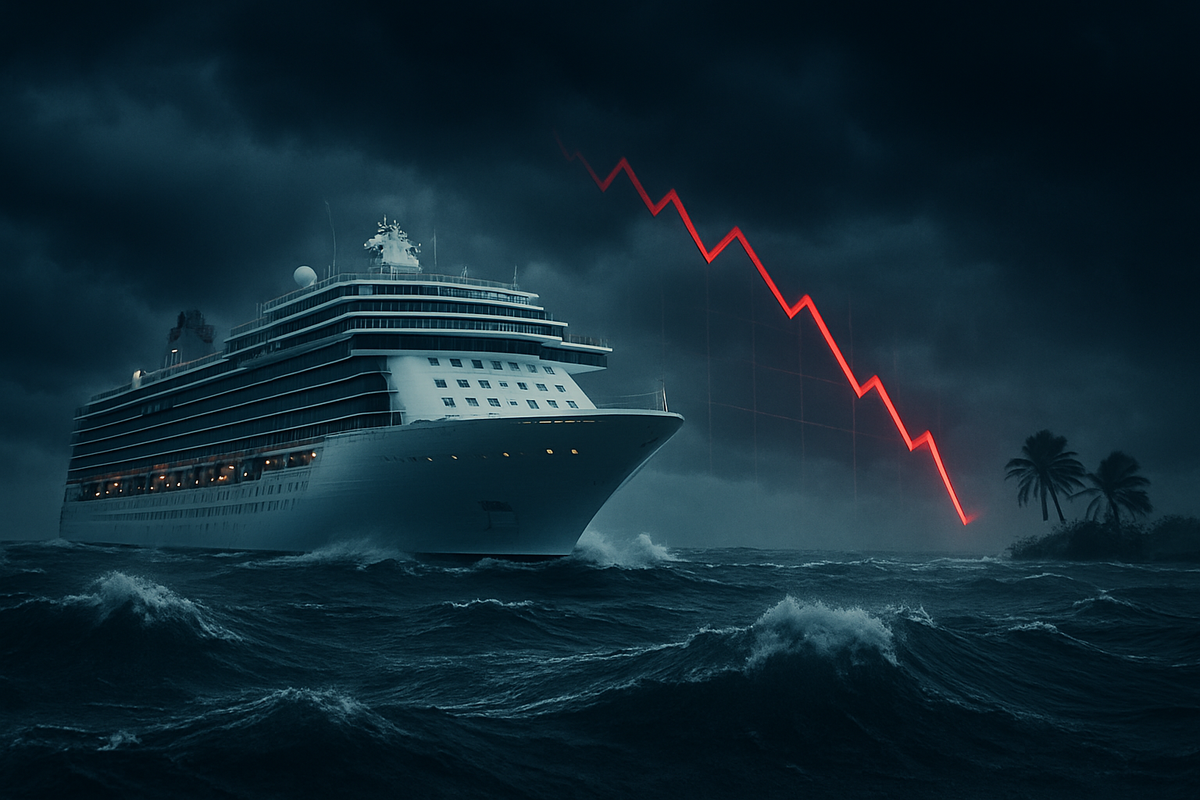
MIAMI — In a turbulent week for the cruise industry, Norwegian Cruise Line Holdings Ltd. (NYSE: NCLH) saw its market valuation evaporate after the company issued a sobering downward revision to its 2026 profit outlook. The announcement, which executives attributed to a series of internal "execution missteps" and a massive, poorly timed capacity surge in the Caribbean, sent shares tumbling as much as 14.5% in early March trading. The selloff marks a stark reversal for a company that had previously projected a robust recovery following the post-pandemic travel boom.
The fallout from Norwegian’s guidance cut has rippled across the broader travel sector, arriving at a moment of heightened global instability. As geopolitical tensions in the Middle East drive crude oil prices toward historic highs, investors are reassessing the sustainability of the cruise industry’s growth model. For Norwegian, the combination of internal operational friction and a deteriorating macroeconomic backdrop has created a "perfect storm" that threatens to derail its multi-year turnaround strategy.
Operational Friction and the Caribbean Capacity Crunch
The catalyst for the current crisis was Norwegian’s Q4 2025 earnings report, released on March 2, 2026, which revealed a significant disconnect between the company’s ambitious growth plans and its actual execution. Chief Executive Officer John Chidsey and CFO Mark Kempa offered a rare, public apology to shareholders, citing "short-term misfires" within the company's Caribbean operations. Specifically, the company admitted to a "siloed organization" where marketing and pricing departments failed to coordinate with new ship deployments, leading to a commercial misalignment that left cabins empty at premium price points.
At the heart of the issue is a staggering 40% year-over-year capacity increase that Norwegian pushed into the Caribbean market for the 2026 season. While the strategy was intended to capture market share through high-volume, short-duration sailings, the infrastructure was not ready to support it. The company aggressively increased itineraries to its private island, Great Stirrup Cay, before essential amenities and infrastructure expansions were completed. This resulted in a diminished passenger experience and forced the company to pivot toward aggressive discounting to maintain occupancy levels, which were forecasted at 105.7% but achieved only through the sacrifice of pricing power.
Furthermore, Norwegian’s foray into new homeports, including a highly publicized expansion in Philadelphia, faced immediate pricing pressure. By the time the company realized the demand was not meeting the supply, it had already fallen "behind the ideal booking curve." This forced a desperate late-season discounting cycle that eroded net yields, which are now projected to be flat for the full year of 2026—a sharp downgrade from previous growth estimates.
Winners and Losers: A Divergent Sector Reaction
The market reaction to Norwegian’s woes has been swift and unforgiving, but the impact has not been uniform across the "Big Three" cruise operators. Norwegian Cruise Line Holdings Ltd. (NYSE: NCLH) remains the primary casualty, with its stock price hovering near a bearish floor of $19 per share. The company’s vulnerability is compounded by its relatively weak fuel hedging position; with only 51% of its 2026 fuel needs hedged, the recent spike in Brent crude is eating directly into its remaining margins.
Carnival Corporation & plc (NYSE: CCL) has arguably suffered more in the immediate aftermath, with shares plunging 23% in early March. As the only major operator currently without a substantial fuel hedging program, Carnival has become the "whipping boy" for rising energy costs. Conversely, Royal Caribbean Cruises Ltd. (NYSE: RCL) has emerged as a relative beacon of stability. Although its shares dipped 4.4% in sympathy with the sector, analysts remain bullish on the company. Royal Caribbean reported that 60% of its 2026 capacity was already booked at record rates before the current volatility, providing a significant buffer that Norwegian lacks.
Adding a layer of complexity to Norwegian’s future is the reported involvement of Elliott Investment Management. The activist hedge fund is rumored to be building a stake in NCLH, potentially eyeing a board shake-up or a forced overhaul of the company’s "siloed" management structure. This pressure from institutional investors suggests that the market is losing patience with Norwegian’s operational excuses.
Geopolitical Tensions and the Global Oil Shock
The internal failures at Norwegian are being amplified by a deteriorating global security environment. In early March 2026, escalating tensions between the U.S., Israel, and Iran sent shockwaves through the energy markets. Brent crude prices surged by $27 per barrel in a single week, crossing the psychological $100 mark. For an industry as fuel-dependent as cruising, this represents a massive, unforecasted headwind that threatens to turn projected profits into losses.
This geopolitical instability has also forced a strategic retreat for many cruise lines. Ongoing conflict in the Middle East and Mediterranean has led to a wave of itinerary cancellations. Ships originally destined for European or Red Sea routes are being rerouted back into the Caribbean—an already saturated market. This "tonnage dump" is further depressing regional pricing, making it even harder for Norwegian to recover from its initial pricing missteps.
Historically, the cruise industry has proven resilient to localized conflicts, but the current scale of the oil shock combined with waning consumer sentiment—the University of Michigan consumer sentiment index fell to 56.4 this month—suggests a more profound slowdown. Investors are drawing parallels to the 2008 financial crisis, where a spike in energy costs coincided with a sharp contraction in discretionary travel spending.
The Path Forward: Strategic Pivots and Scenarios
In the short term, Norwegian must move quickly to break down the internal silos that led to this "execution gap." Management has already hinted at a strategic pivot that includes slowing down new capacity growth beyond 2026 and focusing on "yield over volume." The immediate priority will be the completion of the Great Stirrup Cay infrastructure, which is essential if the company hopes to justify premium pricing for its Caribbean sailings in the latter half of the year.
However, the long-term outlook remains clouded by the potential for a broader economic downturn. If geopolitical tensions do not de-escalate, fuel costs could remain elevated through 2027, forcing Norwegian to implement even more drastic cost-cutting measures. There is also the possibility of a "strategic reset" led by activist investors, which could involve selling off non-core assets or consolidating brands to streamline the organizational structure that CEO John Chidsey admitted was currently failing the company.
Market participants are also watching for a potential "flight to quality" within the sector. If Norwegian cannot stabilize its booking curve by the end of Q2 2026, it may lose further ground to Royal Caribbean, which continues to demonstrate superior pricing discipline and operational coordination.
Navigating Uncertain Waters
The plunge in Norwegian Cruise Line’s stock serves as a stark reminder that even in a high-demand environment, operational excellence is the only true safeguard against external shocks. The company’s decision to slash its 2026 outlook was not just a result of high oil prices or war in the Middle East; it was a self-inflicted wound caused by a lack of internal coordination and an overly ambitious capacity expansion that outpaced its infrastructure.
Moving forward, the market will be hyper-focused on Norwegian’s ability to regain its pricing power. Investors should closely monitor the monthly "net yield" reports and the progress of the Great Stirrup Cay expansion. Furthermore, the actions of Elliott Investment Management will be a critical bellwether for the company’s governance and potential for a turnaround.
For the broader market, the "Norwegian Incident" highlights the fragility of the travel recovery in an era of $100 oil and global unrest. While the cruise industry has survived many storms, the coming months will test whether Norwegian has the structural integrity to weather this one, or if it will be forced into a more radical transformation to stay afloat.
This content is intended for informational purposes only and is not financial advice.