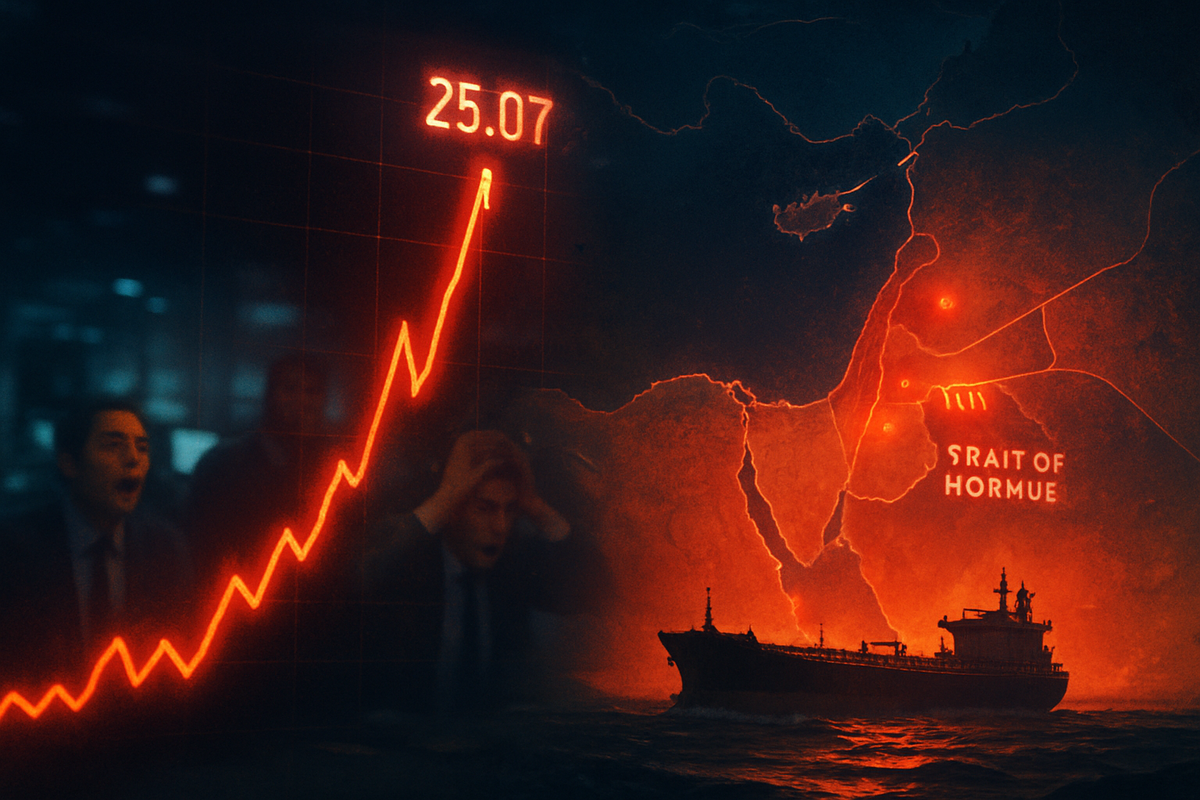
The "fear gauge" of Wall Street has officially sounded the alarm. On March 11, 2026, the CBOE Volatility Index (VIX) surged to 25.07, marking a dramatic departure from the relative calm of early winter and signaling a high-stress regime for global equity markets. This spike, representing a 57% increase in just over a week, reflects deepening investor anxiety as a kinetic military conflict between the United States, Israel, and Iran threatens to paralyze the world’s most critical energy arteries.
The immediate implications are stark: the S&P 500 (^GSPC) has buckled under the weight of "war premium" pricing, while energy benchmarks have decoupled from the broader market sell-off. With the VIX crossing the psychologically significant 25-point threshold, institutional traders are aggressively hedging against a potential systemic shock, as the threat of a prolonged blockade in the Strait of Hormuz turns from a theoretical tail-risk into a present-day reality.
The current market turmoil is the direct result of an unprecedented escalation that began in late February 2026. Following months of "Maximum Pressure 2.0" sanctions and a 25% tariff regime imposed by Washington on entities doing business with Tehran, the situation turned combustible on February 28. Coordinated military strikes by U.S. and Israeli forces targeted Iranian missile infrastructure and command centers. By the first week of March, unconfirmed reports of the death of Iran’s Supreme Leader sent shockwaves through the geopolitical landscape, leading to a total breakdown in diplomatic backchannels.
Iran’s retaliation was swift and focused on the global economy’s jugular: the Strait of Hormuz. By March 5, reports of drone attacks on commercial tankers and the deployment of naval mines forced insurance providers to cancel coverage for the region, effectively halting 20% of the world’s daily oil supply. The timeline of the VIX reflects this chaos; after hovering near 16.00 in mid-February, it climbed to 23.57 on March 3, before settling at today’s 25.07 as the market digested the reality of a sustained maritime conflict.
The energy sector has emerged as a rare sanctuary for capital. As Brent crude prices climbed past $115 per barrel, the Energy Select Sector SPDR Fund (NYSEARCA: XLE) gained nearly 25% year-to-date. Individual titans such as Exxon Mobil (NYSE: XOM) have seen their shares hit record highs near $159, as the company leverages its massive global charter fleet to bypass Middle Eastern bottlenecks. Similarly, Chevron (NYSE: CVX) and ConocoPhillips (NYSE: COP) have benefited from their significant North American upstream footprints, which are insulated from the physical risks of the Persian Gulf.
Conversely, the losers are widespread. Occidental Petroleum (NYSE: OXY), while benefiting from higher prices, faces extreme pressure on its operational costs and debt servicing if the broader market liquidity dries up. The most severe impact, however, is being felt by the aviation and transport sectors. Major carriers like Delta Air Lines (NYSE: DAL) and United Airlines (NASDAQ: UAL) have seen their stock prices crater as jet fuel costs skyrocket, threatening to erase a year of post-pandemic margin expansion. Technology and consumer discretionary sectors are also flagging, as the VIX spike signals a "risk-off" environment where investors flee growth-oriented assets for the safety of cash and commodities.
The current VIX reading of 25.07 is the highest sustained level of geopolitical volatility since the early days of the Russia-Ukraine conflict in 2022. Historically, when the VIX crosses 25, it signals a "regime shift" where market participants move from opportunistic buying to defensive preservation. Unlike the 1979 Iranian Revolution, where the world lacked the shale-driven output of the United States, the 2026 crisis finds the U.S. as a leading exporter. However, the sheer volume of the 21 million barrels per day flowing through Hormuz means that even record Permian Basin production cannot fully bridge the deficit.
This event fits into a broader trend of "weaponized trade" and the fragmentation of global energy markets. The regulatory implications are already surfacing; the White House has signaled it may tap the Strategic Petroleum Reserve (SPR) yet again, despite its historically low levels. Furthermore, the European Union, already weary from its transition away from Russian gas, is facing a renewed crisis as Qatari LNG shipments from the Ras Laffan plant are delayed by the naval blockade.
In the short term, the market is bracing for the possibility of the VIX testing the 30 to 35 range. If Iran continues to disrupt shipping or if Saudi Arabian facilities like the Ras Tanura refinery suffer significant drone damage, a move toward $130 oil is within the realm of possibility. Strategic pivots are already underway; defense contractors like Lockheed Martin (NYSE: LMT) and Northrop Grumman (NYSE: NOC) are seeing increased order flow as Western allies bolster regional defenses, suggesting that the "war premium" may remain embedded in stock valuations for the foreseeable future.
Long-term, this crisis may accelerate the transition toward energy independence and nuclear power in the West, as the risks of Middle Eastern dependence are once again laid bare. For investors, the challenge will be navigating the "whipsaw" effect: sudden rallies on rumors of a ceasefire followed by sharp drops on reports of new hostilities. The primary scenario for a market recovery requires a "de-escalation corridor" in the Strait, though such a path remains obscured by the current fog of war.
The surge of the VIX to 25.07 is more than just a data point; it is a manifestation of a world in transition. The combination of domestic Iranian instability and the breakdown of international maritime norms has created a "perfect storm" for energy markets. While the immediate shock has favored large-cap domestic energy producers, the broader threat of stagflation—high energy prices coupled with slowing growth—looms large over the global economy as we move further into 2026.
Investors should maintain a high degree of caution in the coming months, keeping a close eye on tanker traffic data and the "contango" or "backwardation" of oil futures contracts. The 25.07 level on the VIX serves as a warning that the floor of the market has become unstable. Until the "fear gauge" retreats below 20, the prevailing sentiment will remain one of defensive posturing and high sensitivity to every headline emerging from the Persian Gulf.
This content is intended for informational purposes only and is not financial advice