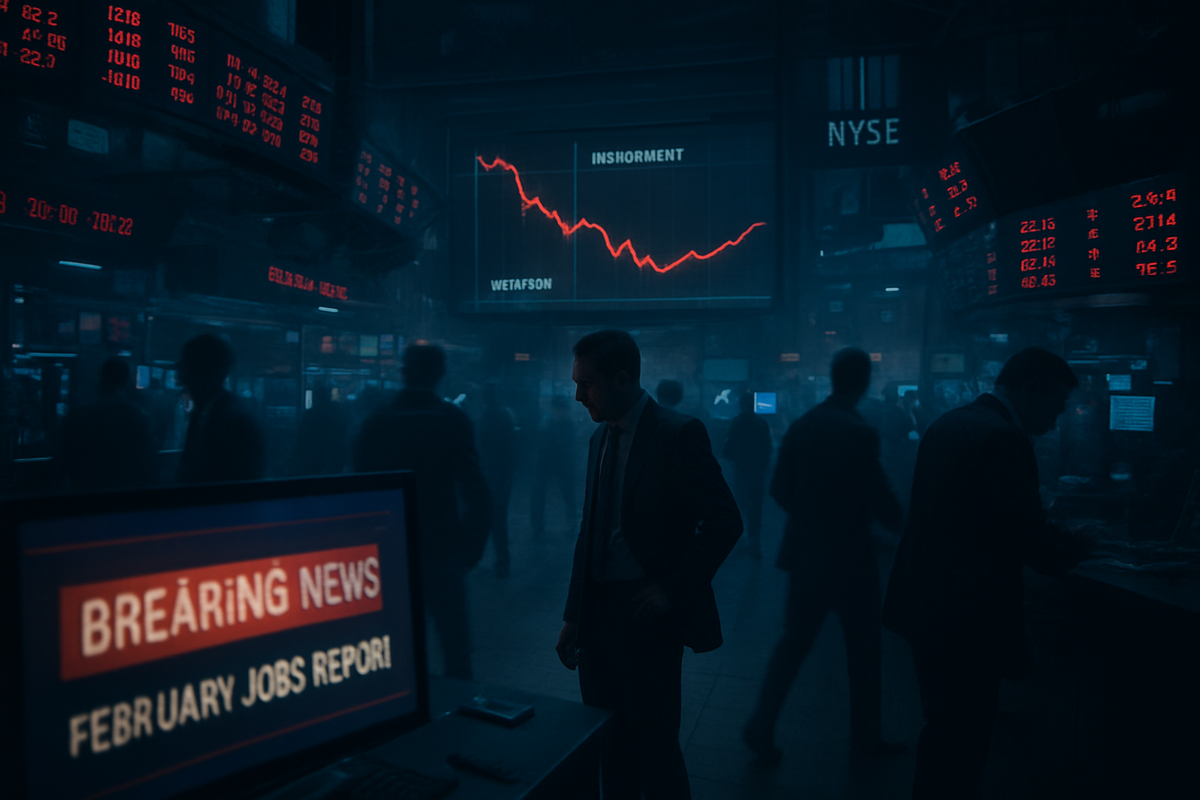
The U.S. economy was dealt a staggering blow this month as the Department of Labor’s February Jobs Report revealed a sudden and unexpected contraction in the workforce. In a report released on March 6, 2026, nonfarm payrolls plummeted by 92,000, a figure that stood in stark contrast to economist expectations of a modest gain. This unexpected decline has pushed the national unemployment rate up to 4.4%, the highest level seen in nearly two years, signaling that the "soft landing" many analysts had predicted for early 2026 may be veering toward a far more turbulent economic reality.
The immediate implications of this data have sent shockwaves through financial markets, as investors grapple with the reality of a cooling labor market paired with stubbornly high inflation. The S&P 500 and Nasdaq Composite both saw sharp declines following the news, as the prospect of "stagflation"—the dreaded combination of stagnant growth and rising prices—moved from a fringe concern to a central market theme. With energy prices surging due to geopolitical tensions in the Middle East, the Federal Reserve now finds itself in a precarious "policy trap," unable to easily cut interest rates to stimulate hiring without risking a further spike in inflation.
Detailed Coverage of the February Contraction
The February report was a definitive "miss" across nearly every metric, following a period of deceptive stability in late 2025. While January had initially reported a gain of 126,000 jobs, that figure was revised downward alongside December’s data, revealing that the labor market had actually been losing momentum throughout the winter. The loss of 92,000 jobs in February marks the first major contraction since the post-pandemic recovery period began to level off. The rise in the unemployment rate to 4.4% was driven not only by layoffs but by a slowdown in new hiring, as companies across the board hit the "pause" button on expansion.
Key players in this downturn included the healthcare and technology sectors, which faced unique and compounding pressures. A significant portion of the healthcare job losses—approximately 28,000—was tied to massive strikes involving healthcare giants like Kaiser Permanente, which disrupted operations across California and Hawaii. Meanwhile, the manufacturing sector continued its 15-month slump, shedding 12,000 positions as erratic tariff policies and cooling global demand weighed on industrial output. Even the construction sector, usually a bedrock of the economy, lost 11,000 jobs, though analysts partially blamed an unusually frigid February for stalling new projects.
Market reaction was swift and unforgiving on the day of the release. The S&P 500 fell 1.3%, while the tech-heavy Nasdaq dropped 1.5%, led by a sell-off in high-growth companies that are particularly sensitive to interest rate fluctuations. Small-cap stocks, represented by the Russell 2000, fared even worse, sliding 1.7% as investors worried that smaller firms would be the first to break under the weight of a cooling economy and high borrowing costs. By the time markets closed on March 13, 2026, the initial shock had transitioned into a deeper, more systemic anxiety about the path forward for the remainder of the year.
Corporate Winners and Losers in a Volatile Market
The tech sector remains the primary focal point of the current labor shift. Block (NYSE: SQ) recently made headlines by announcing a massive 40% reduction in its workforce, affecting roughly 5,000 employees. The company is pivoting aggressively toward AI-driven automation to protect margins in a slowing economy—a move that initially spooked the market but is now being viewed as a potential blueprint for other tech firms. Similarly, Amazon (NASDAQ: AMZN) has continued to refine its headcount following a series of layoff cycles that began in January, as consumer demand for discretionary goods shows signs of softening under the pressure of $119-per-barrel oil.
In the financial sector, major institutions are bracing for a wave of credit tightening. Wells Fargo (NYSE: WFC) and Bank of America (NYSE: BAC) saw their shares trade lower as the "stagflation" narrative took hold. With the unemployment rate rising, the risk of loan defaults increases, and the narrowing yield curve threatens the net interest margins of these banking giants. Conversely, "defensive" plays have seen renewed interest from institutional investors. Defense contractors like Boeing (NYSE: BA) and RTX (NYSE: RTX) have remained relatively resilient, bolstered by continued government spending and a heightened global security environment that keeps their order books full despite the domestic economic slowdown.
One of the few bright spots has been the continued dominance of Nvidia (NASDAQ: NVDA), which remains central to the AI infrastructure boom. While the broader tech sentiment has weighed on its stock price, the company’s role in facilitating the very automation that firms like Block are using to cut costs provides a unique hedge. However, healthcare leaders like UnitedHealth (NYSE: UNH) have faced volatility not just from the labor reports but from slowing growth in Medicare Advantage programs, suggesting that even historically "safe" sectors are not immune to the current macro-economic shifts.
The Specter of Stagflation and Policy Implications
The current situation bears an eerie resemblance to the stagflationary periods of the late 1970s, a historical precedent that many economists hoped to avoid. Unlike the typical recessionary cycle where inflation drops as unemployment rises, current price pressures are being driven by supply-side shocks—specifically the surge in Brent crude oil prices toward $120 per barrel. This creates a "March Bind" for the Federal Reserve. Cutting rates to combat the loss of 92,000 jobs could devalue the dollar and send energy-driven inflation even higher, while holding rates steady at 3.50%–3.75% could accelerate the rise in unemployment.
This event fits into a broader industry trend of "efficiency-first" corporate governance. For years, companies prioritized growth at any cost; in 2026, the trend has shifted toward lean operations and the integration of artificial intelligence to replace human labor. The February job loss in the tech and information sectors is a direct ripple effect of this strategy. Furthermore, the regulatory environment is becoming more complex, as the administration faces pressure to address the "tax" that high energy prices are placing on the average American household, even as the labor market weakens.
The policy implications are profound. Goldman Sachs (NYSE: GS) analysts have noted that the Fed’s traditional toolkit may be largely ineffective against inflation that is not driven by domestic demand but by geopolitical instability. This suggests a prolonged period of sluggish growth is likely. If the unemployment rate continues its upward trajectory toward 5% while core PCE inflation remains stuck above 3%, the Fed may be forced to choose between saving the labor market or saving the value of the currency—a choice with no easy winners.
Strategic Pivots and the Road Ahead
Looking forward, the short-term outlook remains grim as the market waits for the Fed’s next move in late March. Many corporations are expected to follow the lead of Block and Amazon, slowing or freezing hiring altogether while they re-evaluate their 2026 capital expenditures. The "strategic pivot" for most firms will involve a deeper dive into automation and a reduction in non-core business lines. For investors, the challenge will be identifying companies with strong balance sheets that can withstand a period of high interest rates and low growth—a environment where "cash is king."
Long-term possibilities include a structural shift in the U.S. labor market. If AI and automation can fill the gaps left by a shrinking workforce without causing a total collapse in consumer spending, the economy might eventually emerge more productive. However, the transition period is likely to be painful. We may see an increase in labor unrest, similar to the Kaiser Permanente strikes, as workers demand higher wages to keep up with energy-driven inflation while companies attempt to slash costs. This social friction could become a major volatility driver for the markets in the second half of 2026.
Summary and Investor Outlook
The February Jobs Report has served as a wake-up call for an economy that many thought had finally moved past the volatility of the early 2020s. The loss of 92,000 jobs and the jump to 4.4% unemployment are not just numbers; they represent a fundamental shift in the economic trajectory toward a stagflationary environment. The core takeaway for investors is that the "Goldilocks" scenario of low inflation and steady growth has, for now, come to an end, replaced by a complex landscape of geopolitical risks and labor market softening.
Moving forward, the market will be hyper-focused on two things: energy prices and the Fed’s rhetoric regarding the "dual mandate." If oil remains above $115, the pressure on the consumer will eventually lead to a more pronounced drop in corporate earnings. Investors should watch for the next Consumer Price Index (CPI) print and any signs of further downward revisions to labor data. For now, a defensive posture, focusing on value and essential services, appears to be the most prudent path in a market that has been thoroughly "shocked" by the February data.
This content is intended for informational purposes only and is not financial advice