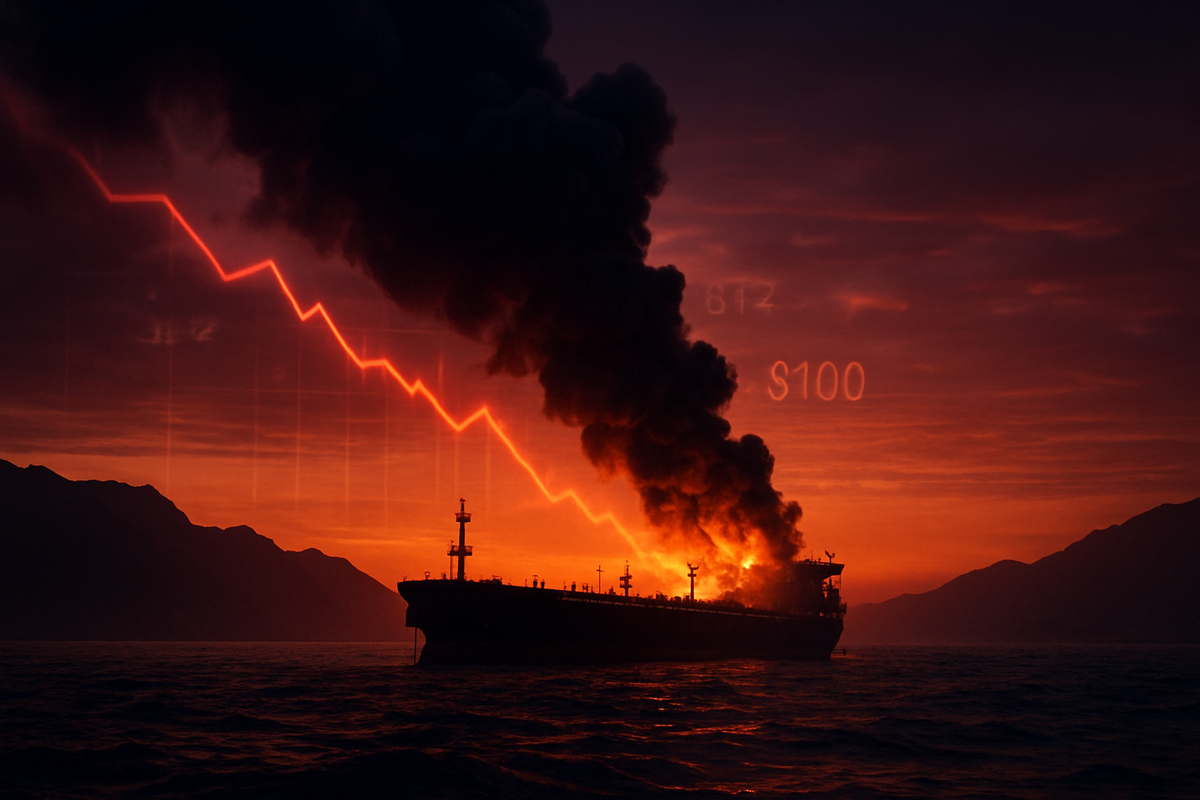
The global economy is reeling this week as crude oil prices surged past the psychological $100-per-barrel threshold, peaking at nearly $120 following a dramatic escalation of hostilities in the Persian Gulf. The sudden spike, triggered by Iranian military strikes on commercial tankers and the subsequent closure of the Strait of Hormuz, has sent shockwaves through equity markets and reignited fears of a global inflationary spiral. As of March 13, 2026, the energy crisis has forced a total suspension of shipping through the world’s most vital maritime chokepoint, leaving 20% of the world’s daily oil supply effectively stranded.
The immediate implications are stark: the S&P 500 and Nasdaq have seen their sharpest weekly declines in over two years, while the VIX volatility index has spiked above 30. Economists warn that if the blockade persists, the "March Shock" could add a full percentage point to global headline inflation, potentially forcing central banks to abandon long-awaited interest rate cuts scheduled for later this year.
The Siege of the Strait: A Timeline of Escalation
The current crisis traces back to late February 2026, following a series of precision strikes by U.S. and Israeli forces against Iranian military infrastructure. In a move military analysts describe as "Operation Epic Fury," Tehran retaliated on March 11 by deploying Islamic Revolutionary Guard Corps (IRGC) fast-attack boats into Iraqi territorial waters near the Umm Qasr anchorage. Two commercial vessels—the U.S.-owned Safesea Vishnu and the Malta-flagged Zefyros—were targeted with explosive-laden drones and limpet mines, resulting in catastrophic fires that halted all Iraqi oil exports from its southern ports.
Within hours of the attacks in Iraqi waters, Iran’s leadership officially declared the Strait of Hormuz a "prohibited war zone," warning that any vessel entering the waterway would be treated as a hostile combatant. This maneuver effectively locked 21 million barrels of oil per day behind a wall of geopolitical risk. Leading shipping giants, including A.P. Møller - Mærsk A/S (OTC: AMKBY) and Hapag-Lloyd AG (OTC: HPGLY), immediately suspended transits through the region, opting for the lengthy and costly detour around the Cape of Good Hope.
The market reaction was instantaneous. Brent Crude futures jumped $15 in a single trading session, as the realization set in that the disruption was not merely a temporary skirmish but a fundamental breakdown of maritime security in the Gulf. "We are in uncharted territory for the modern energy market," noted one senior analyst. "This isn't just a supply squeeze; it's a total disconnection of the Middle East from the global energy grid."
Corporate Impact: High-Stakes Winners and Losers
The surge in energy costs has created a stark divide in corporate performance. Large-scale oil producers with significant assets outside the Persian Gulf are seeing a windfall. Exxon Mobil Corp. (NYSE: XOM), Shell PLC (NYSE: SHEL), and BP PLC (NYSE: BP) have seen their share prices climb as their non-Gulf production becomes exponentially more valuable. These companies are currently capturing massive margins on Permian Basin and North Sea output, even as their logistical divisions scramble to manage the global supply rerouting.
Conversely, the airline and logistics sectors are facing an existential threat. American Airlines Group Inc. (NASDAQ: AAL) and United Airlines Holdings Inc. (NASDAQ: UAL) have been particularly hard-hit, as jet fuel prices have nearly doubled to over $1,500 per tonne. Both carriers are heavily exposed to fuel price fluctuations due to a lack of significant hedging strategies, leading to analyst warnings of imminent fare hikes and capacity cuts. However, Delta Air Lines Inc. (NYSE: DAL) has shown relative resilience, thanks to its ownership of the Trainer Refinery, which provides a unique internal hedge against soaring fuel costs.
The shipping industry is also facing a bifurcated reality. While tanker owners like Frontline PLC (NYSE: FRO) and Euronav NV (NYSE: EURN) could theoretically benefit from skyrocketing spot rates, the cost of war-risk insurance has jumped 12-fold, from 0.25% to 3.0% of hull value. For many, the risk of losing a vessel—or the inability to secure insurance at any price—has outweighed the potential profits of navigating the Gulf.
A New Era of Stagflation? Analyzing the Significance
This event fits into a broader trend of "weaponized geography," where regional powers leverage maritime chokepoints to exert disproportionate influence on the global economy. The closure of the Strait of Hormuz is reminiscent of the "Tanker War" of the 1980s, but the stakes are significantly higher in 2026. The world is more interconnected, and the "just-in-time" nature of global supply chains means that a two-week delay for a tanker re-routing around Africa has cascading effects on everything from European heating costs to Asian manufacturing schedules.
Furthermore, the "March Shock" bears a haunting resemblance to the 1979 oil crisis, which ushered in a decade of stagflation. Unlike the 2022 energy spike following the invasion of Ukraine—which was largely a crisis of redirection and sanctions—the current situation involves a physical blockade of the world's most critical supply artery. This has severe regulatory implications; policymakers are already discussing the mandatory expansion of Strategic Petroleum Reserves (SPR) and accelerated subsidies for renewable energy to decouple national security from Middle Eastern volatility.
Historical precedents suggest that such shocks often lead to a "hawkish" pivot by central banks. The Federal Reserve, which had been signaling a move toward lower interest rates to support a cooling economy, now faces the nightmare scenario of rising inflation and slowing growth. The "higher-for-longer" interest rate environment is likely to persist, putting further pressure on high-growth tech stocks and consumer discretionary spending.
Strategic Pivots and the Road Ahead
In the short term, the market will likely see a frantic effort by the U.S. and its allies to establish "Blue Water" escort corridors to reopen the Strait, a 2026 iteration of the 1980s "Operation Earnest Will." However, military intervention carries the risk of a broader regional war, which could further destabilize energy infrastructure in Saudi Arabia and the UAE. Investors should prepare for a period of extreme volatility as naval maneuvers and diplomatic negotiations play out in real-time.
Long-term, this crisis will likely force a strategic pivot toward energy independence and alternative transit routes. We may see increased investment in pipelines that bypass the Strait of Hormuz, such as Saudi Arabia’s East-West Pipeline, and a renewed focus on the Arctic Northern Sea Route as a viable, albeit controversial, alternative for East-West trade. For public companies, the ability to adapt to a high-energy-cost environment will become a primary metric of management quality.
Final Assessment: What Investors Must Watch
The events of March 2026 serve as a stark reminder that geopolitical risk is never truly "priced in." The sudden surge of oil past $100 has fundamentally altered the 2026 economic outlook, shifting the focus from growth to survival for many energy-dependent sectors. Key takeaways for the coming months include the persistence of the $100+ oil floor, the potential for a "second wave" of inflation, and the increased importance of corporate fuel hedging and supply chain diversification.
Investors should closely monitor weekly inventory reports from the Energy Information Administration (EIA) and any announcements regarding the deployment of naval assets to the Gulf. The resilience of the consumer in the face of $5-per-gallon gasoline will also be a critical indicator of whether the global economy can avoid a full-scale recession. For now, the world remains at the mercy of the Strait, waiting to see if diplomacy or further escalation will define the next chapter of the 2026 energy crisis.
This content is intended for informational purposes only and is not financial advice.