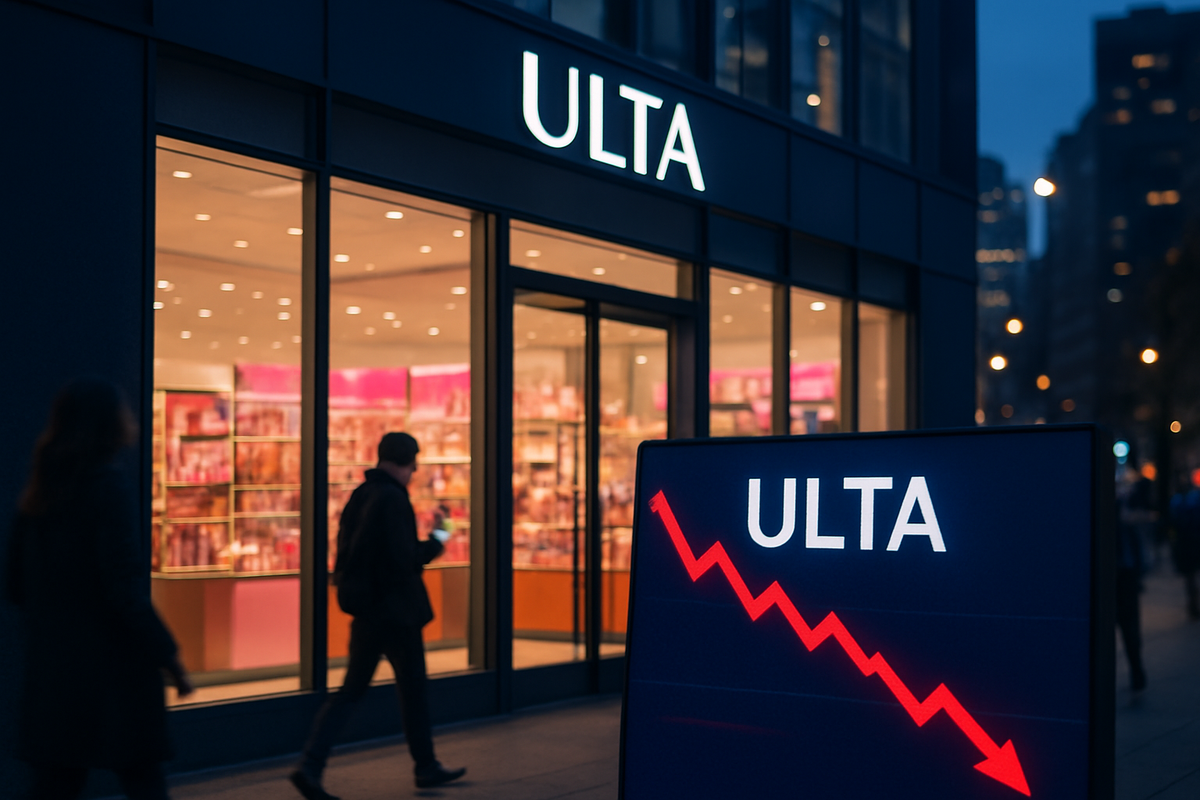
Shares of beauty giant Ulta Beauty (NASDAQ: ULTA) experienced a dramatic sell-off today, March 13, 2026, sliding more than 10% to lead the decliners in the S&P 500. The sharp descent followed the company's late-Thursday earnings release, which revealed a rare miss on the bottom line despite a robust performance in total sales. Investors were primarily spooked by a massive 23% surge in Selling, General, and Administrative (SG&A) expenses, which effectively eroded the gains from a stronger-than-expected holiday shopping season.
The market's reaction highlights a growing anxiety regarding the sustainability of the "beauty boom" that has fueled Ulta’s growth for years. While consumer demand for prestige cosmetics and fragrances remains resilient, the rising cost of maintaining market dominance through digital transformation and international expansion has begun to weigh heavily on margins. Today's double-digit drop represents the steepest single-day decline for the retailer in nearly two years, wiping out billions in market capitalization in a matter of hours.
A Perfect Storm of Rising Costs and Narrow Misses
The catalyst for today’s volatility was Ulta’s fourth-quarter fiscal 2025 financial report. The company reported diluted earnings per share (EPS) of $8.01, falling just short of the Wall Street consensus estimate of $8.03 to $8.05. While a two-cent miss might seem marginal, it marks the first time in several years that Ulta has failed to exceed analyst expectations. This earnings pressure came despite a healthy 11.8% rise in net sales to $3.9 billion, which actually beat the $3.82 billion forecast.
The primary culprit for the profit erosion was a staggering 23% jump in SG&A expenses, which reached $1.0 billion for the quarter. Management attributed this "expense bubble" to several concurrent factors: heavy investments in the company’s "Beauty Unleashed" digital initiative, higher-than-anticipated incentive compensation for store associates, and the complex integration costs of the Space NK acquisition finalized in late 2025. Operating margins subsequently contracted to 12.2%, down from 14.8% in the same period last year, signaling that the company is spending aggressively to defend its turf against a diversifying field of competitors.
Winners and Losers in the Beauty Battleground
In the wake of Ulta's margin squeeze, investors are re-evaluating the competitive hierarchy of the beauty sector. One clear beneficiary of the shifting landscape has been Kohl’s (NYSE: KSS), which continues to see significant foot traffic and sales growth through its exclusive partnership with Sephora. As Ulta grapples with internal restructuring and rising SG&A, the "shop-in-shop" model at Kohl's has provided a more cost-effective expansion route for LVMH-owned Sephora, potentially poaching prestige shoppers who are increasingly looking for convenience.
Conversely, traditional department stores and smaller specialty boutiques may find themselves the biggest losers. If a powerhouse like Ulta is struggling to maintain margins while spending $1 billion on overhead, smaller players with less capital to invest in technology and supply chain automation may be forced to consolidate or shutter. Meanwhile, Amazon (NASDAQ: AMZN) continues to loom as a major threat, with its "Premium Beauty" storefront gaining significant traction among price-sensitive consumers who are increasingly opting for "dupes" and more affordable alternatives in the face of persistent inflation in the luxury tier.
Navigating the Bifurcated Consumer Landscape
Ulta’s financial results offer a window into a broader trend: the "bifurcation" of the American consumer. While high-income households earning over $100,000 annually continue to drive double-digit growth in prestige fragrances and skincare, middle-income shoppers are showing signs of exhaustion. This trend has forced retailers to lean more heavily into "masstige"—a hybrid of mass-market and prestige products—which often carries lower margins than high-end luxury goods.
Historically, the beauty industry has been viewed as "recession-proof" due to the "lipstick effect," where consumers indulge in small luxuries during economic downturns. However, the current environment is unique. The explosion of TikTok Shop and social media discovery has shortened product lifecycles, forcing retailers like Ulta to spend more on marketing and rapid inventory turnover. This event draws parallels to the retail shifts of the early 2010s, where traditional brick-and-mortar leaders had to endure years of margin pain to successfully pivot to an omni-channel future.
Looking Ahead: A Strategic Pivot or a Persistent Drag?
The road ahead for Ulta Beauty appears fraught with both operational challenges and strategic opportunities. For fiscal 2026, the company has issued a conservative outlook, projecting comparable store sales growth of just 2.5% to 3.5%, a noticeable deceleration from the 5.4% growth achieved in 2025. This guidance suggests that management expects the consumer environment to remain tepid, at least in the short term, as they continue to digest the costs of their international expansion into Mexico and the Middle East.
Investors will be closely watching whether the "Beauty Unleashed" initiative pays off in the form of improved efficiency in late 2026. If the digital infrastructure upgrades can successfully automate supply chain logistics and reduce the need for further SG&A spikes, Ulta could see a rapid recovery in its operating margin. However, if the competitive pressure from Amazon and TikTok Shop continues to escalate, Ulta may be forced to maintain its high level of promotional and capital spending, which could lead to a "new normal" of lower profitability for the industry leader.
Summary of a Significant Market Shift
The 10% slide in Ulta’s stock today serves as a stark reminder that even the most dominant retail leaders are not immune to the rising costs of doing business in a digital-first economy. While the company continues to grow its top-line revenue and attract loyal customers, the 23% jump in expenses has set off alarm bells on Wall Street regarding the long-term profitability of the beauty sector.
Moving forward, investors should keep a close eye on two critical metrics: operating margin stability and the performance of new international markets. As the "lipstick effect" meets the reality of modern operating costs, the coming months will determine if Ulta’s current dip is a buying opportunity or a warning sign of a broader cooling in the beauty market. For now, the "Beauty Unleashed" strategy remains a high-stakes bet on the future of retail that the market is not yet ready to fully endorse.
This content is intended for informational purposes only and is not financial advice.