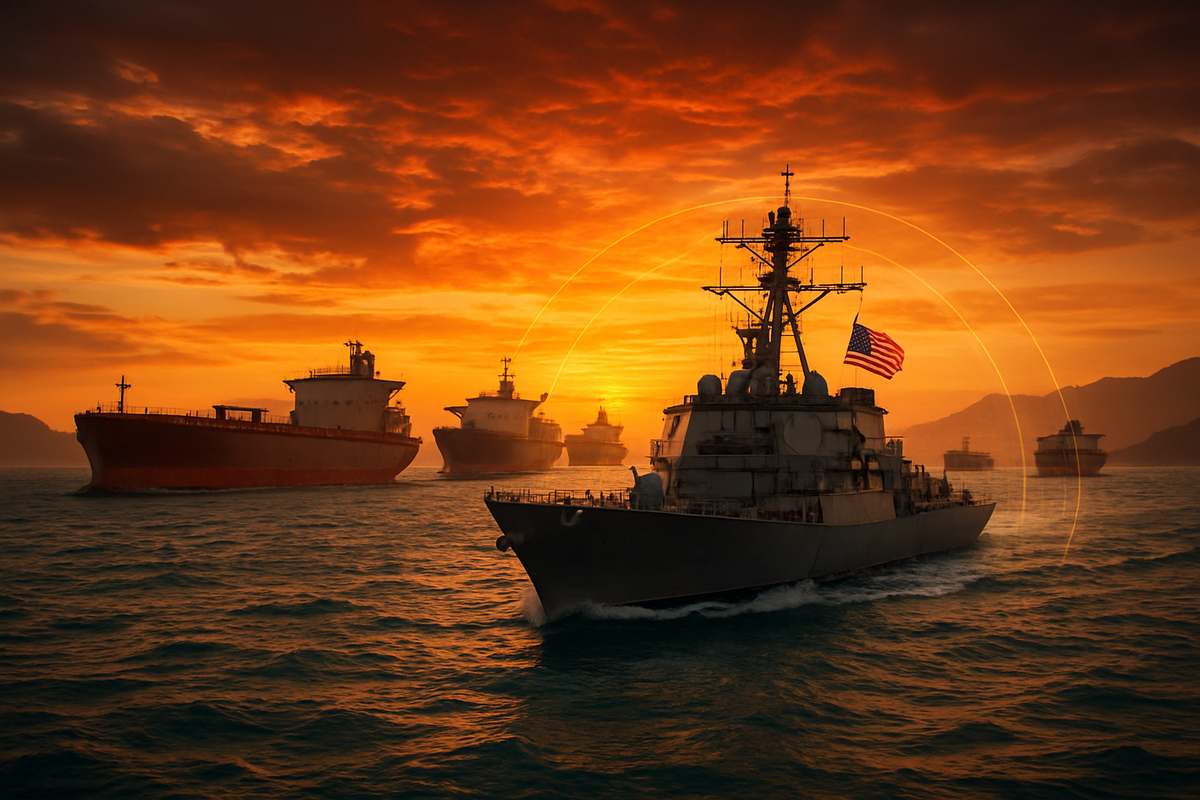
In a decisive move to avert a global economic meltdown, the U.S. government has unveiled a high-stakes strategy to bypass the ongoing Iranian blockade of the Strait of Hormuz. By activating a massive $20 billion maritime reinsurance facility and promising military escorts, Washington is effectively "tapping" the vast global fleet of foreign-flagged tankers to resume energy shipments through the world’s most dangerous chokepoint. The plan aims to break the stranglehold on global energy supplies that has seen Brent crude skyrocket past $120 per barrel in less than two weeks.
The immediate implications are profound: if successful, the initiative could significantly deflate the "war risk" premiums that have paralyzed international shipping since early March 2026. For Wall Street, the move offers a potential lifeline to energy-intensive sectors—ranging from airlines to chemical manufacturers—which have been reeling from soaring fuel costs and supply chain disruptions. However, the plan also places the U.S. Navy and the American taxpayer at the center of a volatile maritime standoff, with the risk of direct military escalation at an all-time high.
The Escalation: From "Epic Fury" to a Global Chokepoint
The current crisis traces back to February 28, 2026, when a series of coordinated U.S. and Israeli airstrikes, dubbed "Operation Epic Fury," targeted Iranian military and nuclear infrastructure. In a swift and aggressive retaliation, the Islamic Revolutionary Guard Corps (IRGC) declared the Strait of Hormuz closed on March 2, 2026. Within days, the waterway—responsible for the passage of roughly 20% of the world’s petroleum and liquefied natural gas (LNG)—became a "no-go zone." Over 150 tankers were left stranded in the Gulf of Oman as Iranian drone swarms and naval mines made transit functionally impossible for commercial vessels.
By March 10, the global maritime industry reached a breaking point. War risk insurance premiums for the region spiked by over 50%, and benchmark freight rates for Very Large Crude Carriers (VLCCs) soared to an unprecedented $423,000 per day. Major shipping conglomerates, including A.P. Møller – Mærsk A/S (CPH: MAERSK-B), were forced to reroute vessels around the Cape of Good Hope, adding nearly two weeks to transit times and millions to operational costs. The U.S. response, finalized late last night, involves the U.S. International Development Finance Corporation (DFC) acting as a "sovereign backstop," providing insurance that the private market no longer will, specifically for foreign-flagged ships that agree to follow U.S. Navy escort protocols.
Market Impact: The Winners and Losers of the Bypass Plan
The primary beneficiary of this federal intervention is Chubb Limited (NYSE: CB), which has been tapped as the lead underwriter for the $20 billion sovereign backstop. By managing the program on behalf of the U.S. government, Chubb and its peers like American International Group (NYSE: AIG) and The Travelers Companies, Inc. (NYSE: TRV) may see a surge in fee-based revenue without bearing the full weight of the catastrophic risk, which is now backed by the U.S. Treasury. Furthermore, U.S. energy giants like Exxon Mobil Corporation (NYSE: XOM) and Chevron Corporation (NYSE: CVX) stand to gain as the plan restores the flow of global crude, potentially stabilizing their complex international refining operations while they continue to benefit from elevated domestic prices.
On the other side of the ledger, energy-intensive industries are breathing a sigh of relief, though they remain in a precarious position. Airlines such as Delta Air Lines, Inc. (NYSE: DAL) and United Airlines Holdings, Inc. (NYSE: UAL) have seen their stock prices battered by the surge in jet fuel costs. A successful reopening of the Strait would be their biggest "win" of the quarter. Conversely, global petrochemical leaders like Dow Inc. (NYSE: DOW), which depend on Middle Eastern feedstocks like methanol and ammonia, have faced severe supply shocks. These firms are desperate for the U.S. bypass plan to succeed, as the alternative—a prolonged shutdown—could lead to plant closures and multi-billion-dollar losses in the second half of 2026.
A New Era of Maritime Geopolitics
This event marks a significant shift in global maritime policy, echoing the "Tanker War" of the 1980s but on a much more complex scale. By incentivizing foreign-flagged ships to participate in a U.S.-led escort system, Washington is asserting a level of control over international commerce not seen in decades. This fits into a broader trend of "weaponized interdependence," where trade routes and financial mechanisms like insurance are used as strategic tools of statecraft. The reliance on foreign ships—many of which fly "flags of convenience" from nations like Liberia or the Marshall Islands—highlights the U.S. government's pragmatic approach to leveraging the globalized nature of shipping to achieve domestic energy security.
The ripple effects are already being felt among competitors. Saudi Arabia has maximized its "East-West" pipeline to the Red Sea port of Yanbu, attempting to bypass the Strait via land, while Saudi Arabian Oil Co. (TADAWUL: 2222) continues to coordinate closely with U.S. authorities. However, the limited capacity of such pipelines underscores the necessity of the maritime route. Historically, such blockades have led to long-term shifts in energy sourcing, and this crisis may accelerate the transition toward Western-hemisphere production and alternative energy sources to mitigate the "Hormuz Risk" once and for all.
The Horizon: Strategic Pivots and Escort Realities
In the short term, the success of the U.S. plan hinges on the physical security of the first "test" convoys expected to move in late March. Market participants are watching for any sign of IRGC interference with a U.S.-insured foreign vessel, which would serve as a "red line" for further military action. Strategically, shipping companies may need to pivot their entire logistics models, potentially favoring larger, better-protected fleets over smaller independent operators who cannot meet the rigorous security criteria required for the federal insurance backstop.
Scenario analysis suggests two paths: a "stabilized corridor" where energy flows continue under heavy military guard, or a "protracted conflict" where the cost of protection eventually outweighs the value of the cargo. If the bypass plan holds, we may see a gradual cooling of oil prices toward the $90 range. However, if a major tanker is lost despite U.S. insurance and naval protection, the resulting surge in rates could be permanent, forcing a radical restructuring of global energy markets and potentially triggering a global recession.
Conclusion: What Investors Must Watch
The U.S. government’s decision to underwrite the risks of global shipping is a historic intervention that underscores the fragility of the modern energy supply chain. By tapping foreign ships to bypass the Hormuz blockage, the administration is attempting to decouple the global economy from Iranian regional aggression. For investors, the key takeaways are the resilience of the insurance sector under federal backing and the extreme volatility that will continue to define the energy and transportation markets in the coming months.
As we move forward, the market will be hyper-sensitive to "shipping manifest" updates and CENTCOM briefings. Watch for the performance of the DFC's insurance facility and any expansion of the program to include non-energy commodities. While the bypass plan offers a glimmer of hope for Wall Street’s energy-starved sectors, the geopolitical stakes have never been higher. The coming weeks will determine whether this $20 billion gamble pays off or if the Strait of Hormuz will remain the world's most expensive dead end.
This content is intended for informational purposes only and is not financial advice.