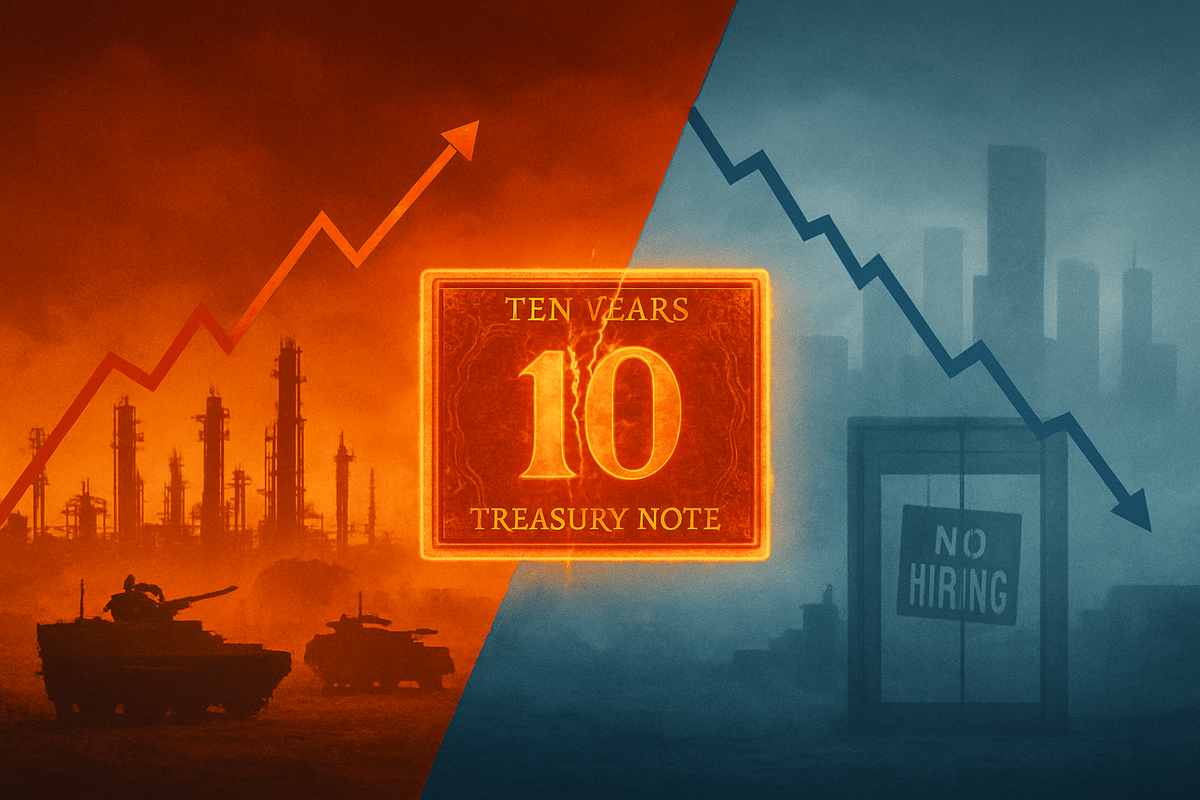
NEW YORK — The global bond market is currently locked in a high-stakes standoff as the 10-year Treasury Note experiences its most volatile month in years. As of March 13, 2026, investors are navigating a treacherous economic landscape where the inflationary pressures of a widening Middle East conflict are colliding head-on with data suggesting the American labor market is finally beginning to crack. The 10-year yield, a critical benchmark for everything from mortgages to corporate debt, has swung wildly between 4.15% and 4.27% over the past week, reflecting a market that is deeply undecided about the Federal Reserve's next move.
The immediate implications are stark: the "higher-for-longer" narrative, which many hoped would fade by early 2026, has gained renewed vigor. This volatility is not merely a technical glitch in trading algorithms; it represents a fundamental repricing of global risk. With oil prices breaching the $100 mark and the national debt ballooning to $38.6 trillion, the bond market is demanding a higher "term premium" to compensate for the dual threats of geopolitical instability and fiscal expansion.
A Perfect Storm of Geopolitical Friction and Fiscal Weight
The current turmoil traces its roots back to the final days of February 2026, when coordinated military strikes in Iran led to the effective closure of the Strait of Hormuz. This geopolitical shock sent immediate ripples through the energy sector, but its most profound impact was seen in the Treasury market. On March 6, the 10-year yield sat at a relatively stable 4.15%. However, as news of the closure’s impact on global fertilizer and oil supplies became clear, yields surged to 4.27% by March 12. The bond market, acting as a sentinel for inflation, began pricing in a "farm-to-fork" price shock that many fear will haunt the Consumer Price Index (CPI) well into the autumn.
Compounding this pressure is the aftermath of the "One Big Beautiful Bill Act" (OBBBA), a massive infrastructure and social spending package passed in late 2025. While the OBBBA has provided a "sugar high" for GDP growth, it has necessitated a massive issuance of new Treasury debt. This surge in supply has coincided with a period where traditional foreign buyers of U.S. debt are more cautious, leading to a "bear steepening" of the yield curve. In this environment, long-term rates rise faster than short-term rates, signaling that the market expects inflation to remain stubborn even if the broader economy slows.
Simultaneously, the release of the February 2026 employment report added a layer of confusion to the narrative. The U.S. economy unexpectedly shed 92,000 jobs, a stark reversal from the projected 60,000 gain. This "cooling" of the labor market usually leads to lower yields as investors bet on Fed rate cuts, but the "war-driven" inflation has complicated that reflex. Stakeholders—from Wall Street traders to the Federal Reserve Board of Governors—are now caught in a "stagflationary" trap, where the tools to fix unemployment (rate cuts) would only exacerbate the inflation caused by energy shortages.
Winners and Losers in a High-Yield Environment
The banking sector has emerged as a tentative beneficiary of this steepening yield curve. JPMorgan Chase & Co. (NYSE: JPM) saw its market capitalization cross the $900 billion threshold this month, as the widening spread between short-term borrowing costs and long-term lending rates boosted its net interest margins. Similarly, Bank of America Corp. (NYSE: BAC) has seen a lift in its profitability forecasts, as it benefits from higher returns on its vast portfolio of long-term assets, provided the economy avoids a full-scale recession.
Conversely, the housing and manufacturing sectors are feeling the burn of 4.25%-plus yields. D.R. Horton, Inc. (NYSE: DHI) and Lennar Corp. (NYSE: LEN) have seen their stock prices retreat as 10-year yields push 30-year mortgage rates back toward the 6.5% mark. To keep sales moving, these homebuilders are being forced to offer expensive "mortgage rate buydowns," which directly erode their profit margins. The cooling jobs market only adds to their woes, as potential homebuyers become more cautious about taking on large debts in an uncertain employment environment.
In the industrial and agricultural sectors, the impact is mixed but leaning toward negative. Caterpillar Inc. (NYSE: CAT) has warned investors of a $2.6 billion headwind due to rising energy costs and manufacturing tariffs, despite strong demand for backup power generators used in AI data centers. Meanwhile, Deere & Company (NYSE: DE) is seeing signs of distress in the American heartland; rising fertilizer and fuel costs, exacerbated by the Middle East conflict, are putting many farmers "underwater," potentially curbing the demand for high-end agricultural machinery in the 2026-2027 cycle.
The Significance of the "K-Shaped" Cooling
This period of volatility fits into a broader industry trend known as the "K-shaped" economic cooling. While high-income earners and large-cap corporations like Alphabet Inc. (NASDAQ: GOOGL) and Apple Inc. (NASDAQ: AAPL) remain insulated by massive cash reserves and aggressive share buybacks, the broader manufacturing and construction sectors are slowing down significantly. This divergence is making the Federal Reserve’s job nearly impossible, as the data points to two different economies: one fueled by high-tech growth and another struggling under the weight of high interest rates and energy shocks.
The historical precedent for this moment is often cited as the late 1970s, but with a modern twist of "fiscal dominance." Unlike previous eras, the U.S. government’s interest expense is now a primary driver of the deficit, creating a feedback loop where higher yields lead to higher deficits, which in turn require more bond issuance. This structural shift means that even a significant cooling in the labor market might not be enough to bring yields back to the 2-3% range seen in the 2010s.
Furthermore, the regulatory environment is shifting. There is renewed talk in Washington about "yield curve control" or more aggressive intervention in the bond market to prevent the national debt service from crowding out other spending. Such a move would be unprecedented in the modern era and would signal a major departure from the market-driven interest rate policies that have defined the last four decades.
Looking Ahead: The Path to 2027
In the short term, all eyes remain on the Federal Reserve's upcoming meeting. If the Fed prioritizes the cooling labor market and signals a rate cut, yields might temporarily dip, but at the risk of letting energy-driven inflation run wild. Alternatively, if they hold steady to fight inflation, they risk turning the current job losses into a broader recession. Market participants should expect a period of "strategic adaptation," where companies shift away from debt-fueled expansion and focus on capital efficiency.
The potential for a "pivot" remains, but it may not be the one investors expect. We could see a move toward more targeted fiscal support for the energy and agricultural sectors to combat the "war-driven" costs without relying solely on interest rate hikes. For the tech sector, the challenge will be maintaining valuations as the "risk-free" rate of return on the 10-year Treasury remains high, forcing a shift from growth-at-all-costs to a focus on sustainable cash flows.
A Summary of a Market in Transition
The volatility in the 10-year Treasury Note is a symptom of an economy at a crossroads. We are witnessing the collision of geopolitical reality and domestic economic softening. The key takeaway for investors is that the old "Fed Put"—the idea that the central bank will always step in to save the market with lower rates—is being severely tested by the reality of war-driven supply shocks and a $38 trillion debt burden.
Moving forward, the market will likely remain in a state of flux until there is clarity on the duration of the Middle East conflict and the depth of the labor market's cooling. Investors should watch the 4.30% level on the 10-year yield; a sustained break above that could trigger a more significant sell-off in equities. In the coming months, the resilience of the American consumer and the stability of global energy supply chains will be the true barometers of whether the U.S. economy can achieve a "soft landing" or if it is heading toward a more turbulent stagflationary era.
This content is intended for informational purposes only and is not financial advice.