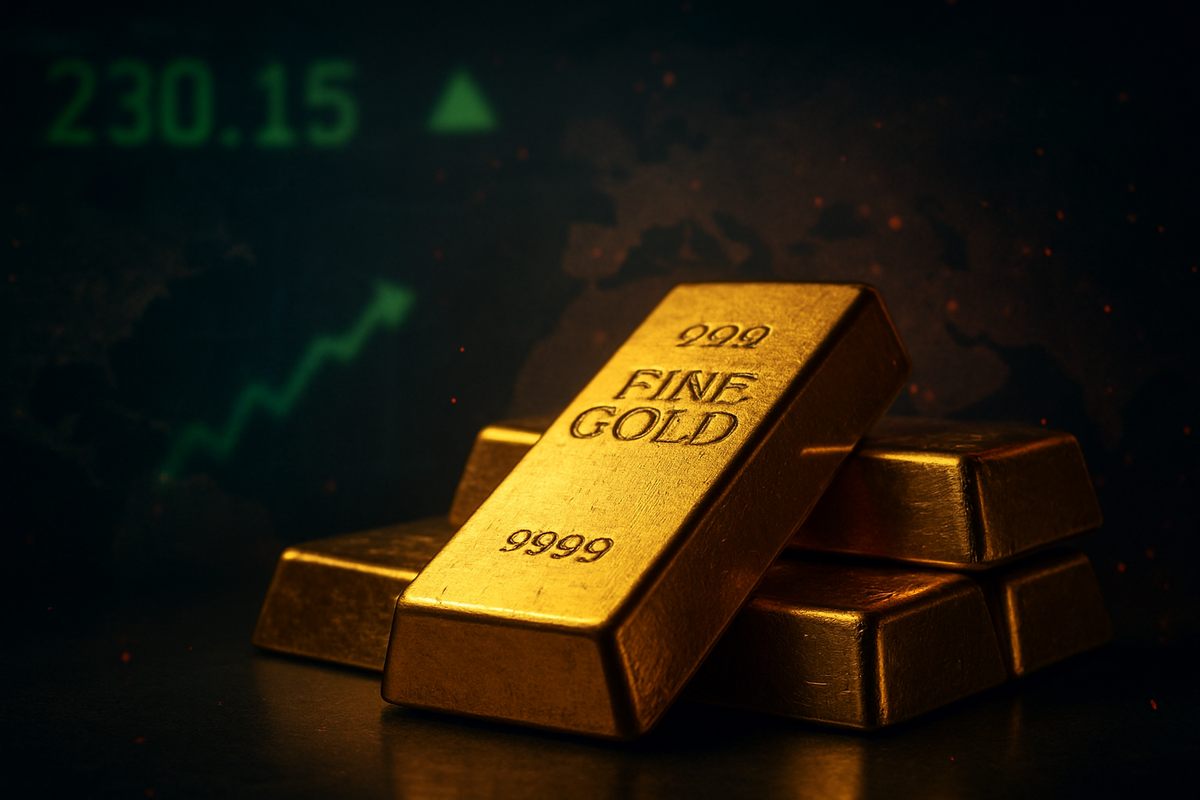
CHICAGO — In a historic trading session that has sent shockwaves through global financial centers, gold prices surged to an all-time high of $5,361 per ounce on Monday, March 2, 2026. The 2.16% intraday jump comes as investors scramble for the ultimate safe-haven asset following a weekend of unprecedented military escalation in the Middle East. With regional stability hanging by a thread and critical energy corridors under threat, the "yellow metal" has reasserted its role as the world's premier hedge against geopolitical catastrophe.
The move marks a definitive breakout for gold, which has been trending upward since the start of the year but found a violent new catalyst in the collapse of diplomatic channels across the Persian Gulf. As equities and high-risk assets saw broad liquidations at the Monday open, bullion stood as one of the few green symbols on trading screens, reflecting a market that is now pricing in a sustained period of global instability and potential supply-side inflationary shocks.
Geopolitical Firestorm Triggers Parabolic Move
The immediate driver for today’s record-breaking price action was the launch of "Operation Roaring Lion," a joint military offensive by the United States and Israel targeting strategic command centers within Iran. The operation, which began in the early hours of February 28, reportedly resulted in the death of Iran’s Supreme Leader, Ayatollah Ali Khamenei, creating a massive power vacuum in the region. The subsequent retaliatory missile strikes against U.S. bases in the Gulf and the functional closure of the Strait of Hormuz—the world’s most vital oil transit point—have effectively paralyzed regional trade.
Markets reacted with immediate panic as the new week began. Spot gold (XAU/USD) opened with a significant "gap-up," briefly touching a peak of $5,419 before settling near $5,361 by mid-afternoon. This surge is not merely a technical breakout but a fundamental "regime change" in how risk is being calculated globally. Analysts at major financial institutions, including JPMorgan Chase & Co. (NYSE: JPM), have already revised their year-end targets, with some now suggesting gold could breach $6,000 before the end of the second quarter.
The timeline leading to this morning’s peak was accelerated by a series of failed diplomatic summits throughout February. As tensions reached a boiling point, the move into physical bullion and gold-backed securities became a stampede. Unlike previous spikes that were often met with profit-taking, the current demand is characterized by institutional "hard money" accumulation, as fund managers pivot away from sovereign debt that is increasingly viewed as vulnerable to the inflationary pressures of a widening war.
Mining Giants and ETFs Caught in the Volatility
The surge in the underlying metal has had a complex impact on the equities market. While one might expect a uniform rally, the reaction among major producers has been nuanced. Newmont Corporation (NYSE: NEM), the world’s largest gold miner, saw its shares buoyed not only by the price of bullion but by its own strong fundamental position. Newmont recently reported a record $7.3 billion in free cash flow for the previous year, and with a dividend record date of March 3, 2026, many investors are doubling down on the stock to capture both the capital appreciation and the immediate payout.
Conversely, Barrick Gold Corp (NYSE: GOLD) has faced some headwinds despite the record gold price. While the company boosted its dividend by 140% in February, it has also guided for lower production in 2026 due to planned "troughs" in its mining cycle. This has led some value-oriented investors to hesitate, even as the company moves toward a highly anticipated IPO of its North American assets later this year. Meanwhile, Agnico Eagle Mines (NYSE: AEM) continues to be the "quality" pick for many, as its stable production profile in low-risk jurisdictions like Canada and Australia makes it a favored hedge against the very regional instability currently driving gold higher.
The VanEck Gold Miners ETF (NYSEARCA:GDX) reflected this sector-wide complexity, trading near $113.29. While GDX is holding near its 52-week highs, it faced some technical pressure on Monday. The ETF is currently navigating a major index rebalancing following its transition to the MarketVector Global Gold Miners Index. With six new additions expected to be announced on March 13, institutional positioning is causing significant "churn" within the fund, preventing it from fully tracking the parabolic 2% move seen in the physical metal.
A Decoupling from Traditional Market Logic
The current surge highlights a significant shift in broader industry trends: the decoupling of gold from traditional correlations. Historically, gold prices have a strong inverse relationship with U.S. Treasury yields; when yields rise, the opportunity cost of holding non-yielding gold increases. However, on March 2, 2026, both gold and yields rose in tandem, a rare phenomenon that signals a lack of confidence in traditional fiat-denominated "safe" assets. Investors are no longer just looking for a return on their capital; they are looking for the return of their capital.
This flight to "hard money" has created a ripple effect across the precious metals complex, though not all assets are benefiting equally. Silver, often considered "gold’s high-beta cousin," showed remarkable volatility, swinging between $88 and $93 per ounce. The iShares Silver Trust (NYSEARCA:SLV) saw heavy volume but failed to match gold's steady climb, as concerns over industrial demand—silver's primary use case—weighted on the metal. This divergence reinforces the narrative that the current move is strictly driven by gold’s unique status as a geopolitical insurance policy rather than a broad-based commodity rally.
Historically, events of this magnitude—such as the 1979 Iranian Revolution or the 2008 financial crisis—have led to long-term structural changes in the gold market. In 2026, the potential closure of the Strait of Hormuz is the "black swan" event that many feared. If energy supplies remain constrained, the resulting "stagflation" (stagnant growth combined with high inflation) creates a perfect environment for gold to maintain its new, higher price floor.
The Road Ahead: $6,000 and Beyond?
In the short term, the market will remain hyper-sensitive to any news regarding the stability of the Iranian government and the safety of global shipping lanes. Should the conflict expand to involve other regional powers directly, a move toward $5,600 per ounce is viewed as the next technical resistance level. Market participants are also watching for any signs of central bank intervention. In recent years, central banks in emerging markets have been massive net buyers of gold; if they continue to diversify away from the U.S. dollar during this crisis, it could provide a permanent floor for the metal.
However, challenges remain. The high price of gold may eventually lead to "demand destruction" in the jewelry and industrial sectors, particularly in major markets like India and China. Furthermore, the rising All-In Sustaining Costs (AISC) for miners—driven by the same energy price spikes currently fueling the gold rally—could eat into the profit margins of companies like Newmont and Barrick, potentially capping the upside for mining equities even if the metal continues to climb.
The most likely scenario for the coming months is one of extreme volatility. As the Middle East enters a period of profound uncertainty, the premium for "safety" is unlikely to evaporate quickly. Investors will need to balance the allure of record prices with the risks of a broader market "risk-off" liquidation, where even safe havens can be sold to cover margin calls in other sectors.
Assessment and Final Thoughts
The breach of the $5,300 level is more than just a headline; it is a signal of a world in transition. Gold has effectively served its purpose for those who held it as a hedge against the "unthinkable." As we move forward into the spring of 2026, the metal's performance will likely remain the primary barometer for global anxiety.
For investors, the key takeaways are clear: diversification into physical assets remains a vital component of a defensive portfolio, but selectivity in the mining sector is more important than ever. Watching the GDX rebalancing in mid-March and the upcoming dividend payments from the major miners will provide critical clues as to where the "smart money" is flowing. In a world where the Strait of Hormuz is closed and regional powers are in direct conflict, gold is no longer a "barbarous relic"—it is the only liquid asset with no counterparty risk.
This content is intended for informational purposes only and is not financial advice