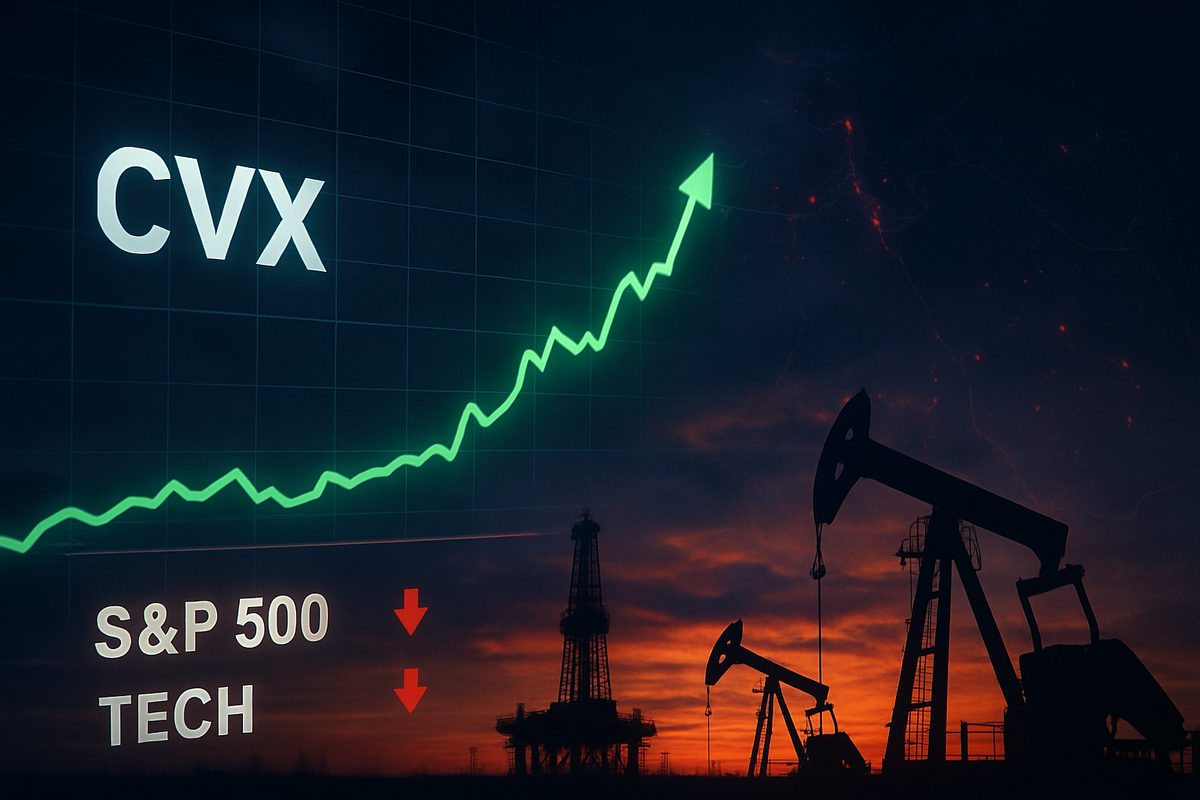
HOUSTON, March 3, 2026 – In a dramatic divergence from a broader market sell-off, Chevron Corporation (NYSE: CVX) climbed to a new all-time high of $189.60 today, as escalating military conflict in the Middle East continues to weaponize global energy prices. While major indices like the S&P 500 and the tech-heavy Nasdaq have entered a period of sharp volatility, the energy sector has emerged as the sole beneficiary of a "geopolitical fear premium" that has sent Brent crude oil prices soaring above $84 per barrel.
The surge in Chevron's stock price marks a historic milestone for the integrated energy giant, reflecting a radical shift in investor sentiment from the "AI-first" growth strategies of 2024 and 2025 back toward the reliability of fossil fuels and energy security. As the threat of a closure of the Strait of Hormuz looms, Chevron’s diversified portfolio—bolstered by its high-profile acquisition of Hess Corporation—has positioned the company as the primary safe haven for institutional capital fleeing inflationary pressures and supply chain disruptions.
The current rally is the culmination of a tense week that saw the Middle East descend into its most significant kinetic conflict in decades. Following a series of U.S. and Israeli strikes on Iranian military and nuclear infrastructure on February 28, 2026, Brent crude prices spiked by more than 13% in just 72 hours. This sudden escalation ended a period of relative price stability where Brent had lingered in the $70 range, effectively re-introducing a massive risk premium into the energy markets.
The path to Chevron’s record high was paved by strategic maneuvers throughout 2025. After the $53 billion merger with Hess Corporation finally cleared regulatory hurdles in July 2025, Chevron gained a significant foothold in Guyana’s offshore oil fields, one of the world's most lucrative production areas outside of OPEC+. Combined with record-breaking production in the Permian Basin—reaching a staggering 1 million barrels per day in late 2025—the company had already entered 2026 with a robust balance sheet and aggressive share buyback programs totaling over $15 billion.
The immediate reaction from Wall Street has been a rotation out of growth and into value. While the Dow Jones Industrial Average plunged over 1,000 points this morning, energy stocks were the only green numbers on the board. Market analysts note that Chevron's ability to maintain a low "breakeven" cost—projected to sustain its dividend even if oil fell back to $50—has made it the quintessential hedge for a market now fearing a repeat of the 1970s-style stagflation.
Chevron (NYSE: CVX) leads a pack of winners that includes fellow supermajor ExxonMobil (NYSE: XOM), which saw its shares rise by 4.7% in early trading. Other upstream and midstream players like Occidental Petroleum (NYSE: OXY) and Marathon Petroleum (NYSE: MPC) have also reached multi-year highs as refining margins expand alongside crude prices. Defense contractors are also seeing a lift, with Lockheed Martin (NYSE: LMT) and Northrop Grumman (NYSE: NOC) up nearly 6% as the U.S. increases its military footprint in the Persian Gulf.
Conversely, the "losers" list is extensive, dominated by sectors with high sensitivity to fuel costs and consumer discretionary spending. The transportation sector was hit hardest; United Airlines (NASDAQ: UAL) and American Airlines (NASDAQ: AAL) both plummeted over 6% today as jet fuel prices surged. In the tech sector, companies like Amazon (NASDAQ: AMZN) faced a double-edged sword: rising logistics costs and operational pauses in its Middle Eastern fulfillment centers. Even the "Magnificent Seven" star Nvidia (NASDAQ: NVDA) was not immune, dropping 3.5% as investors questioned whether the high valuations of AI could survive a prolonged period of high inflation and rising Treasury yields, which touched 4.05% this morning.
Retailers like Dollar Tree (NASDAQ: DLTR) and cruise lines such as Carnival Corp (NYSE: CCL) also suffered significant losses. Investors fear that "pump pain" will drain the excess cash consumers have used to drive the economy, leading to a sharp contraction in non-essential spending.
This event fits into a broader industry trend of "Energy Realism," where global powers and investors are prioritizing supply security over the aggressive timelines of the green energy transition. The current crisis has exposed the fragility of global supply chains, mirroring the historical precedents of the 1973 oil embargo and the 2022 energy shock following the invasion of Ukraine. For Chevron, the record high validates its "all-of-the-above" strategy, focusing on fossil fuel efficiency while the rest of the market attempts to navigate a choppy transition to renewables.
The ripple effects extend far beyond the stock market. Regulatory bodies in both the U.S. and Europe are already facing pressure to relax drilling restrictions and accelerate liquefied natural gas (LNG) export approvals to offset the potential loss of Middle Eastern supply. Furthermore, the "Atlantic Basin Triad"—the growing production power of the U.S., Brazil, and Guyana—is now the primary firewall against total market collapse, a tectonic shift in geopolitical energy dominance that will likely persist long after the current conflict resolves.
In the short term, the market remains on a "knife's edge." If the Strait of Hormuz is de facto closed by retaliatory strikes, analysts at major banks warn that oil could re-test the $120 to $150 per barrel range, which would almost certainly trigger a global recession. For Chevron, this would likely lead to even higher stock valuations in the near term, though at the cost of long-term demand destruction.
Looking further ahead, Chevron may be forced to pivot its capital allocation if high prices persist. While the company is currently enjoying a cash windfall, the threat of "windfall taxes" or increased regulatory scrutiny on "big oil" profits during a crisis remains a significant political risk. Strategic adaptations may involve accelerating investments in carbon capture and hydrogen to mitigate political pressure while continuing to maximize production from its newly acquired Hess assets.
The key takeaway for investors is that the energy sector has reclaimed its role as the ultimate market hedge. Chevron’s ascent to an all-time high is not just a reflection of high oil prices, but a testament to a company that has successfully optimized its cost structure and asset base to thrive in a volatile world. As the rest of the market struggles with "AI fatigue" and inflationary headwinds, the "old economy" energy giants are proving to be the most resilient players on the board.
Moving forward, investors should watch for the March 15th OPEC+ meeting and any potential de-escalation signals from the White House. The lasting impact of this week’s events will be measured by whether the $80 price floor for oil becomes a permanent fixture of the 2026 economy. For now, Chevron stands alone at the peak, a stark contrast to a broad market that is looking increasingly fragile in the face of geopolitical uncertainty.
This content is intended for informational purposes only and is not financial advice.