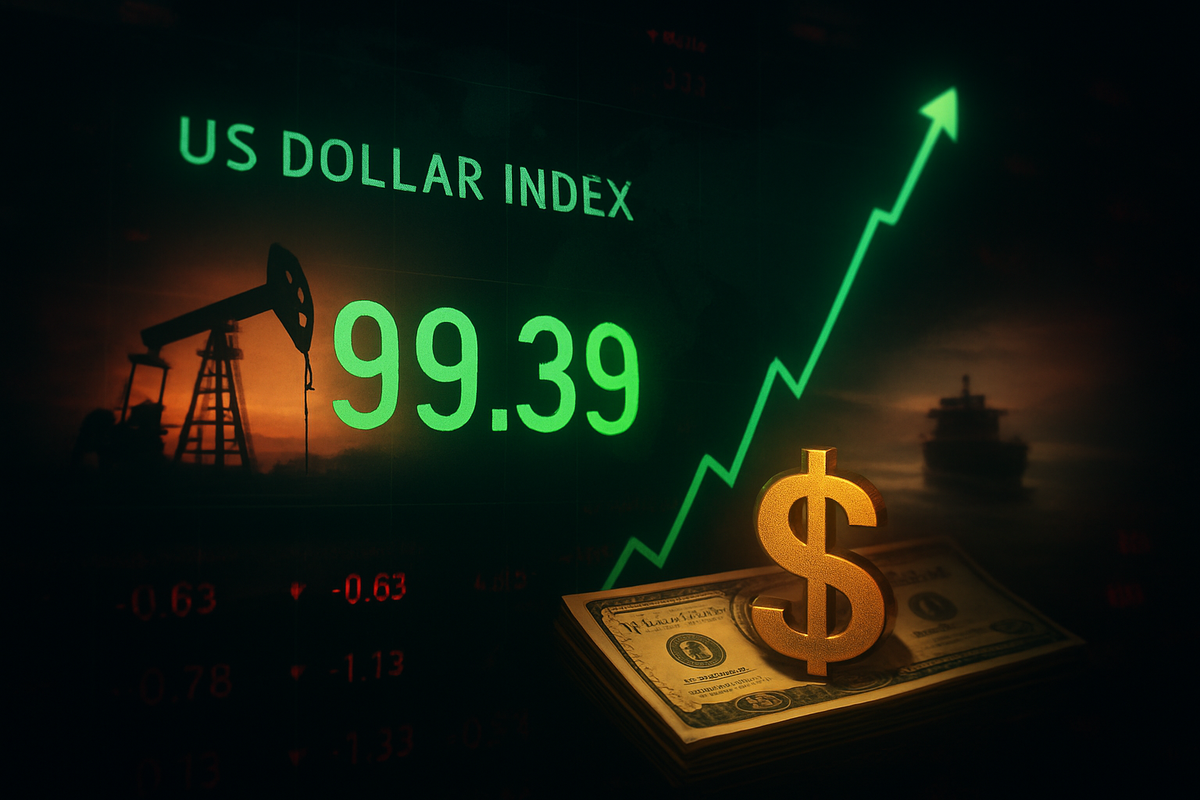
NEW YORK — The global financial landscape shifted violently on Tuesday as the US Dollar Index (DXY) surged 1%, closing at 99.39. This mark represents the greenback's most significant single-day gain since May 2025, as investors scrambled for safety in the face of a rapidly deteriorating geopolitical situation in the Middle East. The rally underscores the dollar's enduring status as the world’s premier "safe haven" asset, even as other major currencies falter under the weight of regional instability and potential energy supply shocks.
The sudden spike in the DXY reflects a profound "risk-off" sentiment that has gripped markets globally. As tensions between major powers in the Middle East escalated into open kinetic conflict over the weekend, capital fled traditional growth-oriented sectors and emerging market currencies, flowing instead into the deep liquidity and relative security of US Treasury bills and the dollar. With the Euro and the Japanese Yen both sliding more than 0.8% against the dollar in the same period, the greenback has reclaimed its throne as the singular hedge against global chaos.
The catalyst for this historic rally was a series of military escalations in the Persian Gulf that began in late February and culminated on March 2nd. Reports of targeted strikes against critical energy infrastructure and the subsequent closure of the Strait of Hormuz—a vital artery through which nearly 20% of the world's oil flows—sent shockwaves through commodity and currency desks. By the morning of March 3, 2026, the DXY had broken through its multi-month resistance of 98.00, sprinting toward 99.39 as the scale of the disruption became clear.
The timeline of this surge is rooted in a "perfect storm" of geopolitical and macroeconomic factors. Throughout early 2026, the dollar had remained relatively stable as the Federal Reserve signaled a potential pause in its interest rate cycle. However, the "Operation Epic Fury" military maneuvers and the resulting Iranian retaliatory drone strikes on logistics hubs in the UAE and Saudi Arabia forced an immediate re-evaluation. Traders who had spent much of 2025 betting on a weaker dollar were forced to cover short positions in a massive "short squeeze," further accelerating the index's climb.
Key stakeholders, including central bank governors from the G7, have spent the last 24 hours in emergency meetings. While the European Central Bank (ECB) and the Bank of Japan (BoJ) are grappling with the inflationary pressure of a devaluing currency and rising fuel costs, the US Federal Reserve now faces a complicated path. The dollar’s strength provides a buffer against imported inflation for American consumers but threatens to stifle the international earnings of the nation’s largest corporations.
The implications for public companies are stark and bifurcated. Multinational technology giants, which derive a significant portion of their revenue from overseas markets, are among the primary losers in this environment. Microsoft (NASDAQ: MSFT) and Apple (NASDAQ: AAPL) both saw their stock prices underperform the broader market today, as analysts began slashing Q1 and Q2 earnings estimates. For these companies, a stronger dollar means that sales in Euros, Pounds, and Yen translate into fewer dollars on the balance sheet, creating a significant "currency translation" headwind that could erase billions in projected profit.
Conversely, domestic-heavy retailers and the energy sector are emerging as the day's winners. Walmart (NYSE: WMT), which has recently reached a historic $1 trillion market cap, saw its shares rise as investors bet on its ability to leverage a strong dollar to lower the cost of imported goods while maintaining dominant domestic pricing power. Similarly, energy behemoths like Exxon Mobil (NYSE: XOM) and Chevron (NYSE: CVX) have benefited from a dual tailwind: the spike in crude oil prices—now nearing $80 per barrel—and the fact that their primary commodity is priced globally in US dollars.
Industrial leaders such as Caterpillar (NYSE: CAT) are also being watched closely. While a strong dollar traditionally makes US exports more expensive, the surge in global defense spending and the need for infrastructure resilience in the wake of the Middle East crisis have provided a "real economy" floor for the stock. However, for many smaller-cap exporters, the rapid appreciation of the dollar to 99.39 represents a looming crisis of competitiveness in a global market already reeling from high logistics costs.
This rally fits into a broader trend of "geopolitical premium" returning to the currency markets. Since the mid-2020s, talks of "de-dollarization" have been a constant theme in financial media. However, the events of March 3, 2026, have provided a stark reminder that in times of genuine existential crisis, the alternatives—such as the Euro or the Chinese Yuan—lack the trust and liquidity that the US financial system provides. The 1% jump is not just a statistical anomaly; it is a vote of confidence in US energy independence and military reach.
Historically, this movement is being compared to the volatility of May 2025, when the dollar saw a similar flight-to-safety peak. However, the current context is arguably more dangerous. In 2025, the rally was driven by interest rate differentials; today, it is driven by the threat of a global energy blockade. This shift suggests a more structural and potentially longer-lasting period of dollar dominance, which could lead to a "dollar scarcity" crisis in emerging markets that carry heavy dollar-denominated debt burdens.
There are also significant policy implications for the US government. A "too strong" dollar can eventually hurt US manufacturing and increase the trade deficit, potentially leading to political pressure for the Treasury Department to intervene. Furthermore, the decoupling of the dollar from the usual inverse relationship with gold—as both hit record highs this week—suggests that investors are no longer looking for a "better" currency, but rather a total hedge against the failure of the global rules-based order.
Looking ahead, the short-term trajectory of the DXY will depend almost entirely on the de-escalation or expansion of the conflict in the Middle East. If the Strait of Hormuz remains closed for more than a fortnight, many analysts believe the index could shatter the 100-point ceiling, a level not seen consistently since the post-pandemic inflation era. This would necessitate a strategic pivot for many global corporations, which may begin moving production closer to their primary customer bases to avoid the volatility of trans-continental shipping and currency swings.
In the long term, this event may accelerate the trend of "friend-shoring" and the regionalization of trade. Companies will likely increase their focus on hedging strategies, utilizing complex derivatives to lock in exchange rates. Market opportunities may emerge in "defensive tech" and cybersecurity firms that protect the digital infrastructure now under threat. However, the challenge remains for the Federal Reserve: can they maintain a high-interest-rate environment to fight domestic energy-led inflation without causing a "death spiral" for foreign currencies that rely on a stable dollar?
The potential scenarios range from a diplomatic resolution that sees the DXY revert to the 96-97 range, to a prolonged regional war that forces the dollar into a "super-cycle" of strength. In the latter case, the global economy could face a period of stagnant growth characterized by expensive energy and expensive capital—a challenging environment for even the most diversified portfolios.
The rally of the US Dollar Index to 99.39 marks a turning point for 2026, ending a period of relative currency stability and re-introducing extreme volatility into the global market. The key takeaway for investors is that the dollar remains the "safe haven of last resort," outperforming all other fiat currencies during periods of kinetic warfare and energy supply disruptions. While this strength benefits US consumers and domestic retailers like Walmart, it poses a direct threat to the earnings of tech leaders like Microsoft and Apple.
Moving forward, the market will likely remain in a "wait-and-see" posture, with high sensitivity to every headline from the Persian Gulf. The dollar’s role as an energy-backed currency has been reinforced, given the US's position as a net energy exporter compared to the energy-vulnerable Eurozone and Japan. Investors should watch for the 100.00 psychological level on the DXY; a sustained break above that mark could signal a regime shift in global finance.
In the coming months, the focus will shift from "when will the Fed cut rates?" to "how will the world survive a strong dollar?" As liquidity dries up in secondary markets and the cost of global trade rises, the resilience of the US economy will be put to its ultimate test. For now, the greenback is king, but the crown is heavy with the weight of global instability.
This content is intended for informational purposes only and is not financial advice.