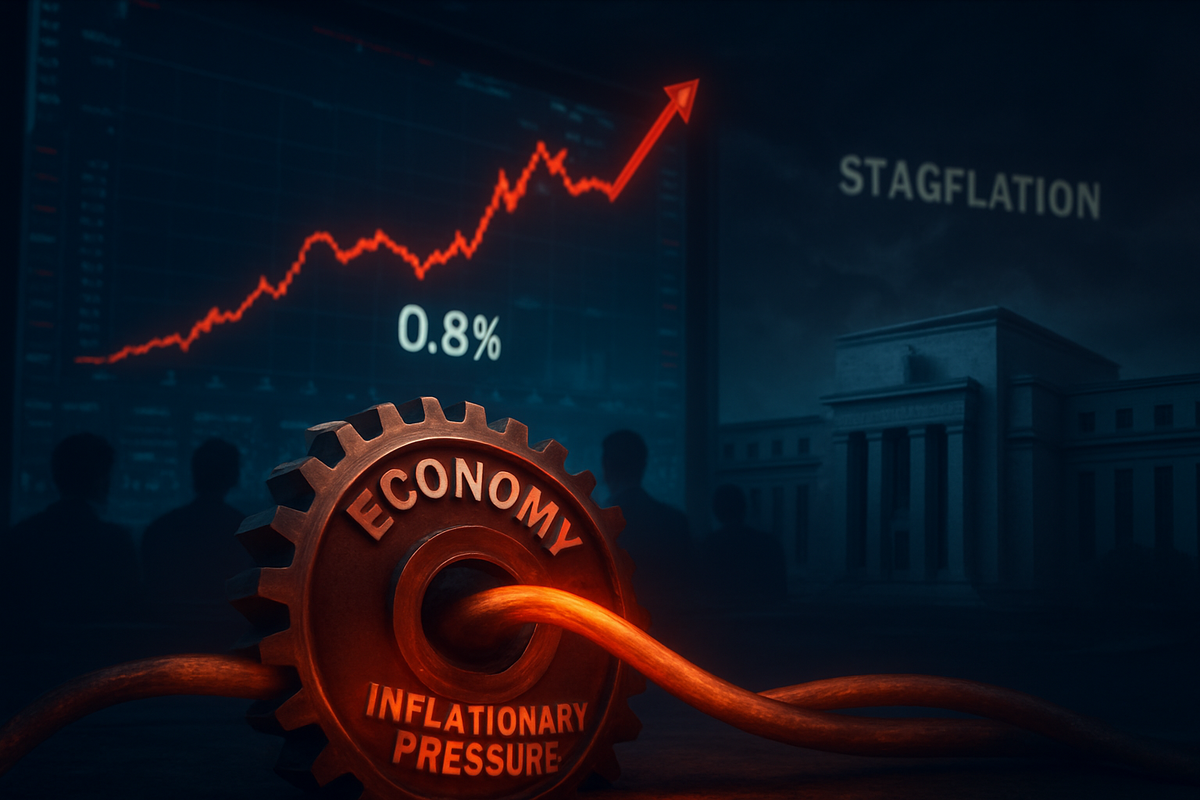
The financial markets were jolted on March 3, 2026, as the Bureau of Labor Statistics (BLS) released the January Producer Price Index (PPI) data, revealing a staggering 0.8% increase in wholesale prices. This figure far surpassed the consensus estimate of 0.3%, marking the sharpest monthly jump in nearly two years and sending a clear signal that the "last mile" of the inflation fight is proving to be a marathon of attrition. The data immediately sparked a sell-off across major indices, with the Dow Jones Industrial Average dropping over 700 points within hours of the opening bell.
This "hot" inflation print has effectively dismantled the prevailing "soft landing" narrative that many analysts had championed heading into 2026. With producer prices serving as a leading indicator for the Federal Reserve’s preferred Consumer Price Index (CPI) and Personal Consumption Expenditures (PCE) metrics, the spike suggests that inflationary pressures are becoming deeply entrenched in the supply chain. For the Federal Reserve, the data represents a significant setback, complicating any plans for a spring interest rate cut and reviving the dreaded specter of stagflation—a toxic mix of stagnant economic growth and stubbornly high prices.
A Perfect Storm: The January PPI Breakdown
The 0.8% spike in the January PPI was driven by a confluence of factors that took both the market and policymakers by surprise. While energy prices had shown signs of stabilizing in late 2025, the January report highlighted a 2.5% surge in wholesale trade margins and a significant uptick in service-sector costs. This suggests that businesses are no longer able—or willing—to absorb the cumulative cost increases of the past year, instead passing them directly to downstream partners and, ultimately, consumers.
The timeline leading up to today’s release has been fraught with tension. Throughout 2025, the U.S. economy grappled with a new regime of 10% to 15% effective tariffs on major trading partners, which added an estimated 0.4 percentage points to core inflation. As the 2026 calendar turned, investors were looking for signs that these "one-time shocks" were fading. Instead, the data confirms that the secondary effects of these trade policies are now manifesting as persistent wholesale price increases. Initial market reactions were swift: Treasury yields spiked as traders aggressively repriced the Federal Reserve’s terminal rate, with many now betting that interest rates will remain above 5% well into the autumn.
Winners and Losers: The Great Margin Divide
In this high-inflation environment, the market is quickly bifurcating into companies with immense pricing power and those trapped in the "mushy middle" of discretionary spending. Large-scale energy giants like ExxonMobil (NYSE: XOM) and Chevron (NYSE: CVX) emerged as the day’s few bright spots. As wholesale energy costs climb, these integrated firms are able to capture higher margins at the wellhead, with some analysts projecting oil could test $100 per barrel if the current trend holds. Similarly, JPMorgan Chase (NYSE: JPM) saw resilience in its share price, as the "higher-for-longer" interest rate environment allows the banking titan to leverage its massive balance sheet and maintain high net interest income.
Conversely, the retail sector is witnessing a brutal divergence. Walmart (NYSE: WMT) has managed to hold its ground by positioning itself as the "trade-down" destination for budget-conscious consumers, but its competitor Target (NYSE: TGT) has not been as fortunate. Target’s exposure to discretionary categories and higher sensitivity to logistics costs led to a 4.5% slide in its stock price following the PPI news, as investors fear a massive margin squeeze. In the tech sector, high-valuation growth engines like Apple (NASDAQ: AAPL) and NVIDIA (NASDAQ: NVDA) are facing a dual threat: rising Treasury yields are devaluing future cash flows, while the high cost of components is beginning to weigh on the sustainability of the AI infrastructure boom. Even "defensive" stalwarts like Procter & Gamble (NYSE: PG) are under fire, facing a projected $1 billion pre-tax hit from the cumulative effect of tariffs and wholesale price spikes.
The Stagflationary Shadow and Policy Paralysis
The broader significance of today’s PPI print cannot be overstated. It confirms that the U.S. has entered a "stagflation-lite" phase, where GDP growth has slowed to a tepid 1.6%–1.8% while inflation remains well above the Fed's 2% target. This puts the Federal Reserve in an almost impossible position. Traditionally, a slowing economy would prompt the central bank to cut rates to stimulate growth. However, doing so now would risk letting inflation spiral out of control, potentially leading to a repeat of the 1970s-style price-wage spiral.
The ripple effects are extending beyond U.S. borders. With the dollar strengthening on the back of higher interest rate expectations, emerging markets are facing increased debt-servicing costs and capital flight. Domestically, the industrial sector is feeling the heat. While Caterpillar (NYSE: CAT) has benefited from demand for AI data center infrastructure, its core construction and mining customers are beginning to defer large-scale equipment orders due to prohibitive financing costs. The historical precedent of the "1974 Shock" is being frequently cited by institutional desks, as the market realizes that high interest rates are no longer just a temporary tool, but a permanent fixture of the 2026 economic landscape.
The Road Ahead: September or Later?
Looking forward, the immediate focus shifts to the upcoming Federal Open Market Committee (FOMC) meeting. Before today, a May rate cut was the base case for many; now, that probability has evaporated. Market consensus has shifted toward September 2026 as the earliest possible window for easing, provided that the labor market begins to show more significant signs of softening. Companies will likely pivot toward "radical efficiency," with a renewed focus on AI-driven cost savings and supply chain near-shoring to mitigate the impact of tariffs and rising wholesale prices.
The short-term reality is one of increased volatility. Investors should prepare for a period of "valuation resets," particularly in sectors that have benefited from the low-rate environment of the previous decade. Opportunities may emerge in hard assets and commodities—gold and industrial metals like copper are already seeing a flight to safety—but the broader equity market faces a challenging climb. The "pivot" that the market has been longing for since 2024 has once again been pushed over the horizon, replaced by a grueling reality of high costs and restricted liquidity.
A New Era of Economic Friction
The January PPI report serves as a stark reminder that the global economy is in a state of fundamental transition. The era of cheap money and frictionless global trade has been replaced by a period of "economic friction," where geopolitical tensions, trade barriers, and labor shortages have created a floor for inflation that the Federal Reserve is struggling to break. The 0.8% spike today is not just a data point; it is a manifestation of this new regime.
For investors, the key takeaway is that "the trend is no longer your friend" in the traditional sense. Diversification into value, energy, and large-cap financials with fortress balance sheets appears to be the only viable strategy in a stagflationary environment. As we move through the spring of 2026, the market will be hyper-fixated on any signs of a crack in the labor market, as that may be the only thing that forces the Fed’s hand. Until then, the "higher-for-longer" mantra remains the law of the land, and the "hot" January PPI is its latest supporting evidence.
This content is intended for informational purposes only and is not financial advice