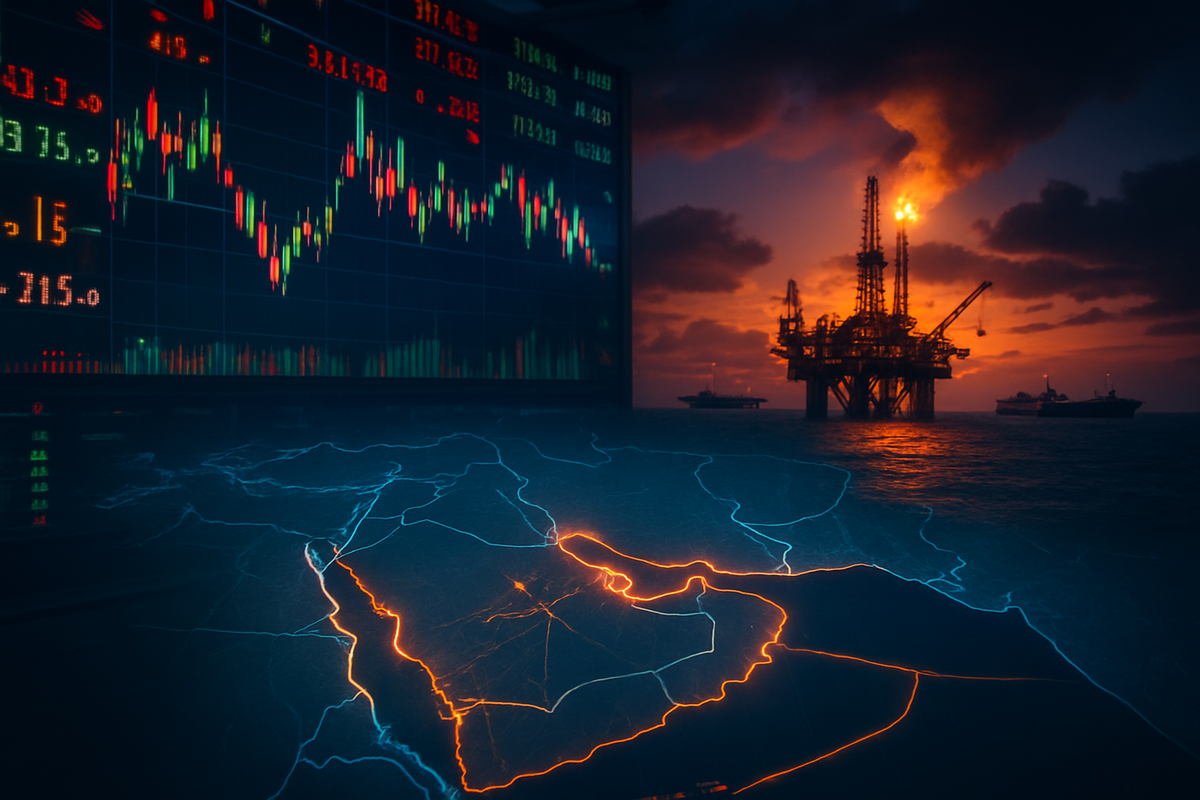
The global energy landscape was thrust into chaos this week as an escalating military confrontation between the United States and Iran sent oil and natural gas prices to their highest levels in over a year. As of March 6, 2026, Brent crude futures have breached the $85 per barrel mark, while West Texas Intermediate (WTI) is trading near $81, representing a sharp 20% surge since the beginning of the year. The spike comes on the heels of "Operation Epic Fury," a significant U.S.-led military campaign that has effectively crippled Iranian naval capabilities but prompted a retaliatory blockade of the world’s most critical maritime oil artery.
The immediate implications for the global economy are severe. Beyond the pump, the "geopolitical risk premium" has returned to the forefront of financial markets, disrupting a year of relative stability. With the Strait of Hormuz currently designated a "high-risk zone" by international insurers, the flow of roughly 20 million barrels of oil per day—nearly a fifth of global consumption—has slowed to a trickle. For consumers and industries already grappling with the tail-end of inflationary pressures, this latest supply shock threatens to derail the fragile economic recovery of early 2026.
Operation Epic Fury and the Path to Escalation
The current crisis is the culmination of a volatile 18-month period that saw the "shadow war" between Washington and Tehran erupt into direct combat. Following the collapse of nuclear negotiations in mid-2025 and a series of drone strikes on U.S. regional assets, the situation reached a breaking point on February 28, 2026. Under the directive of the U.S. administration, "Operation Epic Fury" targeted Iranian missile production facilities, air defense systems, and command centers. The operation, supported by key regional allies, aimed to neutralize Tehran’s ability to project power across the Persian Gulf.
Iran’s response, dubbed "Operation True Promise IV," was swift and disruptive. Utilizing swarms of "kamikaze" drones and anti-ship missiles, the Islamic Revolutionary Guard Corps (IRGC) targeted commercial shipping and energy infrastructure in neighboring states. Significant damage was reported at major refining hubs and desalination plants in the United Arab Emirates and Saudi Arabia. Most critically, the IRGC declared the Strait of Hormuz "closed to all hostile traffic," leading to a de facto blockade as over 150 tankers dropped anchor or diverted to safer waters, awaiting military escort or a de-escalation that has yet to materialize.
The market reaction was instantaneous. On March 2, 2026, the first full trading day following the strikes, energy markets saw their largest single-day gain since 2022. Volatility indexes (VIX) spiked as investors scrambled to price in the possibility of a prolonged conflict. The International Energy Agency (IEA) has already signaled the potential release of strategic petroleum reserves (SPR), though analysts warn that such measures may only provide temporary relief if the physical flow of oil through the Gulf remains obstructed for more than a month.
Winners and Losers in a Wartime Economy
The sudden shift in the energy paradigm has created a stark divide in the corporate world. Integrated oil giants with diversified global portfolios have seen their valuations soar. Chevron (NYSE: CVX) reached an all-time high of $189.90 earlier this week, as investors bet on its massive upstream production in the Permian Basin to offset any Middle Eastern losses. Similarly, ExxonMobil (NYSE: XOM) has outperformed the broader S&P 500 by over 15% since the conflict began, benefiting from its "advantaged assets" in Guyana and North America, which remain shielded from the immediate theater of war.
In the defense sector, the escalation has triggered a "flight-to-safety" trade. Lockheed Martin (NYSE: LMT) and RTX Corporation (NYSE: RTX) have seen their stocks surge to record levels, with LMT hitting $702 per share as of yesterday. The heavy reliance on F-35 fighter jets and Tomahawk cruise missiles during the initial strikes has not only validated the strategic importance of these platforms but also signaled a massive restocking phase for the U.S. and its allies. For these firms, the 2026 conflict represents a significant expansion of their multi-billion dollar backlogs.
Conversely, the airline and logistics sectors are bearing the brunt of the crisis. United Airlines (NASDAQ: UAL) and Delta Air Lines (NYSE: DAL) have seen their shares tumble by double digits this week. The "no-hedge" policy adopted by many major carriers in 2025 has left them uniquely exposed to skyrocketing jet fuel prices, which hit a four-year high of $4.12 per gallon at the U.S. Gulf Coast. United, in particular, has been forced to suspend lucrative routes to the Middle East and Southeast Asia, turning its international expansion strategy into a liability overnight as fuel costs threaten to wipe out projected 2026 profits.
A New Era of Geopolitical Energy Risk
The events of March 2026 mark a decisive shift in how global energy security is perceived. For much of 2024 and 2025, the market had grown somewhat complacent, focusing on the transition to renewables and a projected surplus of crude. The current conflict has shattered that narrative, proving that traditional "chokepoint" geography remains the ultimate arbiter of global economic health. This crisis fits into a broader trend of "weaponized energy," where geopolitical objectives take precedence over market fundamentals and supply chain efficiency.
The ripple effects are being felt far beyond the United States and Iran. China, India, and Japan—who collectively import over 70% of their crude through the Strait of Hormuz—are facing a looming energy shortage. This has forced these nations to activate emergency protocols and seek alternative supplies from Russia and West Africa, potentially reshaping global alliances. Furthermore, the disruption to Liquefied Natural Gas (LNG) shipments, particularly from QatarEnergy, has sent European gas prices up by 40%, raising fears of a renewed energy crisis just as the continent was emerging from the shadows of the Ukraine-Russia fallout.
Historically, this event draws parallels to the 1970s oil shocks and the 1980s "Tanker War." However, the 2026 iteration is complicated by modern technology. The use of low-cost, high-impact drone swarms has made defending the Strait of Hormuz significantly more difficult and expensive than in decades past. Regulatory bodies and maritime authorities are now being forced to rethink shipping lanes and insurance frameworks for an era where non-state actors and rogue regimes can hold the global economy hostage with relatively inexpensive weaponry.
Navigating the Volatile Road Ahead
In the short term, the market's direction hinges entirely on the success of international efforts to reopen the Strait of Hormuz. Strategic pivots are already underway; shipping companies are exploring "land bridges" across the Arabian Peninsula, and oil majors are exploring projects in "safe" jurisdictions like Brazil and the North Sea. However, these adaptations take time and capital that the current market volatility does not afford. A sustained blockade lasting more than 90 days could push oil prices into the triple digits, a scenario that Goldman Sachs warns could trigger a global recession by the third quarter of 2026.
Looking longer-term, the conflict is likely to accelerate the decoupling of Western energy needs from the Middle East. While the "Green Transition" was already a policy priority, the 2026 energy shock provides a powerful national security argument for domestic renewable energy and nuclear power. Investors should expect a surge in capital expenditure toward energy independence initiatives, as governments seek to insulate their economies from future Persian Gulf flare-ups. The "strategic pivot" for many energy companies will likely involve a more aggressive move into hydrogen and carbon capture to mitigate the risks associated with global oil transit.
Market Outlook: What to Watch
The key takeaways from this week’s turmoil are clear: geopolitical risk is no longer a peripheral concern but a primary driver of equity and commodity valuations. The energy sector, led by stalwarts like Chevron and ExxonMobil, remains a necessary hedge in any diversified portfolio during times of war. However, the broader market's health is now tied to a delicate balance of military success and diplomatic restraint. If the U.S. and its allies can secure the Strait of Hormuz without a full-scale regional war, the current "risk premium" may deflate by early summer.
Moving forward, investors should closely monitor the "Additional War Risk Premiums" set by Lloyd’s of London, as these will serve as a leading indicator of maritime security. Additionally, the Q1 2026 earnings calls for major airlines will reveal the true extent of the damage caused by the fuel price spike. While the situation remains fluid, the lasting impact of this March 2026 conflict will be a permanent repricing of energy risk and a renewed focus on supply chain resilience. For now, the world watches the Gulf, where the next few weeks will determine the economic trajectory for the remainder of the decade.
This content is intended for informational purposes only and is not financial advice.