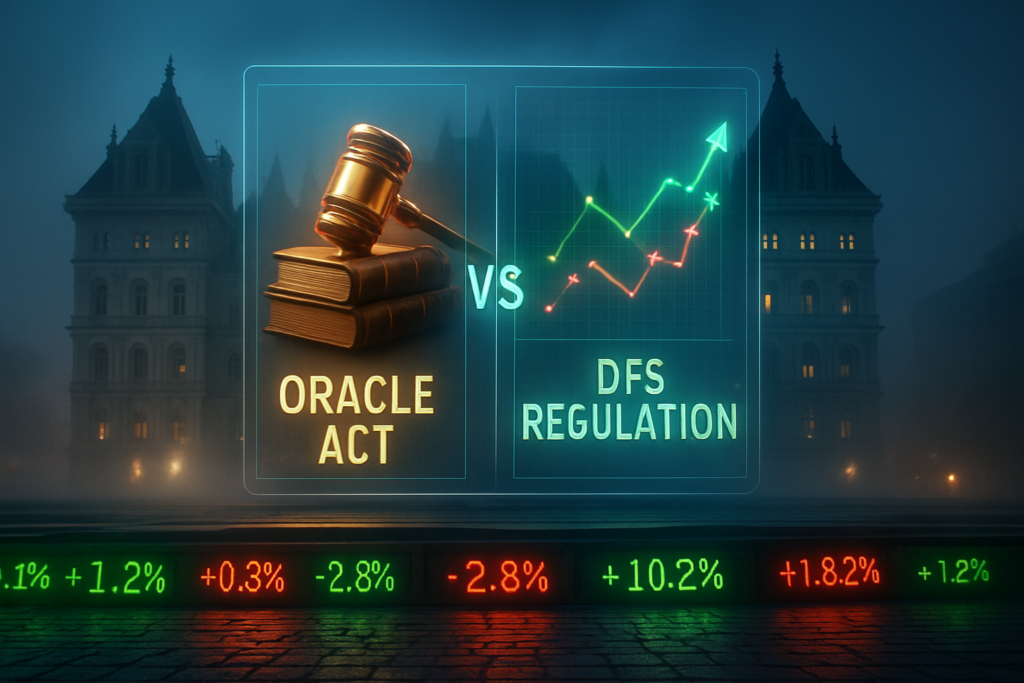
As the 2026 legislative session kicks off in Albany, New York has become the epicenter of a national struggle over the legality of "information finance." At the heart of the storm are two competing visions for the state’s regulatory future: a "scorched-earth" prohibition known as the ORACLE Act (Assembly Bill A9251) and a rival regulatory framework (Senate Bill S8889) designed to bring prediction markets under the oversight of the Department of Financial Services.
Traders on platforms like Kalshi and ForecastEx, operated by Interactive Brokers Group, Inc. (NASDAQ: IBKR), are currently pricing the probability of a comprehensive ban on political event contracts in New York at roughly 38%. This represents a significant decline from the 65% odds seen in late 2025, suggesting that the industry’s push for a regulated middle ground is gaining momentum despite aggressive rhetoric from anti-gambling advocates. The market is generating intense interest because New York represents the largest financial hub in the world; a total ban here could isolate the U.S. financial capital from the fastest-growing sector of the fintech landscape.
The Market: What's Being Predicted
The primary market being watched by analysts is the "Will New York pass a bill to ban political event contracts in 2026?" contract on Kalshi. Trading volume has surged as the legislative session began on January 7, with liquidity reaching levels rarely seen for state-level political outcomes. While the headline probability sits at 38%, more granular "shadow markets" and community-based platforms like Manifold present a more nuanced picture. Traders there see a roughly 60% chance that the ORACLE Act passes the Assembly, but only a 22% chance it survives the Senate, where more moderate voices prevail.
The resolution criteria for these markets are tied to the signature of Governor Kathy Hochul or the expiration of the legislative session in June 2026. If a bill is signed into law that explicitly prohibits residents from participating in event contracts related to elections or government actions, the "Yes" side pays out. Conversely, if the session ends without such a ban, or if a regulatory bill like Senator Jeremy Cooney’s S8889 is passed instead, the "No" side wins.
Why Traders Are Betting
The sudden shift in odds toward a "No" outcome—meaning no ban—is driven by several high-profile developments in early January. Most notably, the "normalization" of prediction markets took a massive leap forward on January 8, 2026, when Madison Square Garden Sports Corp (NYSE: MSGS) announced a landmark partnership naming Polymarket the "Official Prediction Market Partner" of the New York Rangers. This deal has made it politically difficult for lawmakers to frame the industry as a "shadow" operation when it is prominently displayed on the scoreboard of one of the state's most iconic sports teams.
However, the "Yes" camp remains vocal, fueled by the controversial "Maduro Trade." In early January, a trader reportedly turned a $32,000 position into $400,000 just hours before a U.S.-led raid in Venezuela, sparking fears of systemic insider trading. Assemblymember Clyde Vanel, the sponsor of the ORACLE Act, has used this incident to argue that these platforms are "skipping the hard part: licensure and oversight." His bill includes a "nuclear option" fine of $1 million per day for platforms that defy state injunctions, a provision that traders are closely monitoring as a potential deal-breaker for the industry.
Broader Context and Implications
The New York battle is a microcosm of a larger federal-state conflict. While Albany debates a ban, U.S. Rep. Ritchie Torres (D-NY) has introduced the federal Public Integrity in Financial Prediction Markets Act, which aims to regulate the participants (government insiders) rather than banning the platforms themselves. Many traders on Manifold are betting on "Federal Preemption," with an 81% probability that any state-level ban in New York will eventually be overridden by federal law or a Supreme Court challenge.
If the ORACLE Act passes, it would set a precedent that could lead other states to follow suit, potentially fragmenting the U.S. market. Conversely, if Senator Cooney’s S8889 succeeds, it would place prediction markets under the Department of Financial Services (DFS), the same body that regulates Wall Street banks. This would effectively rebrand prediction markets from "gambling" to "risk management," a shift that competitors like DraftKings Inc. (NASDAQ: DKNG) and Flutter Entertainment plc (NYSE: FLUT) are watching closely as they weigh their own entries into the event-contract space.
What to Watch Next
The most immediate catalyst for the market is a looming decision from the Southern District of New York (SDNY). A ruling in the ongoing lawsuit between Kalshi and the New York State Gaming Commission is expected by late February 2026. If the court rules that the Gaming Commission lacks the authority to block these markets under current law, the odds of the ORACLE Act passing the Assembly will likely spike as prohibitionists scramble to close the legal loophole.
Investors should also keep an eye on the Senate Banks Committee, where Senator Cooney’s S8889 currently resides. If the bill gains co-sponsors from key Democratic leadership, it will signal that the "regulatory path" is the preferred route for the Governor’s office. Any public comments from Governor Hochul regarding the "Maduro Trade" or the MSG partnership could also lead to double-digit swings in market probability overnight.
Bottom Line
The legislative battle in Albany is more than a local dispute; it is a referendum on whether the U.S. will lead or lag in the "Information Finance" revolution. The ORACLE Act represents a "scorched-earth" approach that views prediction markets as a threat to public order, while SB S8889 views them as a technological evolution of the financial markets that New York has pioneered for centuries.
Current market data suggests that while the ban has teeth in the Assembly, the industry’s push for legitimacy through high-profile partnerships and regulatory compliance is winning over the more cautious Senate. For now, the "smart money" is betting on a compromise that includes strict oversight and anti-insider trading rules, rather than a total blackout. As we move toward the June deadline, the volatility in these markets will serve as a real-time pulse of the political climate in one of the world's most influential legislatures.
This article is for informational purposes only and does not constitute financial or betting advice. Prediction market participation may be subject to legal restrictions in your jurisdiction.
PredictStreet focuses on covering the latest developments in prediction markets.
Visit the PredictStreet website at https://www.predictstreet.ai/.