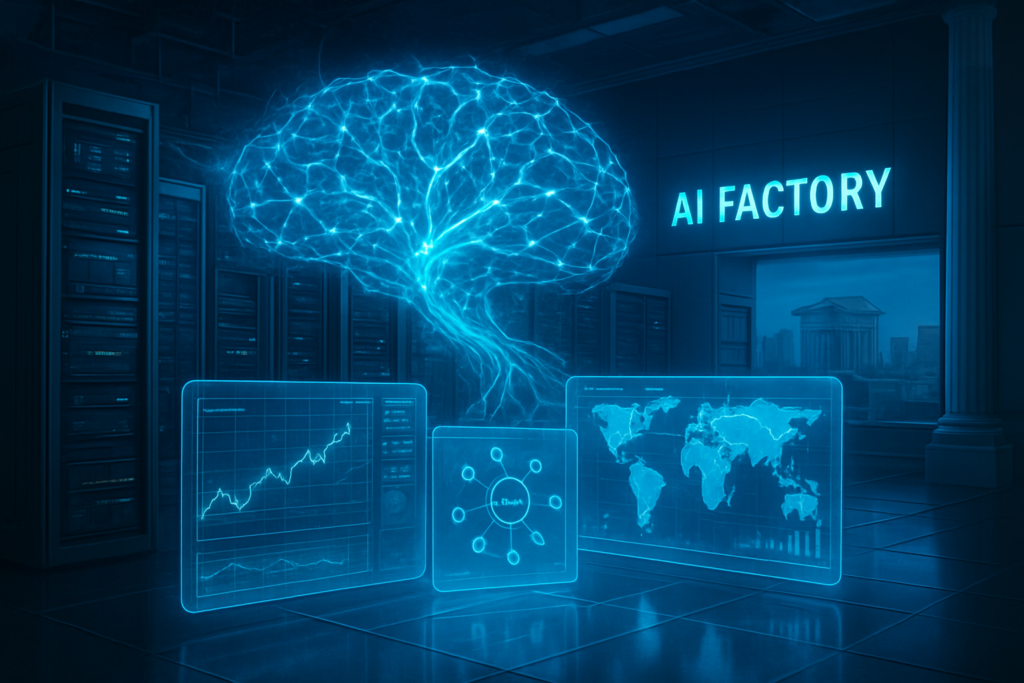
In a landmark move that signals the end of the artificial intelligence "experimentation era," Eurobank (ATH: EUROB), Microsoft (NASDAQ: MSFT), and EY have announced a strategic partnership to launch a first-of-its-kind "AI Factory." This initiative is designed to move beyond simple generative AI chatbots and instead embed "agentic AI"—autonomous systems capable of reasoning and executing complex workflows—directly into the core banking mainframes that power the financial infrastructure of Southern Europe.
Announced in late 2025, this collaboration represents a fundamental shift in how legacy financial institutions approach digital transformation. By integrating high-performance AI agents into the very heart of the bank’s transactional layers, the partners aim to achieve a new standard of operational efficiency, moving from basic automation to what they describe as a "Return on Intelligence." The project is poised to transform the Mediterranean region into a global hub for industrial-scale AI deployment.
Technical Foundations: From LLMs to Autonomous Mainframe Agents
The "AI Factory" distinguishes itself from previous AI implementations by focusing on the transition from Large Language Models (LLMs) to Agentic AI. While traditional generative AI focuses on processing and generating text, the agents deployed within Eurobank’s ecosystem are designed to reason, plan, and execute end-to-end financial workflows autonomously. These agents do not operate in a vacuum; they are integrated directly into the bank’s core mainframes, allowing them to interact with legacy transaction systems and modern cloud applications simultaneously.
Technically, the architecture leverages the EY.ai Agentic Platform, which utilizes NVIDIA (NASDAQ: NVDA) NIM microservices and AI-Q Blueprints for rapid deployment. This is supported by the massive computational power of NVIDIA’s Blackwell and Hopper GPU architectures, which handle the trillion-parameter model inference required for real-time decisioning. Furthermore, the integration utilizes advanced mainframe accelerators, such as the IBM (NYSE: IBM) Telum II, to enable sub-millisecond fraud detection and risk assessment on live transactional data—a feat previously impossible with disconnected cloud-based AI silos.
This "human-in-the-loop" framework is a critical technical specification, ensuring compliance with the EU AI Act. While the AI agents can handle approximately 90% of a task—such as complex lending workflows or risk mitigation—the system is hard-coded to hand off high-impact decisions to human officers. This ensures that while the speed of the mainframe is utilized, ethical and regulatory oversight remains paramount. Industry experts have noted that this "design-by-governance" approach sets a new technical benchmark for regulated industries.
Market Impact: A New Competitive Moat in Southern Europe
The launch of the AI Factory has immediate and profound implications for the competitive landscape of European banking. By moving AI from the periphery to the core, Eurobank is positioning itself miles ahead of regional competitors who are still struggling with siloed data and experimental pilots. This move effectively creates a "competitive gap" in operational costs and service delivery, as the bank can now deploy "autonomous digital workers" to handle labor-intensive processes in wealth management and corporate lending at a fraction of the traditional cost.
For the technology providers involved, the partnership is a major strategic win. Microsoft further solidifies its Azure platform as the preferred cloud for high-stakes, regulated financial data, while NVIDIA demonstrates that its Blackwell architecture is essential not just for tech startups, but for the backbone of global finance. EY, acting through its AI & Data Centre of Excellence in Greece, has successfully productized its "Agentic Platform," proving that consulting firms can move from advisory roles to becoming essential technology orchestrators.
Furthermore, the involvement of Fairfax Digital Services as the "architect" of the factory highlights a new trend of global investment firms taking an active role in the technological maturation of their portfolio companies. This partnership is likely to disrupt existing fintech services that previously relied on being "more agile" than traditional banks. If a legacy bank can successfully embed agentic AI into its mainframe, the agility advantage of smaller startups begins to evaporate, forcing a consolidation in the Mediterranean fintech market.
Wider Significance: The "Return on Intelligence" and the EU AI Act
Beyond the immediate technical and market shifts, the Eurobank AI Factory serves as a blueprint for the broader AI landscape. It marks a transition in the industry’s North Star from "cost-cutting" to "Return on Intelligence." This philosophy suggests that the value of AI lies not just in doing things cheaper, but in the ability to pivot faster, personalize services at a hyper-scale, and manage risks that are too complex for traditional algorithmic systems. It is a milestone that mirrors the transition from the early internet to the era of high-frequency trading.
The project also serves as a high-profile test case for the EU AI Act. By implementing autonomous agents in a highly regulated sector like banking, the partners are demonstrating that "high-risk" AI can be deployed safely and transparently. This is a significant moment for Europe, which has often been criticized for over-regulation. The success of this factory suggests that the Mediterranean region—specifically Greece and Cyprus—is no longer just a tourism hub but a burgeoning center for digital innovation and AI governance.
Comparatively, this breakthrough is being viewed with the same weight as the first enterprise migrations to the cloud a decade ago. It proves that the "mainframe," often dismissed as a relic of the past, is actually the most potent environment for AI when paired with modern accelerated computing. This "hybrid" approach—merging 1970s-era reliability with 2025-era intelligence—is likely to be the dominant trend for the remainder of the decade in the global financial sector.
Future Horizons: Scaling the Autonomous Workforce
Looking ahead, the roadmap for the AI Factory includes a rapid expansion across Eurobank’s international footprint, including Luxembourg, Bulgaria, and the United Kingdom. In the near term, we can expect the rollout of specialized agents for real-time liquidity management and cross-border risk assessment. These "digital workers" will eventually be able to communicate with each other across jurisdictions, optimizing the bank's capital allocation in ways that human committees currently take weeks to deliberate.
On the horizon, the potential applications extend into hyper-personalized retail banking. We may soon see AI agents that act as proactive financial advisors for every customer, capable of negotiating better rates or managing personal debt autonomously within set parameters. However, significant challenges remain, particularly regarding the long-term stability of agent-to-agent interactions and the continuous monitoring of "model drift" in autonomous decision-making.
Experts predict that the success of this initiative will trigger a "domino effect" across the Eurozone. As Eurobank realizes the efficiency gains from its AI Factory, other Tier-1 banks will be forced to move their AI initiatives into their core mainframes or risk becoming obsolete. The next 18 to 24 months will likely see a surge in demand for "Agentic Orchestrators"—professionals who can manage and audit fleets of AI agents rather than just managing human teams.
Conclusion: A Turning Point for Global Finance
The partnership between Eurobank, Microsoft, and EY is more than just a corporate announcement; it is a definitive marker in the history of artificial intelligence. By successfully embedding agentic AI into the core banking mainframe, these organizations have provided a tangible answer to the question of how AI will actually change the world of business. The move from "chatting" with AI to "working" with AI agents is now a reality for one of Southern Europe’s largest lenders.
As we look toward 2026, the key takeaway is that the "AI Factory" model is the new standard for enterprise-grade deployment. It combines the raw power of NVIDIA’s hardware, the scale of Microsoft’s cloud, and the domain expertise of EY to breathe new life into the traditional banking model. This development signifies that the most impactful AI breakthroughs are no longer happening just in research labs, but in the data centers of the world's oldest industries.
In the coming weeks, the industry will be watching closely for the first performance metrics from the Cyprus and Greece deployments. If the promised "Return on Intelligence" manifests as expected, the Eurobank AI Factory will be remembered as the moment the financial industry finally stopped talking about the future of AI and started living in it.
This content is intended for informational purposes only and represents analysis of current AI developments.
TokenRing AI delivers enterprise-grade solutions for multi-agent AI workflow orchestration, AI-powered development tools, and seamless remote collaboration platforms.
For more information, visit https://www.tokenring.ai/.