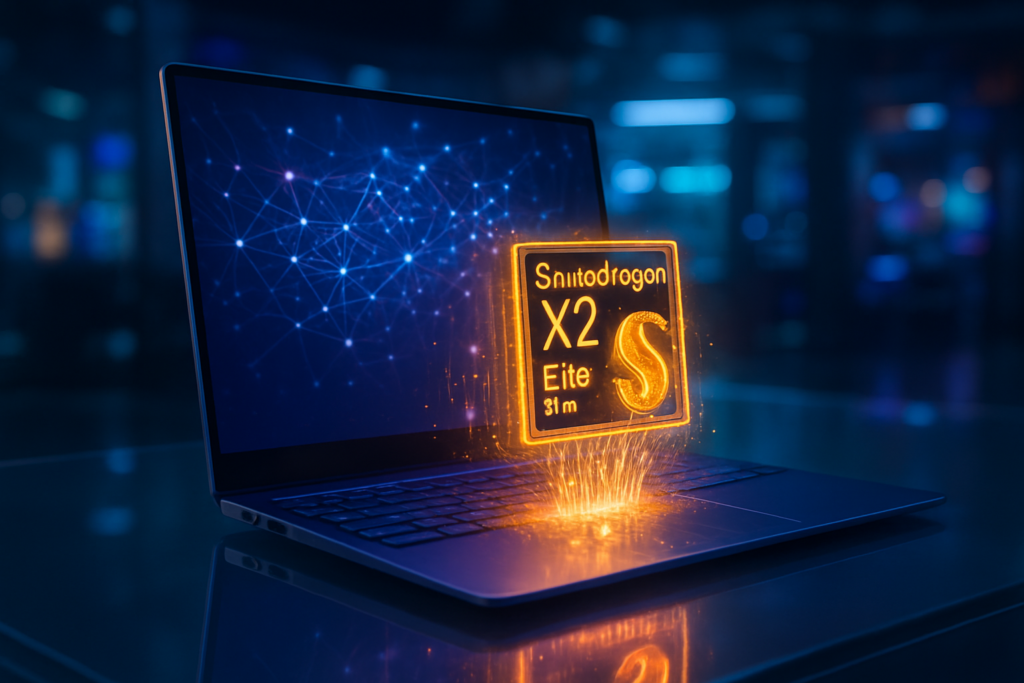
LAS VEGAS — At the opening of CES 2026, Qualcomm (NASDAQ: QCOM) has officially set a new benchmark for the personal computing industry with the debut of the Snapdragon X2 Elite. This second-generation silicon represents a pivotal moment in the "AI PC" era, moving beyond experimental features toward a future where "Agentic AI"—artificial intelligence capable of performing complex, multi-step tasks locally—is the standard. By leveraging a cutting-edge 3nm process and a record-breaking Neural Processing Unit (NPU), Qualcomm is positioning itself not just as a mobile chipmaker, but as the dominant architect of the next generation of Windows laptops.
The announcement comes at a critical juncture for the industry, as consumers and enterprises alike demand more than just incremental speed increases. The Snapdragon X2 Elite delivers a staggering 80 to 85 TOPS (Trillions of Operations Per Second) of AI performance, effectively doubling the capabilities of many current-generation rivals. When paired with its new shared memory architecture and significant gains in single-core performance, the X2 Elite signals that the transition to ARM-based computing on Windows is no longer a compromise, but a competitive necessity for high-performance productivity.
Technical Breakthroughs: The 3nm Powerhouse
The technical specifications of the Snapdragon X2 Elite highlight a massive leap in engineering, centered on TSMC’s 3nm manufacturing process. This transition from the previous 4nm node has allowed Qualcomm to pack over 31 billion transistors into the silicon, drastically improving power density and thermal efficiency. The centerpiece of the chip is the third-generation Oryon CPU, which boasts a 39% increase in single-core performance over the original Snapdragon X Elite. For multi-threaded workloads, the top-tier 18-core variant—featuring 12 "Prime" cores and 6 "Performance" cores—claims to be up to 75% faster than its predecessor at the same power envelope.
Beyond raw speed, the X2 Elite introduces a sophisticated shared memory architecture that mimics the unified memory structures seen in Apple’s M-series chips. By integrating LPDDR5x-9523 memory directly onto the package with a 192-bit bus, the chip achieves a massive 228 GB/s of bandwidth. This bandwidth is shared across the CPU, Adreno GPU, and Hexagon NPU, allowing for near-instantaneous data transfer between processing units. This is particularly vital for running Large Language Models (LLMs) locally, where the latency of moving data from traditional RAM to a dedicated NPU often creates a bottleneck.
Initial reactions from the industry have been overwhelmingly positive, particularly regarding the NPU’s 80-85 TOPS output. While the standard X2 Elite delivers 80 TOPS, a specialized collaboration with HP (NYSE: HPQ) has resulted in an exclusive "Extreme" variant for the new HP OmniBook Ultra 14 that reaches 85 TOPS. Industry experts note that this level of performance allows for "always-on" AI features—such as real-time translation, advanced video noise cancellation, and proactive digital assistants—to run in the background with negligible impact on battery life.
Market Implications and the Competitive Landscape
The arrival of the X2 Elite intensifies the high-stakes rivalry between Qualcomm and Intel (NASDAQ: INTC). At CES 2026, Intel showcased its Panther Lake (Core Ultra Series 3) architecture, which also emphasizes AI capabilities. However, Qualcomm’s early benchmarks suggest a significant lead in "performance-per-watt." The X2 Elite reportedly matches the peak performance of Intel’s flagship Panther Lake chips while consuming 40-50% less power, a metric that is crucial for the ultra-portable laptop market. This efficiency advantage is expected to put pressure on Intel and AMD (NASDAQ: AMD) to accelerate their own transitions to more advanced nodes and specialized AI silicon.
For PC manufacturers, the Snapdragon X2 Elite offers a path to challenge the dominance of the MacBook Air. The flagship HP OmniBook Ultra 14, unveiled alongside the chip, serves as the premier showcase for this new silicon. With a 14-inch 3K OLED display and a chassis thinner than a 13-inch MacBook Air, the OmniBook Ultra 14 is rated for up to 29 hours of video playback. This level of endurance, combined with the 85 TOPS NPU, provides a compelling reason for enterprise customers to migrate toward ARM-based Windows devices, potentially disrupting the long-standing "Wintel" (Windows and Intel) duopoly.
Furthermore, Microsoft (NASDAQ: MSFT) has worked closely with Qualcomm to ensure that Windows 11 is fully optimized for the X2 Elite’s unique architecture. The "Prism" emulation layer has been further refined, allowing legacy x86 applications to run with near-native performance. This removes one of the final hurdles for ARM adoption in the corporate world, where legacy software compatibility has historically been a dealbreaker. As more developers release native ARM versions of their software, the strategic advantage of Qualcomm's integrated AI hardware will only grow.
Broader Significance: The Shift to Localized AI
The debut of the X2 Elite is a milestone in the broader shift from cloud-based AI to edge computing. Until now, most sophisticated AI tasks—like generating images or summarizing long documents—required a connection to powerful remote servers. This "cloud-first" model raises concerns about data privacy, latency, and subscription costs. By providing 85 TOPS of local compute, Qualcomm is enabling a "privacy-first" AI model where sensitive data never leaves the user's device. This fits into the wider industry trend of decentralizing AI, making it more accessible and secure for individual users.
However, the rapid escalation of the "TOPS war" also raises questions about software readiness. While the hardware is now capable of running complex models locally, the ecosystem of AI-powered applications is still catching up. Critics argue that until there is a "killer app" that necessitates 80+ TOPS, the hardware may be ahead of its time. Nevertheless, the history of computing suggests that once the hardware floor is raised, software developers quickly find ways to utilize the extra headroom. The X2 Elite is effectively "future-proofing" the next two to three years of laptop hardware.
Comparatively, this breakthrough mirrors the transition from single-core to multi-core processing in the mid-2000s. Just as multi-core CPUs enabled a new era of multitasking and media creation, the integration of high-performance NPUs is expected to enable a new era of "Agentic" computing. This is a fundamental shift in how humans interact with computers—moving from a command-based interface (where the user tells the computer what to do) to an intent-based interface (where the AI understands the user's goal and executes the necessary steps).
Future Horizons: What Comes Next?
Looking ahead, the success of the Snapdragon X2 Elite will likely trigger a wave of innovation in the "AI PC" space. In the near term, we can expect to see more specialized AI models, such as "Llama 4-mini" or "Gemini 2.0-Nano," being optimized specifically for the Hexagon NPU. These models will likely focus on hyper-local tasks like real-time coding assistance, automated spreadsheet management, and sophisticated local search that can index every file and conversation on a device without compromising security.
Long-term, the competition is expected to push NPU performance toward the 100+ TOPS mark by 2027. This will likely involve even more advanced packaging techniques, such as 3D chip stacking and the integration of even faster memory standards. The challenge for Qualcomm and its partners will be to maintain this momentum while ensuring that the cost of these premium devices remains accessible to the average consumer. Experts predict that as the technology matures, we will see these high-performance NPUs trickle down into mid-range and budget laptops, democratizing AI access.
There are also challenges to address regarding the thermal management of such powerful NPUs in thin-and-light designs. While the 3nm process helps, the heat generated during sustained AI workloads remains a concern. Innovations in active cooling, such as the solid-state AirJet systems seen in some high-end configurations at CES, will be critical to sustaining peak AI performance without throttling.
Conclusion: A New Era for the PC
The debut of the Qualcomm Snapdragon X2 Elite at CES 2026 marks the beginning of a new chapter in personal computing. By combining a 3nm architecture with an industry-leading 85 TOPS NPU and a unified memory design, Qualcomm has delivered a processor that finally bridges the gap between the efficiency of mobile silicon and the power of desktop-class computing. The HP OmniBook Ultra 14 stands as a testament to what is possible when hardware and software are tightly integrated to prioritize local AI.
The key takeaway from this year's CES is that the "AI PC" is no longer a marketing buzzword; it is a tangible technological shift. Qualcomm’s lead in NPU performance and power efficiency has forced a massive recalibration across the industry, challenging established giants and providing consumers with a legitimate alternative to the traditional x86 ecosystem. As we move through 2026, the focus will shift from hardware specs to real-world utility, as developers begin to unleash the full potential of these local AI powerhouses.
In the coming weeks, all eyes will be on the first independent reviews of the X2 Elite-powered devices. If the real-world battery life and AI performance live up to the CES demonstrations, we may look back at this moment as the day the PC industry finally moved beyond the cloud and brought the power of artificial intelligence home.
This content is intended for informational purposes only and represents analysis of current AI developments.
TokenRing AI delivers enterprise-grade solutions for multi-agent AI workflow orchestration, AI-powered development tools, and seamless remote collaboration platforms. For more information, visit https://www.tokenring.ai/.