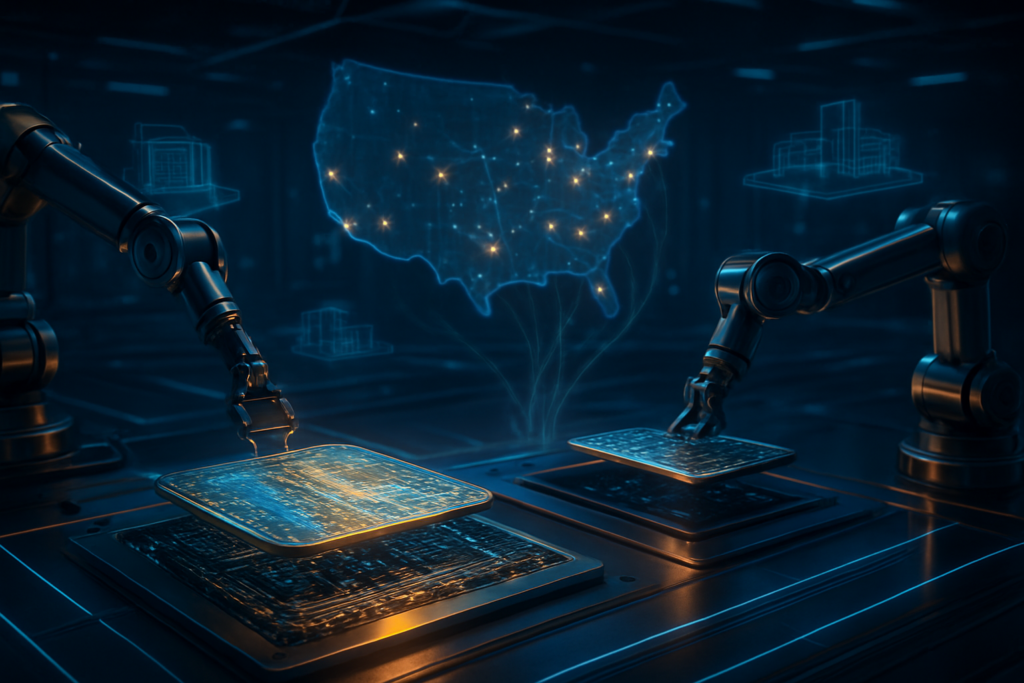
As of early February 2026, the United States has officially entered what industry leaders are calling the "Production Era" of semiconductor manufacturing. This transition, marked by the first high-volume output of sub-2nm chips on American soil, represents the culmination of a multi-year effort to reshore the critical hardware necessary for artificial intelligence. The recent unveiling of the SEMI "Securing the Semiconductor Supply Chain" strategy, combined with the mature execution of the CHIPS and Science Act, has shifted the national focus from subsidizing construction to optimizing the high-tech value chain that powers the global AI economy.
The immediate significance of this development cannot be overstated. With the Biden-era incentives now transitioning into operational reality and the current administration’s aggressive "Silicon Sovereignty" trade policies taking effect, the U.S. is no longer just a designer of chips, but a primary manufacturer of the world's most advanced logic. This shift provides a domestic hedge against geopolitical volatility in the Taiwan Strait and ensures that American AI firms have a direct, tariff-advantaged line to the cutting-edge silicon required for next-generation large language models and autonomous systems.
The Dawn of the Angstrom Era: Technical Milestones and Policy Pillars
Technically, the landscape has been redefined by Intel (NASDAQ: INTC) achieving high-volume manufacturing (HVM) at its Fab 52 in Ocotillo, Arizona. Utilizing the Intel 18A (1.8nm) process, this facility is the first in the United States to break the 2nm barrier, effectively reclaiming the process leadership crown for a domestic firm. Simultaneously, TSMC (NYSE: TSM) has confirmed that its Fab 1 in Phoenix is operating at full capacity with yields exceeding 92% for 4nm and 5nm nodes—matching the performance of its "mother fabs" in Taiwan. These milestones demonstrate that the "yield gap" once feared by critics of American manufacturing has been successfully bridged through rigorous engineering and local talent development.
The 2026 policy landscape is anchored by the SEMI "Securing the Semiconductor Supply Chain" strategy, which outlines five strategic pillars for the year. Beyond mere manufacturing, the strategy emphasizes "R&D and Tax Certainty," advocating for the permanency of the Section 174 R&D tax credit. This is viewed as essential for sustaining the momentum of the CHIPS Act, which has now allocated approximately 95% of its $39 billion in manufacturing incentives. The focus has moved toward "National Workforce Pipeline" development, as the industry faces a projected shortage of 67,000 skilled workers by 2030.
Reactions from the AI research community have been overwhelmingly positive, particularly regarding the increased availability of specialized silicon. Dr. Aris Thompson, a lead researcher at the National Semiconductor Technology Center (NSTC), noted that having 1.8nm capacity within the U.S. borders reduces the latency in the "design-to-wafer" cycle for custom AI accelerators. Industry experts point out that this domestic capability differs from previous decades because it integrates advanced gate-all-around (GAA) transistor architecture and backside power delivery, technologies that were considered experimental just three years ago but are now the standard for AI-optimized hardware.
Market Disruption and the Rise of the "Silicon Tariff"
The strategic implications for technology giants are profound. In mid-January 2026, the U.S. government implemented a 25% global tariff on advanced computing chips manufactured outside of North America. This move has created a massive competitive advantage for companies that secured early capacity in domestic fabs. NVIDIA (NASDAQ: NVDA) and AMD (NASDAQ: AMD) are currently racing to transition their flagship AI GPU production—such as the successors to the H200 and MI325X—to TSMC’s Arizona facilities and Samsung (OTCMKTS: SSNLF) in Taylor, Texas, to avoid these steep duties.
While the "Silicon Tariff" aims to incentivize reshoring, it has caused temporary market turbulence. Startups and mid-tier AI labs that rely on imported hardware are facing a sudden spike in capital expenditures. However, major cloud providers like Amazon (NASDAQ: AMZN) and Microsoft (NASDAQ: MSFT) are benefiting from long-term supply agreements with Intel and TSMC, positioning them to offer "Made in USA" AI compute clusters at a premium to government and defense clients who prioritize supply chain security and national sovereignty.
Samsung’s pivot in Taylor, Texas, has also shaken the competitive landscape. By skipping the 4nm node and moving directly to 2nm GAA production in early 2026, Samsung has successfully attracted several high-profile AI chip design firms as anchor clients. This "leapfrog" strategy has intensified the rivalry between the three major foundries on American soil, driving down costs for advanced packaging and fostering a more robust ecosystem for "chiplets"—modular components that can be mixed and matched to create highly specialized AI processors.
Global Significance and the "Packaging Gap"
The current policy shift represents a broader trend toward "Silicon Sovereignty," where nations view semiconductor capacity as a foundational element of national security, akin to energy or food supplies. The U.S. approach in 2026 is no longer just about competing with China; it is about ensuring that the entire AI value chain—from silicon wafers to final assembly—is insulated from global shocks. This is exemplified by the historic US-Taiwan trade deal signed on January 15, 2026, which grants Taiwanese firms Section 232 exemptions for chips bound for U.S. construction projects, ensuring a stable transition as domestic capacity ramps up.
Despite these successes, a critical "packaging gap" remains a primary concern for 2026. While the U.S. is now producing the world's most advanced wafers, many of those chips must still be sent to Asia for advanced packaging and assembly. To address this, current policy priorities are funneling billions into projects like Amkor’s (NASDAQ: AMKR) Arizona facility and SK hynix’s (KRX: 000660) High Bandwidth Memory (HBM) packaging plant in Indiana. The goal is to move the U.S. from 3% to 15% of global advanced packaging capacity by 2030, a move essential for the "heterogeneous integration" required by next-generation AI models.
Comparing this to previous milestones, the 2026 shift is more significant than the initial passage of the CHIPS Act in 2022. While the 2022 legislation provided the capital, the 2026 policies provide the structural framework—including the "Silicon Tariff" and the National Apprenticeship System—to ensure that the industry is sustainable without perpetual government subsidies. This represents a transition from a "rescue mission" for American manufacturing to a dominant "industrial policy" that other Western nations are now attempting to emulate.
Future Horizons: 1.4nm and Beyond
Looking toward the late 2020s, the roadmap is focused on the sub-1.4nm nodes and the integration of silicon photonics. Experts predict that by 2028, the first 1.4nm chips will enter pilot production in the U.S., further pushing the boundaries of Moore’s Law. The near-term challenge remains the environmental and regulatory hurdle; the SEMI strategy specifically calls for streamlining EPA reviews to prevent bureaucratic delays from stalling the startup of the "next wave" of fabs planned for the end of the decade.
Potential applications on the horizon include "edge-native" AI chips produced in domestic fabs that will power autonomous vehicle fleets and medical robotics with unprecedented efficiency. As advanced packaging facilities come online in Arizona and Indiana over the next 24 months, we expect to see the first "fully domestic" high-performance computing modules. The ability to manufacture, package, and deploy these units within the U.S. will be a game-changer for sensitive industries like aerospace and national intelligence.
The ultimate test for 2026 and beyond will be the ability to maintain this momentum through potential political shifts and economic cycles. Industry analysts predict that if the current "Silicon Sovereignty" policies hold, the U.S. will successfully reduce its reliance on foreign advanced logic from 90% in 2020 to less than 20% by 2032. The focus will then shift from capacity to innovation, as the NSTC begins to operationalize its "lab-to-fab" programs to ensure the next breakthrough in transistor design happens in an American lab.
A New Era for American Technology
The semiconductor landscape of early 2026 is a testament to the power of coordinated industrial policy and private-sector ingenuity. From Intel’s 1.8nm breakthroughs to the aggressive trade maneuvers designed to protect domestic investments, the United States has successfully repositioned itself at the center of the hardware world. The SEMI strategy has provided the necessary roadmap to ensure that this isn't just a temporary boom, but a permanent shift in how the world's most important technology is produced and governed.
In summary, the 2026 policy priorities mark the moment when "American AI" stopped being just a software story and became a hardware reality. The significance of this development in AI history cannot be overstated; by securing the supply chain, the U.S. has effectively secured its leadership in the intelligence age. As we look ahead to the coming months, the focus will be on the first "Silicon Tariff" quarterly reports and the progress of advanced packaging facilities, which remain the final piece of the puzzle for true domestic autonomy.
This content is intended for informational purposes only and represents analysis of current AI developments.
TokenRing AI delivers enterprise-grade solutions for multi-agent AI workflow orchestration, AI-powered development tools, and seamless remote collaboration platforms.
For more information, visit https://www.tokenring.ai/.