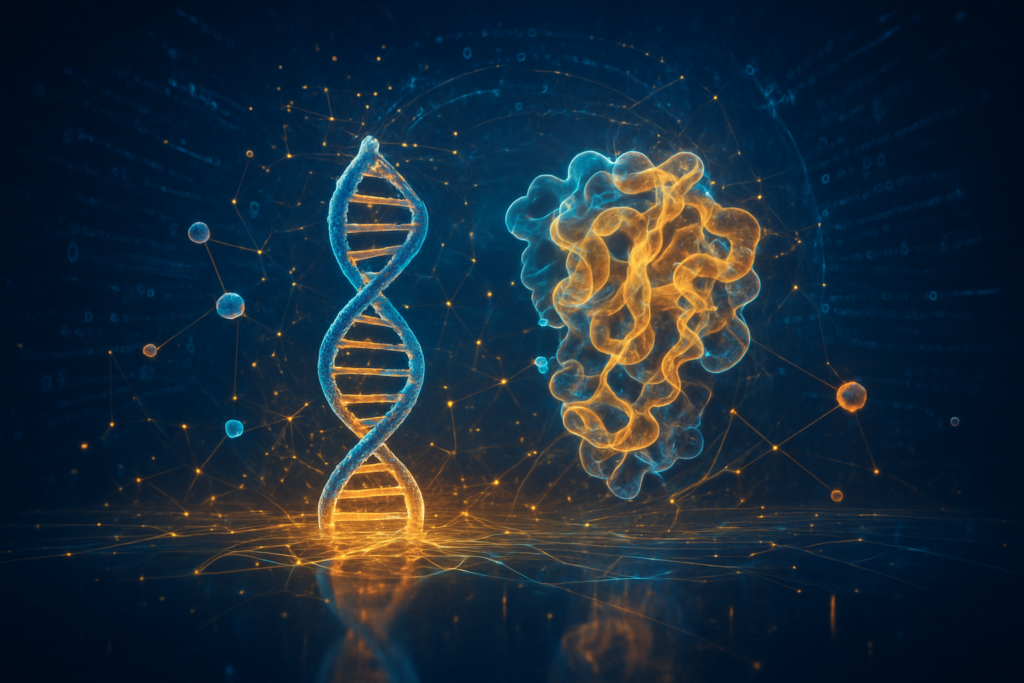
As of early 2026, the promise of “digital-first” drug discovery has shifted from a speculative horizon to a tangible industrial reality. Since its groundbreaking release in May 2024, AlphaFold 3 (AF3)—the generative AI model developed by Google DeepMind and its commercial sibling, Isomorphic Labs—has fundamentally transformed the landscape of molecular biology. By expanding beyond simple protein structures to model the complex "interactome" of life, AF3 has solved a multi-decade puzzle: how to predict the interactions between proteins, DNA, RNA, and small molecules with atomic precision.
The significance of this development was cemented in late 2024 when the Nobel Prize in Chemistry was awarded to Sir Demis Hassabis and John Jumper for their work on protein structure prediction. Today, in February 2026, the technology is no longer just a research tool; it is the backbone of multi-billion-dollar pharmaceutical pipelines. By shortening the initial drug discovery phase from years to mere months, AlphaFold 3 is paving the way for a new era of rapid-response medicine, from oncology to vaccine development for emerging pathogens.
From Shape to Synthesis: The Diffusion Revolution
Unlike its predecessor, AlphaFold 2, which revolutionized the field by predicting the static 3D shapes of proteins, AlphaFold 3 utilizes a sophisticated Generative Diffusion architecture. This is the same underlying technology that powers high-end AI image generators, but instead of pixels, AF3 diffuses the 3D coordinates of atoms. This shift allows the model to "dream" the most stable configuration of a molecular complex, starting from a cloud of disordered noise and iteratively refining it until every atom is in its mathematically optimal position.
Technical specifications of the model reveal a "Universal Tokenization" approach, where every biological component—be it an amino acid, a nucleotide of DNA or RNA, or a ligand (a small drug molecule)—is treated as a standard unit of information. This unified representation allows AF3 to predict how these disparate molecules bind together in a single, holistic step. Furthermore, AF3’s "Pairformer" architecture is significantly more data-efficient than previous iterations, allowing it to provide high-accuracy predictions even when evolutionary data is scarce. According to internal benchmarks released by Isomorphic Labs, AF3 provides a 50% improvement over traditional physics-based "docking" software, particularly in its ability to account for the "induced fit" phenomenon—where a protein changes its shape to accommodate a drug molecule.
The Billion-Dollar Pivot: Pharma’s New Power Broker
The commercial implications of AlphaFold 3 have sent shockwaves through the healthcare sector, specifically benefiting Alphabet Inc. (NASDAQ: GOOGL) and its partners. Isomorphic Labs has leveraged AF3 to secure massive strategic collaborations with industry titans like Eli Lilly and Company (NYSE: LLY) and Novartis AG (NYSE: NVS). These deals, valued at over $3 billion in potential milestones, are focused on "undruggable" targets—diseases like certain aggressive cancers and neurodegenerative conditions that have eluded traditional chemistry for decades.
In early 2026, Johnson & Johnson (NYSE: JNJ) joined this elite circle, announcing a deep-integration partnership to utilize AlphaFold 3 for designing novel protein-protein interaction inhibitors. This move signals a competitive shift in the market; while major AI labs like Meta (NASDAQ: META) and academic groups like David Baker’s team at the University of Washington (RoseTTAFold) continue to innovate, Google DeepMind’s integration with Isomorphic Labs provides a unique end-to-end "discovery-to-clinic" pipeline. This has created a strategic advantage where the software doesn't just predict a shape—it designs a candidate drug that is ready for biological validation, potentially disrupting the multi-billion-dollar market for traditional Contract Research Organizations (CROs).
Redefining the Bio-Landscape: Beyond Protein Folding
The broader significance of AlphaFold 3 lies in its ability to model the "dynamic" nature of biology. While AlphaFold 2 showed us the "bricks" of life, AlphaFold 3 shows us the "machinery" in motion. This transition mirrors the shift in the AI industry from static large language models to agentic systems that can interact with their environment. In the context of the global AI landscape, AF3 is the ultimate proof of "Science AI," proving that transformer architectures and diffusion models can master physical and chemical laws as effectively as they master human language.
However, this breakthrough is not without its concerns. The ability to predict how any molecule interacts with human biology raises significant biosecurity questions. Experts have warned that the same tech used to design life-saving vaccines could, in theory, be used to design novel toxins. This has led to a major international dialogue in 2025 and early 2026 regarding "guarded access" to high-end molecular models. Comparing AF3 to previous milestones like the Human Genome Project, the consensus is that while the genome gave us the "parts list," AlphaFold 3 is giving us the "instruction manual" for life itself.
The Horizon: From Prediction to Clinical Trials
Looking ahead to the remainder of 2026 and 2027, the focus is shifting from "in silico" (computer-based) design to "in vivo" (living organism) results. Isomorphic Labs and its partners are expected to announce the first set of AI-designed drug candidates to enter Phase I clinical trials by the end of this year. This represents a monumental compression of the drug discovery timeline; a process that typically takes five to seven years has been condensed into roughly 24 to 30 months for the pre-clinical phase.
Future developments are likely to include "AlphaFold-Cell," a theoretical successor that could model entire cellular environments rather than isolated complexes. This would allow researchers to predict how a drug interacts not just with its target, but with every other component in a human cell, virtually eliminating the risk of unforeseen side effects. The primary challenge remaining is the "data bottleneck" in biological validation—the physical lab work required to prove that the AI’s "perfect fit" actually cures a disease in a human patient.
A New Era of Precision Medicine
AlphaFold 3 stands as a watershed moment in the history of science. It has successfully bridged the gap between computer science and biology, transforming the latter into a predictable, engineering-driven discipline. The key takeaway for 2026 is that the bottleneck in medicine is no longer "knowing" what a molecule looks like; it is now about "verifying" its efficacy in the complex, messy reality of human biology.
As we move forward, the world will be watching the clinical trial results of the first AF3-designed molecules. If successful, these trials will validate the most significant technological leap in medical history. For now, AlphaFold 3 has already achieved something remarkable: it has made the invisible visible, turning the chaotic world of molecular interactions into a clear, navigable map for the future of human health.
This content is intended for informational purposes only and represents analysis of current AI developments.
TokenRing AI delivers enterprise-grade solutions for multi-agent AI workflow orchestration, AI-powered development tools, and seamless remote collaboration platforms.
For more information, visit https://www.tokenring.ai/.