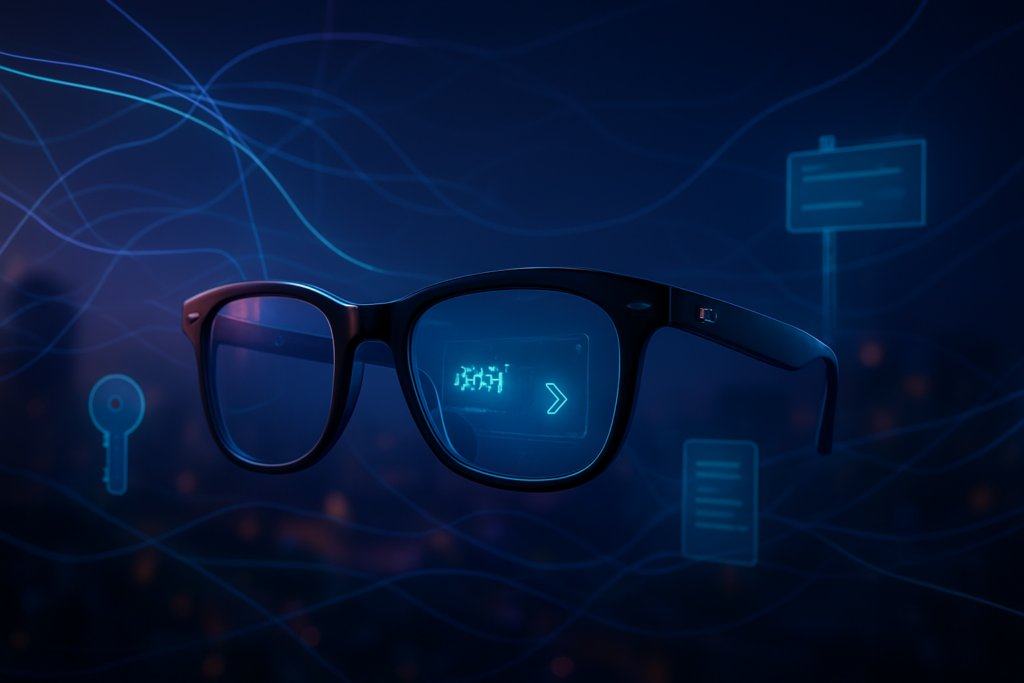
The era of the smartphone is beginning to show its age, as artificial intelligence makes its most significant leap yet: from our pockets to our faces. On February 2, 2026, the tech landscape is no longer defined by the glowing rectangles we hold in our hands, but by the seamless, "ambient" intelligence woven into the frames of our glasses. Meta Platforms (NASDAQ: META) has successfully pivoted from its much-maligned "metaverse" origins to become the undisputed leader in wearable AI, transforming the Ray-Ban Meta Smart Glasses from a niche enthusiast gadget into a ubiquitous tool for everyday life.
This transformation is driven by a breakthrough in multimodal AI that allows the glasses to see, hear, and understand the world in real-time. With the rollout of the "Gen 3" hardware and the high-end "Hypernova" display model, the promise of a screenless future is becoming a reality. By integrating "Hey Meta, look"—a feature that once only took snapshots but now offers continuous vision—Meta has created a digital companion that identifies landmarks, translates foreign menus instantly, and even remembers where you left your keys, marking a fundamental shift in how humans interact with the digital world.
The Hardware of Perception: Inside Gen 3 and the Hypernova Display
The technical evolution of Meta’s wearable line in 2026 has focused on two distinct paths: the mainstream Gen 3 "Aperol" and "Bellini" frames, and the premium "Hypernova" model. The Gen 3 series has refined the voice-first experience, featuring a 16MP ultra-wide sensor capable of 4K video at 60fps. This hardware upgrade is supported by the Snapdragon AR1 Gen 2+ chipset, which has pushed battery life to a full 12 hours of typical use. However, the true technical marvel is the Hypernova, which incorporates a monocular waveguide display in the right lens. Boasting 5,000 nits of brightness, this "Heads-Up Display" (HUD) allows for "World Subtitles"—real-time visual captions of foreign languages that float in the wearer's field of vision during a conversation.
Unlike the "snapshots" of 2024, the 2026 multimodal AI operates on a principle of "Continuous Vision." Powered by a specialized version of the Llama 4 model, the glasses can now run an active vision session for hours without overheating. The "Hey Meta, look" command has evolved into a conversational dialogue; a user can look at a complex mechanical engine and ask, "Hey Meta, which bolt should I loosen first?" and the AI will provide audio or visual cues based on the live video feed. This is further augmented by a "Memory Bank" feature, which uses local on-device processing to index objects the wearer has seen, allowing for queries like, "Where did I leave my passport?"
The industry’s reaction to these advancements has been a mix of awe and strategic repositioning. AI researchers have lauded the shift from "Large Language Models" to "Large Multimodal Models" that can process temporal video data. Experts from the research community note that Meta’s success lies in its ability to offload heavy compute to the cloud via 5G while maintaining low-latency "edge" processing for immediate tasks. This architecture differs significantly from previous attempts like Google Glass, which suffered from poor battery life and a lack of clear utility. In 2026, the utility is clear: the AI is no longer a search engine you visit; it is an observer that assists you.
Market Dominance and the "N50" Pivot: META, AAPL, and GOOGL
Meta’s strategic pivot has yielded massive financial dividends. In its most recent earnings report, Meta Platforms (NASDAQ: META) posted record revenues of $201 billion for 2025, driven largely by the 73% market share it now commands in the smart glasses sector. While the company's Reality Labs division still reports significant spending, investor sentiment has shifted. The glasses are seen as the "on-ramp" to the next computing platform, with Meta and partner EssilorLuxottica aiming to scale production to 10 million units by the end of 2026. This success has effectively ended the debate over whether consumers would wear cameras on their faces.
This dominance has forced a dramatic realignment among tech giants. Apple (NASDAQ: AAPL), recognizing that its Vision Pro headset remained a high-end niche product, reportedly shelved its "cheaper Vision Pro" plans in late 2025. Instead, Apple is fast-tracking "N50," a pair of lightweight smart glasses designed to compete directly with Meta. Meanwhile, Alphabet (NASDAQ: GOOGL) has returned to the fray through "Project Astra," partnering with fashion brands like Warby Parker to integrate Gemini-powered AI into stylish frames. The competitive landscape has shifted from who has the best screen to who has the most "invisible" hardware and the most context-aware AI.
The disruption to the smartphone market is already becoming visible. Analysts suggest that early adopters of AI wearables have reduced their smartphone screen time by nearly 30%. For many, the "quick check"—looking up a flight time, responding to a text, or navigating a city street—is now handled entirely by the glasses. This poses a strategic threat to companies that rely on traditional app-store ecosystems and mobile advertising, as Meta builds its own direct-to-consumer interface that bypasses the traditional smartphone OS.
Privacy, Presence, and the "I-XRAY" Crisis
As AI moves from screens to wearables, the wider significance of "Presence Computing" is coming into focus. This transition represents a shift from "Attention Computing"—where apps fight for your screen time—to a model where the digital layer enhances your physical presence. However, this has not come without significant societal friction. The "always-on" nature of Meta’s "Super Sensing" feature, which allows the glasses to stay aware of the environment for hours, has triggered a global debate over bystander privacy and the erosion of anonymity in public spaces.
The tension reached a breaking point in late 2025 following the "I-XRAY" project, where researchers demonstrated that Ray-Ban Meta glasses could be used to identify strangers in real-time by cross-referencing video feeds with public databases. This incident spurred the European Union to enforce the most stringent sections of the EU AI Act, classifying real-time biometric identification in public as "high-risk." Consequently, Meta has been forced to disable certain "Super Sensing" features within the EU, creating a fragmented user experience between the West and Asia, where countries like Singapore have actually mandated such features to combat fraud.
Beyond privacy, there are growing concerns regarding "cognitive reliance." As the AI begins to act as a memory aid—recalling faces, names, and the location of objects—psychologists have begun to study the long-term impact on human memory and spatial awareness. The comparison to previous milestones, such as the introduction of the iPhone in 2007, is frequently made; while the smartphone changed how we communicate, the AI wearable is changing how we perceive reality itself.
The Road to "Orion": The Future of Neural Wearables
Looking ahead to the remainder of 2026 and 2027, the focus is shifting toward "Neural Interfaces." Meta’s Hypernova model is already being bundled with a Neural Wristband that uses Electromyography (EMG) to detect subtle finger movements. This allows users to control their glasses without speaking or touching the frames, enabling "silent" interaction in public settings. Experts predict that the integration of neural input will be the "mouse and keyboard" moment for wearables, making them a viable tool for productivity rather than just consumption.
The long-term roadmap culminates in "Project Orion," Meta's true augmented reality (AR) glasses, which are expected to debut for consumers in 2027. Unlike the current models, which offer a limited heads-up display, Orion is expected to provide a wide field-of-view AR experience that can project high-fidelity digital objects into the physical world. The challenge remains one of thermal management and battery density; as the AI becomes more powerful, the need for efficient cooling in a lightweight frame becomes the primary engineering hurdle.
A New Era of Human-AI Symbiosis
The developments of early 2026 represent a watershed moment in the history of technology. Meta’s Ray-Ban glasses have successfully demystified AI, moving it away from the abstract "chatbot" interface and into a functional, multimodal tool that augments human capability. By focusing on style and utility over bulky VR headsets, Meta has managed to normalize the presence of AI in our most intimate social settings.
As we move through 2026, the key takeaways are clear: the smartphone is no longer the center of the digital universe, and multimodal AI has become the primary way we interact with information. The significance of this development cannot be overstated; we are moving toward a future where the boundary between digital information and physical reality is permanently blurred. In the coming months, the industry will be watching closely to see if Apple’s "N50" can challenge Meta’s lead, and how global regulators will respond to a world where everyone is a walking, AI-powered camera.
This content is intended for informational purposes only and represents analysis of current AI developments.
TokenRing AI delivers enterprise-grade solutions for multi-agent AI workflow orchestration, AI-powered development tools, and seamless remote collaboration platforms.
For more information, visit https://www.tokenring.ai/.