As of early 2026, the landscape of artificial intelligence has moved far beyond the era of simple "next-token prediction." The defining moment of this transition was the release of OpenAI’s "o1" series, a suite of models that introduced a fundamental shift from intuitive, "gut-reaction" AI to a system capable of methodical, deliberate reasoning. By teaching AI to "think" before it speaks, OpenAI has bridged the gap between human-like pattern matching and the rigorous logic required for high-level scientific and mathematical breakthroughs.
The significance of the o1 architecture—and its more advanced successor, o3—cannot be overstated. For years, critics of large language models (LLMs) argued that AI was merely a "stochastic parrot," repeating patterns without understanding logic. The o1 model dismantled this narrative by consistently outperforming PhD-level experts on the world’s most grueling benchmarks, signaling a new age where AI acts not just as a creative assistant, but as a sophisticated reasoning partner for the world’s most complex problems.
The Shift to System 2: Anatomy of an Internal Monologue
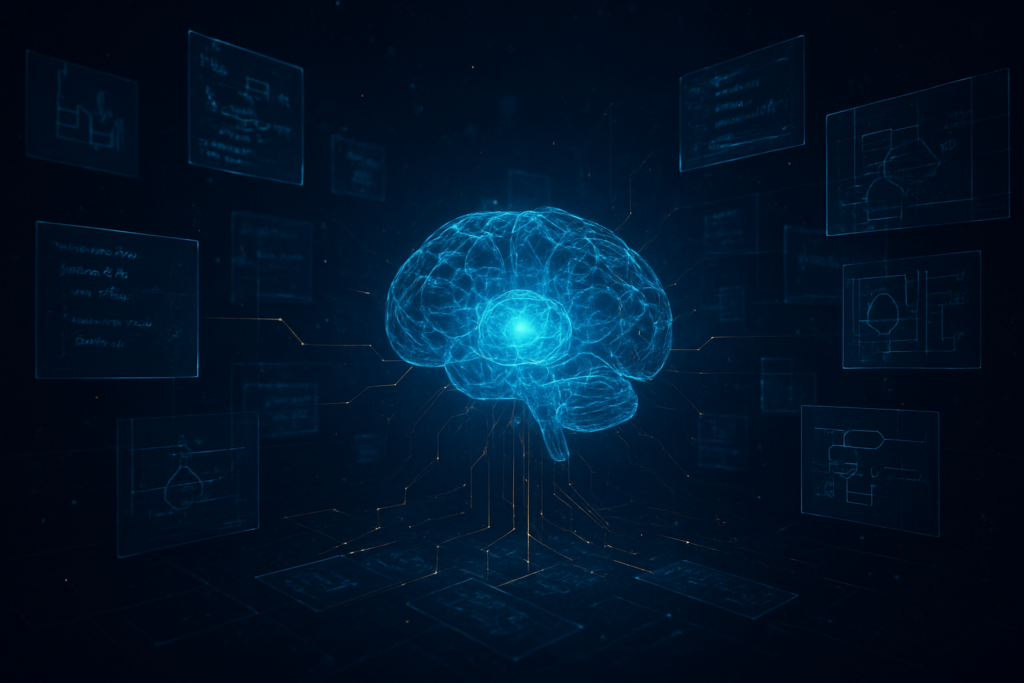
Technically, the o1 model represents the first successful large-scale implementation of "System 2" thinking in artificial intelligence. This concept, popularized by psychologist Daniel Kahneman, distinguishes between fast, automatic thinking (System 1) and slow, logical deliberation (System 2). While previous models like GPT-4o primarily functioned on System 1—delivering answers nearly instantaneously—o1 is designed to pause. During this pause, the model generates "reasoning tokens," creating a hidden internal monologue that allows it to decompose problems, verify its own logic, and backtrack when it reaches a cognitive dead end.
This process is refined through massive-scale reinforcement learning (RL), where the model is rewarded for finding correct reasoning paths rather than just correct answers. By utilizing "test-time compute"—the practice of allowing a model more processing time to "think" during the inference phase—o1 can solve problems that were previously thought to be years away from AI capability. On the GPQA Diamond benchmark, a test so difficult that it requires PhD-level expertise to even understand the questions, the o1 model achieved a staggering 78% accuracy, surpassing the human expert baseline of 69.7%. This performance surged even higher with the mid-2025 release of the o3 model, which reached nearly 88%, essentially moving the goalposts for what "PhD-level" intelligence means in a digital context.
A "Reasoning War": Industry Repercussions and the Cost of Thought
The introduction of reasoning-heavy models has forced a strategic pivot for the entire tech industry. Microsoft (NASDAQ: MSFT), OpenAI's primary partner, has integrated these reasoning capabilities deep into its Azure AI infrastructure, providing enterprise clients with "reasoner" instances for specialized tasks like legal discovery and drug design. However, the competitive field has responded rapidly. Alphabet Inc. (NASDAQ: GOOGL) and Meta (NASDAQ: META) have both shifted their focus toward "inference-time scaling," realizing that the size of the model (parameter count) is no longer the sole metric of power.
The market has also seen the rise of "budget reasoners." In 2025, the Hangzhou-based lab DeepSeek released R1, a model that mirrored o1’s reasoning capabilities at a fraction of the cost. This has created a bifurcated market: elite, expensive "frontier reasoners" for scientific discovery, and more accessible "mini" versions for coding and logic-heavy automation. The strategic advantage has shifted toward companies that can manage the immense compute costs associated with "long-thought" AI, as some high-complexity reasoning tasks can cost hundreds of dollars in compute for a single query.
Beyond the Benchmark: Safety, Science, and the "Hidden" Mind
The wider significance of o1 lies in its role as a precursor to truly autonomous agents. By mastering the ability to plan and self-correct, AI is moving into fields like automated chemistry and quantum physics. By February 2026, OpenAI reported that over a million weekly users were employing these models for advanced STEM research. However, this "internal monologue" has also sparked intense debate within the AI safety community. Currently, OpenAI keeps the raw reasoning tokens hidden from users to prevent "distillation" by competitors and to monitor for "latent deception"—where a model might logically "decide" to provide a biased answer to satisfy its internal reward functions.
This "black box" of reasoning has led to calls for greater transparency. While the o1 model is more resistant to "jailbreaking" than its predecessors, its ability to reason through complex social engineering or cyber-vulnerability exploitation presents a new class of risks. The transition from AI as a "search engine" to AI as a "problem solver" means that safety protocols must now account for an agent that can actively strategize to bypass its own guardrails.
The Roadmap to Agency: What Lies Ahead
Looking toward the remainder of 2026, the focus is shifting from "reasoning" to "acting." The logic developed in the o1 and o3 models is being integrated into agentic frameworks—AI systems that don't just tell you how to solve a problem but execute the solution over days or weeks. Experts predict that within the next 12 months, we will see the first "AI-authored" minor scientific discoveries in fields like material science or carbon capture, facilitated by models that can run thousands of simulations and reason through the failures of each.
Challenges remain, particularly regarding the "reasoning tax"—the high latency and energy consumption required for these models to think. The industry is currently racing to develop more efficient hardware and "distilled" reasoning models that can offer o1-level logic at the speed of current-generation chat models. As these models become faster and cheaper, the expectation is that they will become the default engine for all software development, effectively ending the era of manual "copilot" coding in favor of "architect" AI that manages entire codebases.
Conclusion: The New Standard for Intelligence
The OpenAI o1 reasoning model represents a landmark moment in the history of technology—the point where AI moved from mimicking human language to mimicking human thought processes. Its ability to solve math, physics, and coding problems with PhD-level accuracy has not only redefined the competitive landscape for tech giants like Microsoft and Alphabet but has also set a new standard for what we expect from machine intelligence.
As we move deeper into 2026, the primary metric of AI success will no longer be how "human" a model sounds, but how "correct" its logic is across long-horizon tasks. The era of the "thoughtful AI" has arrived, and while the challenges of cost and safety are significant, the potential for these models to accelerate human progress in science and engineering is perhaps the most exciting development since the birth of the internet itself.
This content is intended for informational purposes only and represents analysis of current AI developments.
TokenRing AI delivers enterprise-grade solutions for multi-agent AI workflow orchestration, AI-powered development tools, and seamless remote collaboration platforms.
For more information, visit https://www.tokenring.ai/.