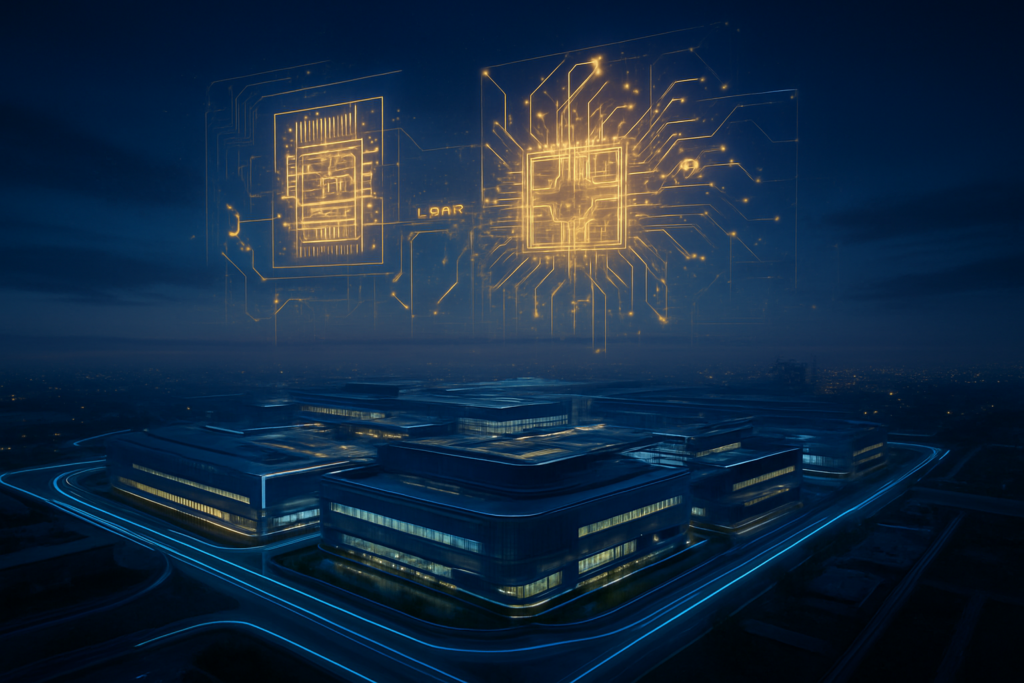
In a move that underscores the sheer scale of the ongoing generative artificial intelligence revolution, Taiwan Semiconductor Manufacturing Company (NYSE: TSM) has officially announced a record-breaking $56 billion capital expenditure plan for 2026. This historic investment, disclosed during the company’s recent Q1 earnings briefing, marks the largest single-year spending commitment in the history of the semiconductor industry. As the world’s leading foundry, TSMC is signaling its absolute confidence that the demand for high-performance computing (HPC) will continue to accelerate, fueled by the insatiable needs of AI hyperscalers and chip designers.
The significance of this announcement extends far beyond simple infrastructure. TSMC has projected a massive 30% revenue growth for the fiscal year 2026, a figure that has sent shockwaves through global markets. By allocating over 80% of its budget to advanced nodes and specialized packaging, TSMC is not just building more factories; it is constructing the physical bedrock upon which the next decade of AI breakthroughs—including autonomous systems, massive-scale LLMs, and personalized digital agents—will be built.
Scaling the Impossible: 2nm and the Rise of A16 Architecture
The technical core of TSMC’s 2026 strategy lies in the aggressive ramp-up of its 2nm (N2) process and the introduction of the groundbreaking A16 (1.6nm) node. The N2 process, which is now hitting mass production across TSMC’s facilities in Baoshan and Kaohsiung, represents a paradigm shift in transistor design. For the first time, TSMC is utilizing Gate-All-Around (GAA) nanosheet transistors. Unlike the previous FinFET architecture, GAA allows for better electrostatic control, resulting in a 10-15% performance boost or a 25-30% reduction in power consumption compared to the 3nm node.
Complementing the 2nm rollout is the A16 node, scheduled for volume production in the second half of 2026. The A16 is being hailed by industry experts as the "crown jewel" of TSMC’s roadmap because it introduces the "Super Power Rail." This backside power delivery system moves power distribution from the front of the wafer to the back, freeing up critical space on the top layers for signal routing. This technical leap effectively eliminates bottlenecks in power delivery that have plagued high-wattage AI accelerators, allowing for even higher clock speeds and more efficient thermal management.
Initial reactions from the semiconductor research community suggest that TSMC has successfully widened its lead over rivals Intel (NASDAQ: INTC) and Samsung. While Intel has made strides with its 18A process, TSMC’s ability to achieve volume production with A16 while maintaining nearly 50% net margins is viewed as a masterstroke in manufacturing execution. "We are no longer just looking at incremental shrinks," said one senior analyst at the Semiconductor Industry Association. "TSMC is re-engineering the very physics of how electricity moves through a chip to meet the thermal demands of the AI era."
The NVIDIA and Meta Connection: Powering the AI Super-Cycle
This $56 billion investment is a direct response to the "AI Super-Cycle" led by tech giants like NVIDIA (NASDAQ: NVDA) and Meta (NASDAQ: META). NVIDIA, which has officially overtaken Apple (NASDAQ: AAPL) as TSMC’s largest customer, is the primary driver for the 2026 capacity surge. NVIDIA’s upcoming "Rubin" architecture, the successor to the Blackwell GPUs, is slated to transition to TSMC’s 3nm (N3P) and eventually 2nm nodes. To satisfy NVIDIA’s roadmap, TSMC is also doubling down on its CoWoS (Chip on Wafer on Substrate) advanced packaging capacity, which remains the primary bottleneck for shipping enough AI chips to meet global demand.
Meta’s role in this expansion is equally pivotal. Mark Zuckerberg’s company has emerged as a top-tier TSMC client, securing massive allocations for its custom Meta Training and Inference Accelerator (MTIA) chips. As Meta continues its pivot toward "General AI" and integrates advanced intelligence across its social platforms, its reliance on bespoke silicon has made it a key strategic partner in TSMC’s long-term planning. For Meta, securing TSMC’s A16 capacity early is a competitive necessity to ensure its future models can out-compute rivals in a high-latency-sensitive environment.
The market positioning here is clear: TSMC has created a "virtuous cycle" where the world’s most powerful software companies are effectively subsidizing the development of the world’s most advanced hardware. This creates a formidable barrier to entry for smaller firms and even legacy tech giants. Companies that do not have "priority access" to TSMC’s 2nm and A16 nodes in 2026 risk falling an entire generation behind in compute efficiency, which in the AI world translates directly to higher costs and slower innovation.
Geopolitics and the Global Fab Cluster Strategy
The $56 billion plan is not just about technology; it is about geographical resilience. TSMC is currently transforming its manufacturing footprint into "Megafab Clusters" located in the United States, Japan, and Germany. In Arizona, Fab 1 is now fully operational at the 4nm node, while the mass production timeline for Fab 2 has been accelerated to late 2027 to handle 3nm and 2nm chips. This expansion is critical for US-based partners like AMD (NASDAQ: AMD) and NVIDIA, who are increasingly under pressure to diversify their supply chains amidst ongoing geopolitical tensions in the Taiwan Strait.
However, this global expansion brings its own set of challenges. Critics have pointed to the rising costs of manufacturing outside of Taiwan, where TSMC benefits from a highly specialized local ecosystem. To maintain its 30% revenue growth target, TSMC has had to implement "regional pricing" models, charging a premium for chips made in US-based fabs. Despite these costs, the "AI gold rush" has made customers willing to pay for the security of supply.
Comparatively, this milestone echoes the early 2010s mobile revolution, but at a significantly larger scale. While the shift to smartphones redefined consumer tech, the current AI infrastructure build-out is fundamental to the entire global economy. The concern among some economists is the potential for an "over-investment" bubble; however, with TSMC’s order books for 2026 and 2027 already reported as "fully booked," the immediate threat appears to be a lack of capacity rather than a surplus.
Looking Ahead: The Road to Sub-1nm
As 2026 unfolds, the industry is already looking toward the next frontier. TSMC has hinted at a "1nm-class" node research phase, potentially designated as the A14 or A10, which will likely integrate even more exotic materials like carbon nanotubes or two-dimensional semiconductors. In the near term, the focus will remain on the successful integration of High-NA EUV (High Numerical Aperture Extreme Ultraviolet) lithography machines, which are essential for printing the incredibly fine features required for the A16 node.
The primary challenges moving forward are no longer just about lithography. Power and water consumption for these mega-facilities have become significant political and environmental hurdles. In Taiwan, TSMC is investing heavily in water reclamation plants and renewable energy to ensure its 2nm ramp-up does not strain local resources. In Arizona, the focus is on building out a local talent pipeline of specialized engineers to staff the three planned facilities.
Experts predict that by the end of 2026, the gap between TSMC and its competitors will be defined not just by transistor density, but by "system-level" integration. This involves 3D stacking of logic and memory (SoIC), which TSMC is rapidly scaling. The future of AI is moving toward "Silicon-as-a-Service," where TSMC provides the entire compute package—not just the chip.
A New Era of Silicon Sovereignty
TSMC’s $56 billion commitment for 2026 is a definitive statement that the AI era is still in its infancy. By betting nearly 30% of its projected revenue back into R&D and capital projects, the company is ensuring its role as the indispensable middleman of the digital age. The key takeaways for 2026 are clear: the transition to 2nm and A16 architecture is the new battlefield for AI supremacy, and NVIDIA and Meta have secured their positions at the front of the line.
As we move through the coming months, the tech world will be watching the yield rates of the new A16 node and the progress of the Arizona Fab 2 construction. This investment represents more than just a business plan; it is the most expensive and complex engineering project in human history, designed to power the next generation of human intelligence. In the high-stakes game of semiconductor manufacturing, TSMC has just raised the stakes to an unprecedented level, and the rest of the world has no choice but to follow.
This content is intended for informational purposes only and represents analysis of current AI developments.
TokenRing AI delivers enterprise-grade solutions for multi-agent AI workflow orchestration, AI-powered development tools, and seamless remote collaboration platforms.
For more information, visit https://www.tokenring.ai/.