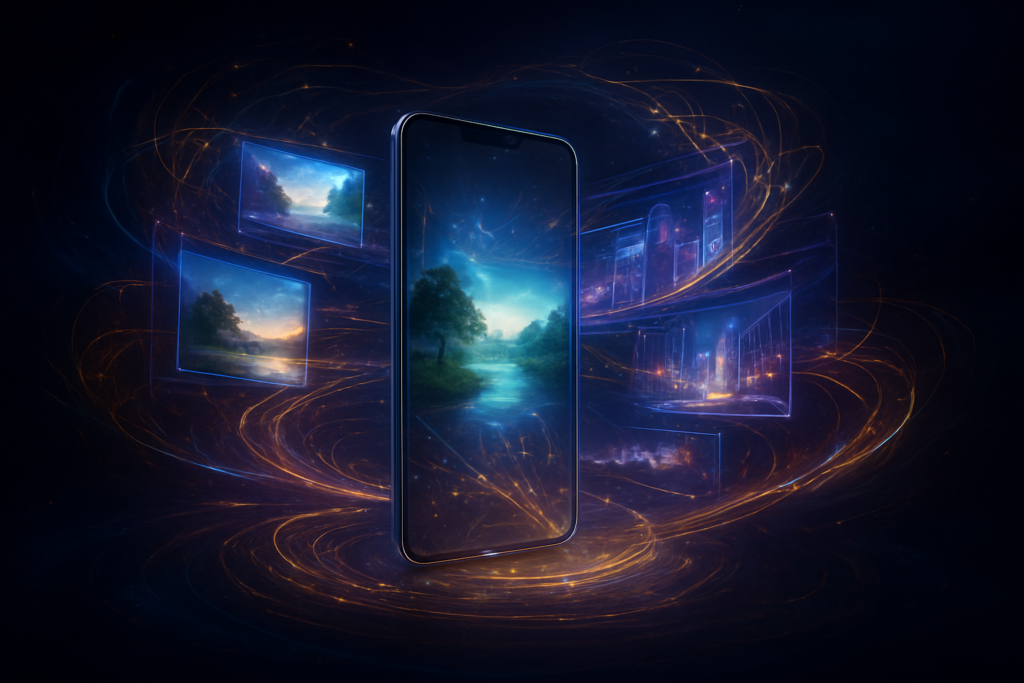
The landscape of digital creation has reached a fever pitch as Meta Platforms Inc. (NASDAQ: META) fully integrates its revolutionary "Movie Gen" suite across its global ecosystem of nearly 4 billion users. By February 2026, what began as a high-stakes research project has effectively transformed every smartphone into a professional-grade film studio. Movie Gen’s ability to generate high-definition video with frame-perfect synchronized audio and perform precision editing via natural language instructions marks the definitive end of the barrier between imagination and visual reality.
The immediate significance of this development cannot be overstated. By democratizing Hollywood-caliber visual effects, Meta has shifted the center of gravity in the creator economy. No longer are creators bound by expensive equipment or years of technical training in software like Adobe Premiere or After Effects. Instead, the "Social Cinema" era allows users on Instagram, WhatsApp, and Facebook to summon complex cinematics with a simple text prompt or a single reference photo, fundamentally altering how we communicate, entertain, and market products in the mid-2020s.
The Engines of Creation: 30 Billion Parameters of Visual Intelligence
At the heart of Movie Gen lies a technical architecture that represents a departure from the earlier diffusion-based models that dominated the 2023-2024 AI boom. Meta’s primary video model boasts 30 billion parameters, utilizing a "Flow Matching" framework. Unlike traditional diffusion models that subtract noise to find an image, Flow Matching optimizes the path between noise and data, resulting in significantly higher efficiency and a more stable temporal consistency. This allows for native 1080p HD generation at cinematic frame rates, with the model managing a massive context length of 73,000 video tokens.
Complementing the visual engine is a specialized 13-billion parameter audio model. This model does more than just generate background noise; it creates high-fidelity, synchronized soundscapes including ambient environments, Foley effects (like the specific crunch of footsteps on gravel), and full orchestral scores that are temporally aligned with the on-screen action. The capability for "Instruction-Based Editing" (Movie Gen Edit) is perhaps the most disruptive technical feat. It enables localized edits—such as changing a subject's clothing or adding an object to a scene—without disturbing the rest of the frame's pixels, a level of precision that previously required hours of manual rotoscoping.
Initial reactions from the AI research community have praised Meta’s decision to pursue a multimodal, all-in-one approach. While competitors focused on video or audio in isolation, Meta’s unified "Movie Gen" stack ensures that motion and sound are intrinsically linked. However, the industry has also noted the immense compute requirements for these models, leading to questions about the long-term sustainability of hosting such power for free across social platforms.
A New Frontier for Big Tech and the VFX Industry
The rollout of Movie Gen has ignited a fierce strategic battle among tech giants. Meta’s primary advantage is its massive distribution network. While OpenAI’s Sora and Alphabet Inc.’s (NASDAQ: GOOGL) Google Veo 3.1 have targeted professional filmmakers and the advertising elite, Meta has brought generative video to the masses. This move poses a direct threat to mid-tier creative software companies and traditional stock footage libraries, which have seen their market share plummet as users generate bespoke, high-quality content on-demand.
For startups, the "Movie Gen effect" has been a double-edged sword. While some niche AI companies are building specialized plugins on top of Meta's open research components, others have been "incinerated" by Meta’s all-in-one offering. The competitive landscape is now a race for resolution and duration. With rumors of a "Movie Gen 4K" and the secret project codenamed "Avocado" circulating in early 2026, Meta is positioning itself not just as a social network, but as the world's largest infrastructure provider for generative entertainment.
Navigating the Ethical and Cultural Shift
Movie Gen’s arrival has not been without significant controversy. As we enter 2026, the AI landscape is heavily influenced by the TAKE IT DOWN Act of 2025, which was fast-tracked specifically to address the risks posed by hyper-realistic video generation. Meta has responded by embedding robust C2PA "Content Credentials" and invisible watermarking into every file generated by Movie Gen. These measures are designed to combat the "liar’s dividend," where public figures can claim real footage is AI-generated, or conversely, where malicious actors create convincing deepfakes.
Furthermore, the impact on labor remains a central theme of the "StrikeWatch '26" movement. SAG-AFTRA and other creative unions have expressed deep concern over the "Personalized Video" feature, which allows users to insert their own likeness—or that of others—into cinematic scenarios. The broader AI trend is moving toward "individualized media," where every viewer might see a different version of a film or ad tailored specifically to them. This shift challenges the very concept of shared cultural moments and has sparked a global debate on the "soul" of human-led artistry versus the efficiency of algorithmic creation.
The Horizon: From Social Reels to Full-Length AI Features
Looking forward, the roadmap for Movie Gen suggests a move toward longer-form narrative capabilities. Near-term developments are expected to push the current 16-second clip limit toward several minutes, enabling the generation of short films in a single pass. Experts predict that by the end of 2026, "AI Directors" will be a recognized job category, with individuals focusing solely on the prompting and iterative editing of high-level AI models to produce commercial-ready content.
The next major challenge for Meta will be the integration of real-time physics and interactive environments. Imagine a Movie Gen-powered version of the Metaverse where the world is rendered in real-time based on your voice commands. While hardware limitations currently prevent such an "infinite world" from being rendered at HD quality, the pace of optimization seen in the 30B parameter model suggests that real-time, high-fidelity AI environments are no longer a matter of "if," but "when."
A Watershed Moment in AI History
Meta’s Movie Gen represents more than just a clever update to Instagram Reels; it is a watershed moment in the history of artificial intelligence. By successfully merging 30-billion parameter video synthesis with a 13-billion parameter audio engine, Meta has effectively solved the "uncanny valley" problem for short-form content. This development marks the transition of generative AI from a novelty tool into a fundamental utility for human expression.
In the coming months, the industry will be watching closely to see how regulators respond to the first wave of AI-generated political content in various international elections and how the "Avocado" project might disrupt traditional streaming services. One thing is certain: the era of the passive consumer is ending. In the age of Movie Gen, everyone is a director, and the entire world is a stage.
This content is intended for informational purposes only and represents analysis of current AI developments.
TokenRing AI delivers enterprise-grade solutions for multi-agent AI workflow orchestration, AI-powered development tools, and seamless remote collaboration platforms.
For more information, visit https://www.tokenring.ai/.