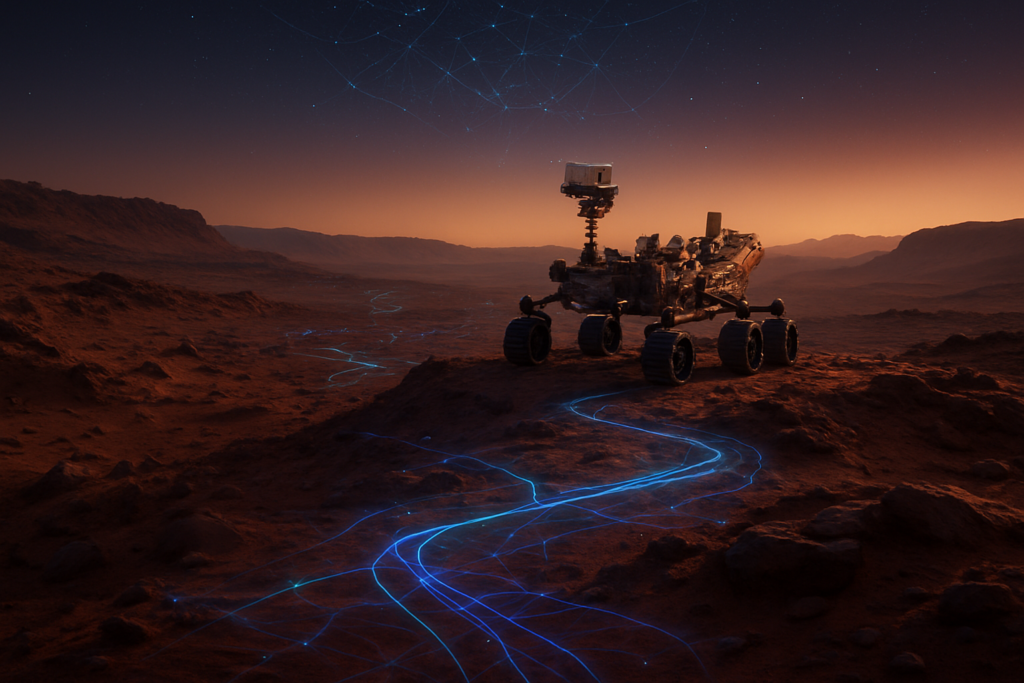
In a historic leap for interplanetary exploration, NASA’s Jet Propulsion Laboratory (JPL) has confirmed the successful completion of the first Martian rover drives planned entirely by an autonomous artificial intelligence agent. Utilizing a specialized iteration of Claude 4.5 from Anthropic, the Perseverance rover navigated a high-risk 456-meter stretch of the Jezero Crater in late 2025, with final mission validation and technical data released this week, February 5, 2026. This milestone marks the definitive shift of Large Language Models (LLMs) from digital assistants to "Super Agents" capable of controlling multi-billion dollar hardware in the most unforgiving environments known to man.
The achievement represents more than just a navigational upgrade; it is a fundamental restructuring of how humanity explores the solar system. By moving the strategic path-planning process away from human operators and into an agentic AI workflow, NASA has effectively doubled the operational tempo of its Mars missions. As the space agency grapples with recent workforce reductions, the integration of autonomous controllers like Claude has become the cornerstone of a new "AI-first" exploration strategy designed to reach the moons of Jupiter and Saturn by the end of the decade.
The Claude Command: Technical Breakthroughs in Martian Navigation
The demonstration, conducted during Sols 1707 and 1709 of the Perseverance mission, saw the rover cross a rugged terrain of bedrock and sand ripples that would typically require days of manual human plotting. Unlike traditional methods where "Rover Planners" manually identify every waypoint in a 20-minute communication-lag loop, the new system utilized Claude Code, Anthropic’s agentic environment, to ingest high-resolution orbital imagery from the Mars Reconnaissance Orbiter. Using its advanced vision-language capabilities, Claude identified hazards such as boulder fields and loose soil with 98.4% accuracy, generating a continuous sequence of movement commands in Rover Markup Language (RML).
This approach differs significantly from previous technologies like NASA’s "AutoNav." While AutoNav provides real-time obstacle avoidance—essentially acting as the rover’s "reflexes"—Claude served as the "cerebral cortex," managing long-range strategic planning. The model utilized an iterative self-critique process, generating 10-meter path segments and then analyzing its own work against safety constraints before finalizing the code. This "thinking" phase allowed the rover to maintain a high safety margin without the constant oversight of engineers on Earth. Prior to transmission, the AI-generated RML was validated through a digital twin simulation that verified over 500,000 telemetry variables, ensuring the path would not endanger the $2.7 billion vehicle.
Initial reactions from the AI research community have been electric. "We are seeing the transition from LLMs that talk to LLMs that do," stated Vandi Verma, a veteran space roboticist at JPL. Industry experts note that the ability of Claude to handle "uncertain, high-stakes environments" without a GPS network proves that agentic AI has matured beyond the "hallucination" phase that plagued earlier models. By automating the most labor-intensive parts of rover operations, NASA has demonstrated that AI can operate as a reliable peer in scientific discovery.
The New Space Race: Anthropic, Google, and the Infrastructure Giants
This successful mission places Anthropic at the forefront of the specialized AI market, creating significant competitive pressure for rivals. While OpenAI has focused on its autonomous coding app Codex and GPT-5.2 (released in late 2025), Anthropic has carved out a niche in high-reliability, safety-critical applications. This victory is also a major win for Amazon.com, Inc. (NASDAQ: AMZN) and Alphabet Inc. (NASDAQ: GOOGL), both of whom have invested heavily in Anthropic. Amazon, in particular, is looking to leverage these agentic capabilities within its "Amazon Leo" satellite constellation to provide advanced AI services to remote terrestrial and orbital assets.
The competition is intensifying as Alphabet Inc. (NASDAQ: GOOGL) pushes its Gemini Robotics 1.5 platform, which focuses on "Embodied Reasoning" for terrestrial robots. Google’s ability to transfer skills across different hardware chassis remains a threat, but Anthropic’s "Claude on Mars" success provides a level of prestige and a "proven-in-vacuum" track record that is difficult to replicate. Meanwhile, Microsoft Corporation (NASDAQ: MSFT) has taken a different strategic path, focusing on the underlying infrastructure with its custom Maia 200 AI chips to power the back-end processing for these autonomous agents, positioning itself as the "foundry" for the agentic era.
The implications for existing space contractors like Lockheed Martin Corporation (NYSE: LMT) are also profound. As AI agents take over the software and planning side of missions, the value proposition for traditional aerospace firms may shift further toward hardware manufacturing and "AI-ready" chassis design. Companies that fail to integrate deep agentic autonomy into their flight software risk being sidelined by more agile, software-first startups that can offer higher mission efficiency at lower costs.
From Chatbots to Controllers: The Shift to Agentic Autonomy
The Mars drive is a sentinel event in the broader AI landscape, signaling the end of the "Chatbot Era." For years, AI was viewed primarily as a tool for text generation and summarization. The move to autonomous controllers—often referred to as Large Action Models (LAMs)—signifies a world where AI has direct agency over physical systems. This fits into the 2026 trend of "Super Agents," systems that do not just suggest a plan but execute it end-to-end. This mirrors the recent launch of OpenAI's Codex App and Google's Antigravity platform, both of which allow AI to operate terminals and browsers as a human would.
However, the shift is not without concerns. The reliance on AI for high-stakes scientific exploration raises questions about "algorithmic bias" in discovery—specifically, whether an AI might prioritize "safe" paths over "scientifically interesting" ones that look hazardous. Furthermore, the 20% workforce reduction at NASA earlier this year has led some to worry that AI is being used as a mandatory replacement for human expertise rather than a complementary tool. Comparisons are already being drawn to the 1997 Deep Blue victory over Garry Kasparov; however, in this case, the AI isn't just winning a game—it's navigating a world where a single mistake could result in the total loss of a flagship mission.
The Horizon: Lunar Colonies and the Moons of the Outer Giants
Looking ahead, the success of Claude on Mars is expected to serve as the blueprint for the Artemis lunar missions. Near-term plans include deploying similar agentic systems to manage autonomous "lunar trucks" and mining equipment on the Moon’s South Pole. Experts predict that by 2027, "Super Agents" will be the standard for all autonomous exploration, capable of not only navigating but also selecting geological samples and performing on-site chemical analysis without waiting for instructions from Earth.
The long-term goal remains the outer solar system. Missions to Europa (Jupiter) and Titan (Saturn) face communication delays that can last hours, making human-in-the-loop operation impossible. AI agents with the reasoning capabilities of Claude 4.5 are the only viable path to exploring the sub-surface oceans of these worlds. The challenge remains in "hardened" AI: ensuring that the complex neural networks required for Claude can survive the intense radiation environments of Jupiter’s orbit.
A New Era of Discovery
The first AI-planned drive on Mars is a definitive milestone in the history of technology. It marks the moment when humanity’s most advanced software met its most challenging physical frontier and succeeded. Key takeaways from this event include the proven reliability of LLM-based planning, the shift toward agentic AI as an operational necessity, and the intensifying battle between tech giants to dominate the "embodied AI" market.
In the coming weeks, NASA is expected to release the full "Claude Mission Logs," which will provide deeper insight into how the AI handled unexpected terrain anomalies. As we move further into 2026, the industry will be watching closely to see if these autonomous agents can maintain their perfect safety record as they are deployed across more diverse and dangerous environments. The red sands of Mars have served as the ultimate testing ground, proving that the future of exploration will not be human-driven or AI-driven—it will be a seamless, agentic partnership.
This content is intended for informational purposes only and represents analysis of current AI developments.
TokenRing AI delivers enterprise-grade solutions for multi-agent AI workflow orchestration, AI-powered development tools, and seamless remote collaboration platforms.
For more information, visit https://www.tokenring.ai/.