SANTA CLARA, CA — As of February 5, 2026, the global landscape of artificial intelligence has reached a critical inflection point. NVIDIA (NASDAQ: NVDA) has officially moved its Blackwell architecture—specifically the B200 GPU and the liquid-cooled GB200 NVL72 rack system—into full-scale volume production. This transition marks the end of the "scarcity era" that defined 2024 and 2025, providing the raw computational horsepower necessary to train and deploy the next generation of frontier AI models, including OpenAI’s highly anticipated GPT-5 and its subsequent iterations.
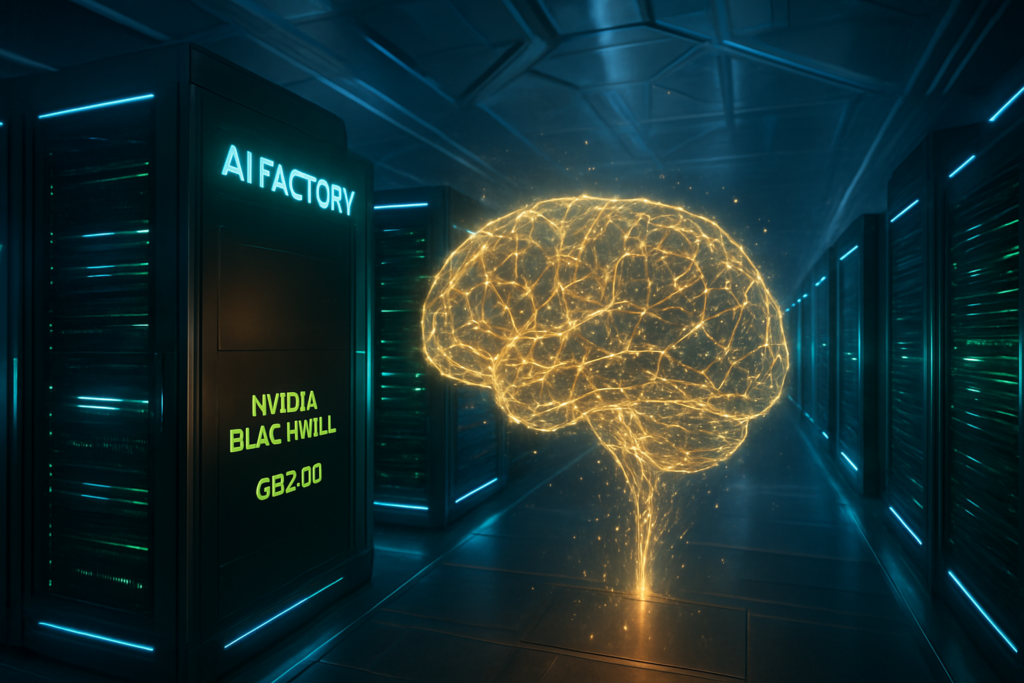
The ramp-up in production is bolstered by a historic milestone: TSMC (NYSE: TSM) has successfully reached high-yield parity at its Fab 21 facility in Arizona. For the first time, NVIDIA’s most advanced 4NP process silicon is being produced in massive quantities on U.S. soil, significantly de-risking the supply chain for North American tech giants. With over 3.6 million units already backlogged by major cloud providers, the Blackwell era is not just an incremental upgrade; it represents the birth of the "AI Factory" as the new standard for industrial-scale intelligence.
The Blackwell B200 is a marvel of semiconductor engineering, moving away from the monolithic designs of the past toward a sophisticated dual-die chiplet architecture. Each B200 houses a staggering 208 billion transistors, effectively functioning as a single, seamless processor through a 10 TB/s interconnect. This design allows for a massive leap in memory capacity, with the standard B200 now featuring 192GB of HBM3e memory and a bandwidth of 8 TB/s. These specs represent a nearly 2.4x increase over the previous H100 "Hopper" generation, which reigned supreme throughout 2023 and 2024.
A key technical breakthrough that has the research community buzzing is the second-generation Transformer Engine, which introduces support for FP4 precision. By utilizing 4-bit floating-point arithmetic without sacrificing significant accuracy, the Blackwell platform delivers up to 20 PFLOPS of peak performance. In practical terms, this allows researchers to serve models with 15x to 30x higher throughput than the Hopper architecture. This shift to FP4 is considered the "secret sauce" that will make the real-time operation of trillion-parameter models economically viable for the general public.
Beyond the individual chip, the GB200 NVL72 system has redefined data center architecture. By connecting 72 Blackwell GPUs into a single unified domain via the 5th-Gen NVLink, NVIDIA has created a "rack-scale GPU" with 130 TB/s of aggregate bandwidth. This interconnect speed is crucial for models like GPT-5, which are rumored to exceed 1.8 trillion parameters. In these environments, the bottleneck is often the communication between chips; Blackwell’s NVLink 5 eliminates this, treating the entire rack as a single computational entity.
The shift to volume production has massive implications for the "Big Three" cloud providers and the labs they support. Microsoft (NASDAQ: MSFT) has been the first to deploy tens of thousands of Blackwell units per month across its "Fairwater" AI superfactories. These facilities are specifically designed to handle the 100kW+ power density required by liquid-cooled Blackwell racks. For Microsoft and OpenAI, this infrastructure is the foundation for GPT-5, enabling the model to process context windows in the millions of tokens while maintaining the reasoning speeds required for autonomous agentic behavior.
Amazon (NASDAQ: AMZN) and its AWS division have similarly aggressive roadmaps, recently announcing the general availability of P6e-GB200 UltraServers. AWS has notably implemented its own proprietary In-Row Heat Exchanger (IRHX) technology to manage the extreme thermal output of these chips. By providing Blackwell-tier compute at scale, AWS is positioning itself to be the primary host for the next wave of "sovereign AI" projects—national-level initiatives where countries like Japan and the UK are building their own LLMs to ensure data privacy and cultural alignment.
The competitive advantage for companies that can secure Blackwell silicon is currently insurmountable. Startups and mid-tier AI labs that are still relying on H100 clusters are finding it difficult to compete on training efficiency. According to recent benchmarks, training a 1.8-trillion parameter model requires 8,000 Hopper GPUs and 15 MW of power, whereas the Blackwell platform can accomplish the same task with just 2,000 GPUs and 4 MW. This 4x reduction in hardware footprint and power consumption has fundamentally changed the venture capital math for AI startups, favoring those with "Blackwell-ready" infrastructure.
Looking at the broader AI landscape, the Blackwell ramp-up signifies a transition from "brute force" scaling to "rack-scale efficiency." For years, the industry worried about the "power wall"—the idea that we would run out of electricity before we could reach AGI. Blackwell’s energy efficiency suggests that we can continue to scale model complexity without a linear increase in power consumption. This development is crucial as the industry moves toward "Agentic AI," where models don't just answer questions but perform complex, multi-step tasks in the real world.
However, the concentration of Blackwell chips in the hands of a few tech titans has raised concerns about a growing "compute divide." While NVIDIA's increased production helps, the backlog into mid-2026 suggests that only the wealthiest organizations will have access to the peak of AI performance for the foreseeable future. This has led to renewed calls for decentralized compute initiatives and government-funded "national AI clouds" to ensure that academic researchers aren't left behind by the private sector's massive AI factories.
The environmental impact remains a double-edged sword. While Blackwell is more efficient per TFLOP, the sheer scale of the deployments—some data centers are now crossing the 500 MW threshold—continues to put pressure on global energy grids. The industry is responding with a massive push into small modular reactors (SMRs) and direct-to-chip liquid cooling, but the "AI energy crisis" remains a primary topic of discussion at global tech summits in early 2026.
Looking ahead, NVIDIA is not resting on its laurels. Even as the B200 reaches volume production, the first shipments of the "Blackwell Ultra" (B300) have begun, featuring an even larger 288GB HBM3e memory pool. This mid-cycle refresh is designed to bridge the gap until the arrival of the "Rubin" architecture, slated for late 2026 or early 2027. Rubin is expected to introduce even more advanced 3nm process nodes and a shift toward HBM4 memory, signaling that the pace of hardware innovation shows no signs of slowing.
In the near term, we expect to see the "inference explosion." Now that the hardware exists to serve trillion-parameter models efficiently, we will see these capabilities integrated into every facet of consumer technology, from operating systems that can predict user needs to real-time, high-fidelity digital twins for industrial manufacturing. The challenge will shift from "how do we train these models" to "how do we govern them," as agentic AI begins to handle financial transactions, legal analysis, and healthcare diagnostics autonomously.
The mass production of Blackwell B200 and GB200 chips represents a landmark moment in the history of computing. Much like the introduction of the first mainframes or the birth of the internet, this deployment provides the infrastructure for a new era of human productivity. NVIDIA has successfully transitioned from being a component maker to the primary architect of the world's most powerful "AI factories," solidifying its position at the center of the 21st-century economy.
As we move through the first half of 2026, the key metric to watch will be the "token-to-watt" ratio. The true success of Blackwell will not just be measured in TFLOPS, but in how it enables AI to become a ubiquitous, affordable utility. With GPT-5 on the horizon and the hardware finally in place to support it, the next few months will likely see the most significant leaps in AI capability we have ever witnessed.
This content is intended for informational purposes only and represents analysis of current AI developments.
TokenRing AI delivers enterprise-grade solutions for multi-agent AI workflow orchestration, AI-powered development tools, and seamless remote collaboration platforms.
For more information, visit https://www.tokenring.ai/.