In a decisive move to secure its dominance in the generative AI era, Alphabet Inc. (NASDAQ: GOOGL) has unveiled a massive expansion of its custom silicon roadmap, centered on the widespread deployment of its sixth-generation "Trillium" (TPU v6) and the seventh-generation "Ironwood" (TPU v7) accelerators. As of February 2026, Google has effectively transitioned its core AI operations—including the massive Gemini 2.0 ecosystem—onto its own hardware, signaling a pivot away from the industry’s long-standing dependency on third-party graphics processing units.
This strategic shift is backed by a staggering $185 billion capital expenditure plan for 2026, a record-breaking investment aimed at building out global data center capacity and proprietary compute clusters. By vertically integrating its hardware and software stacks, Google is not only seeking to insulate itself from the supply chain volatility that has plagued the industry but is also setting a new benchmark for energy efficiency. The company’s latest benchmarks reveal a remarkable 67% gain in energy efficiency for its Trillium architecture, a feat that could fundamentally alter the environmental and economic trajectory of large-scale AI.
The Technical Edge: From Trillium to the Ironwood Frontier
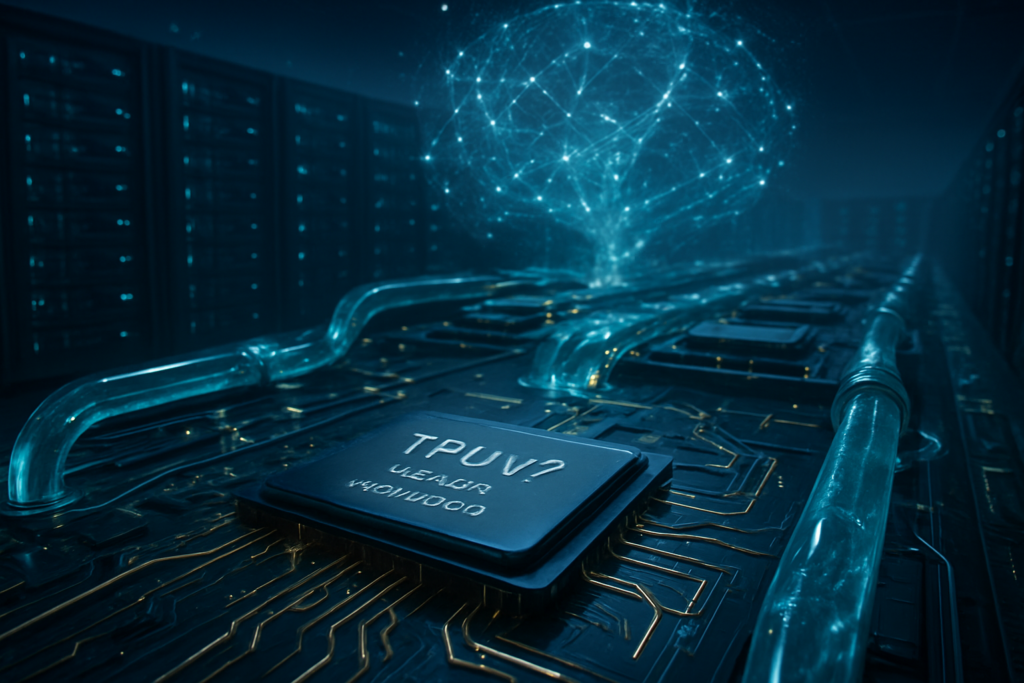
The Trillium (TPU v6) architecture, now the primary workhorse for Google’s production workloads, represents a monumental leap in performance-per-watt. Delivering a 4.7x increase in peak compute performance per chip compared to the previous TPU v5e, Trillium achieves approximately 918 TFLOPs of BF16 performance. The 67% energy efficiency gain is not merely a marketing metric; it is the result of architectural breakthroughs like the third-generation SparseCore, which optimizes ultra-large embeddings, and advanced power gating that minimizes energy waste during idle cycles. These efficiencies are critical for maintaining the high-velocity inference required by Gemini 2.0, which now serves over 750 million monthly active users.
While Trillium handles the current heavy lifting, the seventh-generation "Ironwood" (TPU v7) is the vanguard of Google’s future "reasoning" models. Reaching general availability in early 2026, Ironwood is the first Google-designed TPU to feature native FP8 support, allowing it to compete directly with the latest Blackwell-class architectures from NVIDIA Corp. (NASDAQ: NVDA). With a massive 192GB of HBM3e memory per chip and a record-breaking 7.4 TB/s of bandwidth, Ironwood is designed specifically for the massive key-value (KV) caches required by long-context reasoning models, supporting context windows that now stretch into the millions of tokens.
The engineering of these chips has been a collaborative effort with Broadcom Inc. (NASDAQ: AVGO), Google's primary ASIC design partner. This partnership has allowed Google to bypass many of the "general-purpose" overheads found in standard GPUs, creating a lean, specialized silicon environment. Industry experts note that the move to a 9,216-chip "TPU7x" pod configuration allows Google to treat thousands of individual chips as a single, coherent supercomputer, an architectural advantage that traditional modular GPU clusters struggle to match.
Shifting the Power Dynamics of the AI Industry
Google’s aggressive push into custom silicon sends a clear message to the broader tech industry: the era of GPU hegemony is being challenged by bespoke infrastructure. For years, the AI sector was beholden to NVIDIA’s product cycles and pricing power. By funneling $185 billion into its own ecosystem, Google is effectively "de-risking" its future, ensuring that its most advanced models, like Gemini 2.0 and the upcoming Gemini 3, are not throttled by external hardware shortages. This vertical integration allows Google to offer Vertex AI customers more competitive pricing, as it no longer needs to pay the high margins associated with merchant silicon.
The competitive implications for other AI labs and cloud providers are profound. While Microsoft Corp. (NASDAQ: MSFT) and Amazon.com Inc. (NASDAQ: AMZN) have also developed internal chips like Maia and Trainium, Google’s decade-long head start with the TPU program gives it a significant edge in software-hardware co-optimization. This puts pressure on rival AI labs that rely solely on external hardware, as they may find themselves at a cost disadvantage when scaling models to the trillion-parameter level.
Furthermore, Google's move disrupts the secondary market for AI compute. As Google Cloud becomes increasingly populated by high-efficiency TPUs, the platform becomes the natural home for developers looking for "green" AI solutions or those requiring the massive memory bandwidth that Ironwood provides. This market positioning leverages Google’s infrastructure as a strategic moat, forcing competitors to choose between paying the "NVIDIA tax" or accelerating their own costly silicon development programs.
Efficiency as the New Currency of the AI Landscape
The broader significance of the 67% efficiency gain achieved by Trillium cannot be overstated. As global concerns regarding the power consumption of AI data centers reach a fever pitch, Google’s ability to do more with less energy is becoming a primary competitive advantage. In a world where access to stable power grids is becoming a bottleneck for data center expansion, the "performance-per-watt" metric is replacing raw TFLOPs as the most critical KPI in the industry. Google’s internal data suggests that the transition to Trillium has already saved the company billions in operational energy costs, which are being reinvested into further R&D.
This focus on efficiency also fits into a wider trend of "agentic AI"—systems that operate autonomously over long periods. These systems require constant "always-on" inference, where energy costs can quickly become prohibitive on older hardware. By optimizing Trillium and Ironwood for these persistent workloads, Google is setting the stage for AI agents that are integrated into every facet of the digital economy, from autonomous coding assistants to complex supply chain orchestrators.
However, this consolidation of power within a single company's proprietary hardware stack does raise concerns. Some industry observers worry about "vendor lock-in," where models trained on Google’s TPUs using the JAX or XLA frameworks cannot easily be migrated to other hardware environments. While this benefits Google's ecosystem, it poses a challenge for the open-source community, which largely operates on CUDA-optimized architectures. The "compute wars" are thus evolving into a software ecosystem war, where the hardware and the compiler are inseparable.
The Horizon: Gemini 3 and Beyond
Looking ahead, the focus is already shifting toward the deployment of Gemini 3, which is currently being trained on early-access Ironwood clusters. Experts predict that Gemini 3 will represent the first truly "multi-modal native" model, capable of processing and generating high-fidelity video and 3D environments in real-time. This level of complexity is only possible due to the 4.6 PetaFLOPS of FP8 performance offered by the TPU v7, which provides the necessary throughput for next-generation generative media.
In the near term, we expect to see Google expand its "TPU-as-a-Service" offerings, making Ironwood available to a wider array of enterprise clients through Google Cloud. There are also rumors of a "TPU v8" already in the design phase, which may incorporate even more exotic cooling technologies and optical interconnects to overcome the physical limits of traditional copper-based data pathways. The challenge for Google will be maintaining this blistering pace of development while managing the massive logistical hurdles of its $185 billion infrastructure rollout.
A New Era of Integrated Intelligence
The evolution of Google’s custom silicon—from the efficiency-focused Trillium to the high-performance Ironwood—marks a turning point in the history of computing. By committing $185 billion to this vision, Alphabet has signaled that it views hardware as a fundamental component of its AI identity, not just a commodity to be purchased. The 67% efficiency gains and the massive performance leaps of the TPU v7 provide the foundation for Gemini 2.0 to scale to a billion users and beyond, while reducing the company's reliance on external vendors.
As we move further into 2026, the success of this strategy will be measured by Google's ability to maintain its lead in the "reasoning" AI race and the continued adoption of its Vertex AI platform. For now, Google has successfully built a "silicon fortress," ensuring that the future of its AI is powered by its own ingenuity. The coming months will reveal how the rest of the industry responds to this massive shift in the balance of power, as the race for AI sovereignty intensifies.
This content is intended for informational purposes only and represents analysis of current AI developments.
TokenRing AI delivers enterprise-grade solutions for multi-agent AI workflow orchestration, AI-powered development tools, and seamless remote collaboration platforms.
For more information, visit https://www.tokenring.ai/.