In a move that cements the "circular economy" of the artificial intelligence era, Nvidia (NASDAQ: NVDA) has finalized a staggering $20 billion investment in OpenAI as part of a broader $100 billion funding round. This infusion, confirmed this week in February 2026, values the San Francisco-based AI pioneer at approximately $830 billion—catapulting it into a rare stratosphere of valuation occupied by only a handful of the world’s most powerful corporations.
The deal marks a significant strategic pivot for Nvidia. No longer content with merely being the primary "arms dealer" of the AI revolution, Nvidia is now its most foundational financier. By taking a direct equity stake in its largest customer, Nvidia is ensuring that the massive, multi-gigawatt data centers required for the next generation of "Agentic AI" will be built almost exclusively on its proprietary architecture. This $20 billion commitment serves as a massive backstop for OpenAI’s ambitious infrastructure roadmap, providing the liquidity needed to transition from research-heavy operations to a dominant global utility.
The Vera Rubin Era and the $100 Billion War Chest
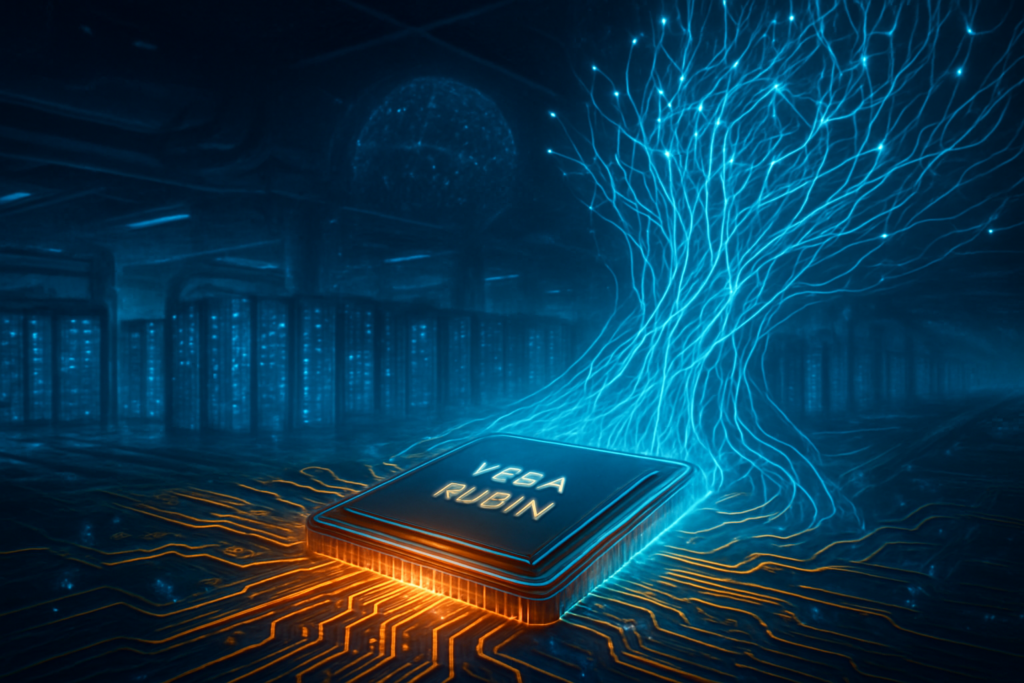
The technical core of this investment is inextricably linked to the rollout of Nvidia’s newest architecture, the "Vera Rubin" platform. Named after the pioneering astronomer, the Rubin GPU and Vera CPU represent the next leap in compute density, with a single rack capable of delivering 8 exaflops of AI performance. OpenAI’s commitment to this hardware is the bedrock of the deal. The $20 billion cash-for-equity transaction replaces a previously discussed $100 billion infrastructure partnership, which analysts say was scaled back to a more "straightforward" stake after internal concerns at Nvidia regarding OpenAI’s fiscal discipline and its flirtation with rival chip startups like Groq and Cerebras.
Initial reactions from the AI research community have been a mix of awe and apprehension. While researchers are eager to see what the massive scale of the Vera Rubin platform can do for GPT-6 and beyond, industry experts like those at Radio Free Mobile have raised alarms about "circular funding." They argue that Nvidia is effectively lending money to its own customer base to ensure they can afford to buy its chips, a feedback loop that could mask underlying market saturation. However, with OpenAI’s revenue projected to hit $25 billion in 2026—up from $13 billion in 2025—the company argues that the capital is backed by real-world enterprise demand rather than speculation.
Securing the Supply Chain Against Rising Rivals
This investment creates a formidable moat for both parties. For OpenAI, the $830 billion valuation provides the leverage needed to negotiate massive power and land deals for its "10-Gigawatt Initiative"—a plan to build "AI factories" that could rival the energy consumption of mid-sized nations. For Nvidia, the deal ensures that its silicon remains the industry standard at a time when Amazon (NASDAQ: AMZN) and Google (NASDAQ: GOOGL) are increasingly pushing their own custom Trainium and TPU chips. By becoming a primary owner of OpenAI, Nvidia effectively locks in its most influential customer for the foreseeable future.
The competitive landscape is shifting rapidly. While Microsoft (NASDAQ: MSFT) remains OpenAI's largest stakeholder with roughly 27% equity, the entry of Nvidia as a multi-billion dollar shareholder introduces a new dynamic. Amazon has also been in talks to contribute as much as $50 billion to this round, seeking a multi-vendor strategy that would integrate OpenAI’s models into AWS while maintaining its own hardware independence. This high-stakes maneuvering has left smaller AI labs and startups in a precarious position, as the capital required to compete at the "frontier" level has now reached the hundreds of billions, effectively pricing out all but the most well-funded tech giants.
The Global AI Factory: Trends and Concerns
Beyond the immediate financial figures, the Nvidia-OpenAI deal signifies the emergence of the "AI Factory" as the new unit of industrial power. We are moving away from the era of "models as products" and into "compute as an economy." This shift fits into a broader trend where AI labs are evolving into vertically integrated infrastructure providers. The massive scale of this funding round mirrors previous industrial milestones, such as the build-out of the global telecommunications network in the late 1990s, but with a much faster rate of capital deployment.
However, the sheer size of the $830 billion valuation raises concerns about a potential "compute bubble." If the transition to "Agentic AI"—models that can autonomously execute workflows and manage enterprise tasks—fails to deliver the expected productivity gains, the entire ecosystem could face a liquidity crisis. Furthermore, the reliance on Middle Eastern sovereign wealth funds and massive debt-to-equity swaps to fund these 10-gigawatt data centers has prompted calls for more transparency regarding the environmental impact and the concentration of AI power within a handful of boardroom circles.
Toward a Trillion-Dollar IPO and Beyond
Looking ahead, this funding round is widely viewed as the final "pre-IPO" benchmark. Sources close to OpenAI suggest the company is preparing for a public listing as early as late 2026, with a target valuation exceeding $1 trillion. The near-term focus will be on the successful deployment of "Project Stargate," the first massive-scale data center resulting from this collaboration. If successful, it will enable a new class of AI agents capable of handling complex multi-step reasoning, from software engineering to scientific discovery, with minimal human intervention.
The challenges remaining are largely physical. Solving the energy constraints of these massive "AI factories" and optimizing inference performance are top priorities. While OpenAI has relied on Nvidia for training, it continues to explore specialized silicon for inference tasks to reduce the exorbitant cost of running its models. How Nvidia responds to OpenAI’s continued research into rival hardware will be the next major test of this multi-billion dollar marriage of convenience.
A New Chapter in Computing History
Nvidia’s $20 billion investment in OpenAI is more than just a financial transaction; it is a declaration of the new world order in technology. It marks the moment when the world’s most valuable chipmaker decided that its future was too important to be left to the whims of its customers' balance sheets. By anchoring the $830 billion OpenAI empire, Nvidia has ensured that it remains at the center of the AI story for the next decade.
The key takeaways from this historic deal are clear: the cost of entry for frontier AI is now measured in the hundreds of billions, and the line between hardware vendor and platform owner has permanently blurred. In the coming months, the industry will be watching the first benchmarks of the Vera Rubin-powered GPT models and monitoring whether the projected revenue growth can justify the astronomical valuations. For now, the Nvidia-OpenAI alliance stands as the most powerful force in the history of computing.
This content is intended for informational purposes only and represents analysis of current AI developments.
TokenRing AI delivers enterprise-grade solutions for multi-agent AI workflow orchestration, AI-powered development tools, and seamless remote collaboration platforms.
For more information, visit https://www.tokenring.ai/.