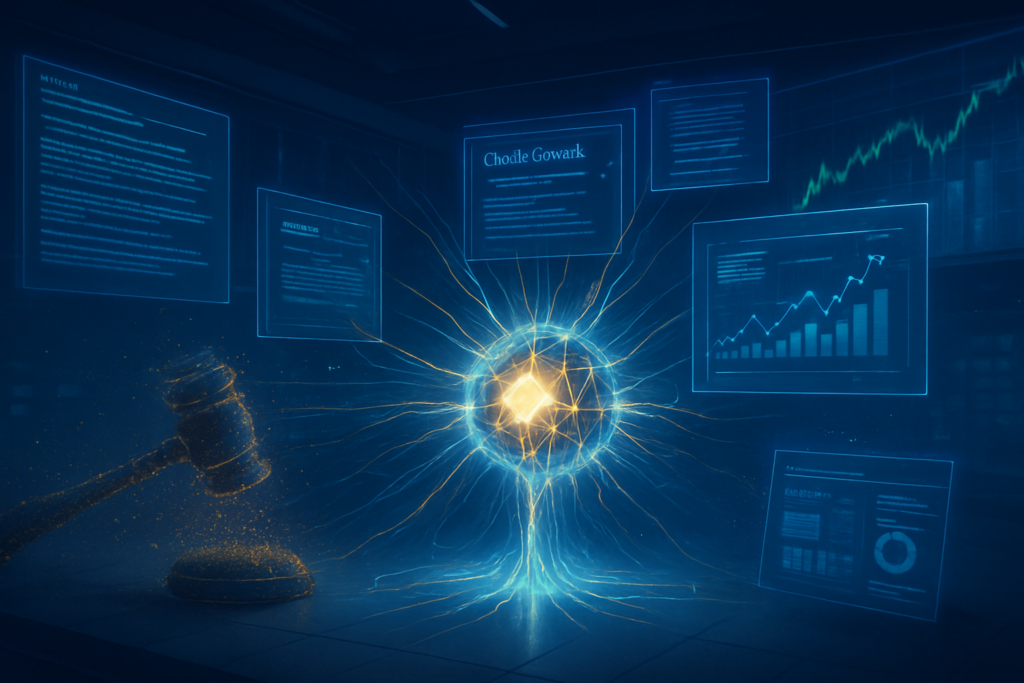
The professional services industry is reeling this week as Anthropic, backed by tech giants like Amazon.com Inc. (NASDAQ: AMZN) and Alphabet Inc. (NASDAQ: GOOGL), launched its long-anticipated "Claude Cowork" suite. Released in early February 2026, the specialized "agentic" plugins for legal and sales workflows have sparked an immediate and violent market reaction. Analysts are calling it the "SaaSpocalypse," a watershed moment where general-purpose AI agents began to demonstrably dismantle the business models of entrenched software-as-a-service (SaaS) providers.
The immediate fallout was felt most acutely on Wall Street, where shares of legal tech stalwarts and sales automation platforms plummeted. Thomson Reuters (NYSE: TRI) saw its stock price drop by a staggering 15.8% in a single session, while LegalZoom (NASDAQ: LZ) cratered by nearly 20%. The investor panic reflects a growing consensus that the era of paying for specialized, high-margin software seats may be coming to an abrupt end as Claude Cowork proves it can perform the complex, multi-step tasks previously reserved for human associates and niche software tools.
The Dawn of Agentic Autonomy: Technical Breakthroughs in Claude Cowork
Unlike the "copilots" of 2024 and 2025, which primarily acted as advanced autocomplete tools, Claude Cowork is built on a foundation of true agency. The "Legal" and "Sales" plugins released this month represent a shift from conversational AI to operational AI. These tools utilize the Model Context Protocol (MCP) to gain direct, permissioned access to a user’s local file system, browser, and enterprise databases. For legal professionals, the plugin doesn't just draft a document; it triages NDAs against a firm’s internal "playbook," flags non-compliant clauses, and independently researches case law to generate a comprehensive litigation strategy.
The Sales plugin is equally disruptive. It functions as a self-directed lead generation engine, capable of pulling data from platforms like Salesforce Inc. (NYSE: CRM), researching prospects across the live web, and drafting hyper-personalized outreach campaigns. Most impressively, the system can deploy "sub-agents"—specialized mini-models that handle data visualization or technical documentation—to work in parallel on a single project. This multi-agent orchestration allows Claude Cowork to handle entire workflows that once required a team of junior employees and multiple software subscriptions.
Industry experts note that this differs fundamentally from previous RAG (Retrieval-Augmented Generation) systems. Claude Cowork doesn't just look for information; it creates a multi-step plan, executes it, and only prompts the user for intervention when it encounters an ethical boundary or a high-stakes decision. This "loop-closing" capability has turned AI into an active participant in professional labor rather than a passive reference tool.
A Market in Turmoil: Disruption of the SaaS Guard
The market reaction has been nothing short of a bloodbath for traditional professional software firms. Beyond the headline drops for Thomson Reuters and LegalZoom, the contagion spread to RELX PLC (NYSE: RELX)—parent company of LexisNexis—which saw its shares fall 14%. Even enterprise giants like ServiceNow (NYSE: NOW) and Adobe Inc. (NASDAQ: ADBE) saw 7% dips as investors questioned the long-term viability of "per-seat" licensing in a world where one AI agent can do the work of ten employees.
The strategic advantage has shifted decisively toward foundation model companies. By offering specialized plugins as part of a general Claude subscription, Anthropic is effectively commoditizing the features that companies like LegalZoom spent decades building. Market analysts suggest that specialized software providers are now facing a "death by a thousand plugins," where generalist AI platforms can replicate their core value proposition for a fraction of the cost.
For major AI labs, this move cements their position as the new "operating systems" of the professional world. The competitive implication is clear: companies that relied on proprietary data silos are being bypassed by AI agents that can synthesize information from across an entire organization’s digital footprint. The disruption isn't just about the software; it's about the billable-hour model itself, which is under existential threat as tasks that once took ten hours are now completed in ten seconds.
The Great Cognitive Shift: Wider Significance of Agentic AI
This development marks the culmination of a trend that began in late 2024, moving from "AI as a feature" to "AI as infrastructure." The ability for Claude Cowork to handle high-level professional workflows suggests that the "Great De-skilling" of entry-level professional roles is no longer a theoretical concern but a current reality. The automation of "associate-level" work in law and sales represents the first major wave of cognitive labor replacement on a mass scale.
However, the shift also raises significant concerns regarding accountability and the "black box" nature of automated legal work. While Anthropic has integrated rigorous "human-in-the-loop" safeguards, the speed at which these agents operate makes oversight a daunting task. The comparison to previous milestones, such as the release of GPT-4, is stark: while GPT-4 could pass the bar exam, Claude Cowork can actually practice—performing the tedious, iterative work that constitutes the bulk of a junior lawyer's day.
Ethical debates are already intensifying. If an AI agent misses a critical clause in a contract or generates a biased sales pitch based on skewed data, who is liable? As AI moves from providing advice to taking action, the legal and ethical frameworks of the 21st century are being pushed to their breaking point.
Looking Ahead: The Future of Professional Automation
In the near term, we expect Anthropic to expand the Cowork suite into other highly regulated fields, including medical diagnostics and structural engineering. The success of the Legal and Sales plugins has already paved the way for "Medical Cowork," which is rumored to be in beta testing with major hospital networks. The challenge for the coming months will be the "last mile" of reliability—ensuring that these agents can handle the messy, unpredictable nuances of human interaction that don't fit into a structured workflow.
Predictions from industry experts suggest that by 2027, the concept of "software" may be entirely replaced by "agentic services." Instead of buying a CRM, companies will hire an AI "Sales Agent" from a platform provider. The primary hurdle remains regulatory; as the "SaaSpocalypse" continues to threaten trillions in market value, we can expect a wave of lobbying and litigation from the incumbents who are being left behind in this new era of AI autonomy.
A Watershed Moment in Economic History
The release of Claude Cowork in February 2026 will likely be remembered as the moment the AI revolution finally "hit home" for the white-collar workforce. The massive sell-off of Thomson Reuters and LegalZoom shares is a clear signal from the market: the old ways of doing professional business are over. This is not just a technological upgrade; it is a fundamental restructuring of how cognitive labor is valued and executed.
As we look toward the rest of 2026, the key metric to watch will not be the "intelligence" of the models, but their "utility"—how effectively they can navigate the complex, real-world systems of modern business. The "SaaSpocalypse" may only be the beginning of a broader economic realignment, as every industry from finance to healthcare prepares for a future where the primary worker is an agent, and the primary software is intelligence itself.
This content is intended for informational purposes only and represents analysis of current AI developments.
TokenRing AI delivers enterprise-grade solutions for multi-agent AI workflow orchestration, AI-powered development tools, and seamless remote collaboration platforms.
For more information, visit https://www.tokenring.ai/.