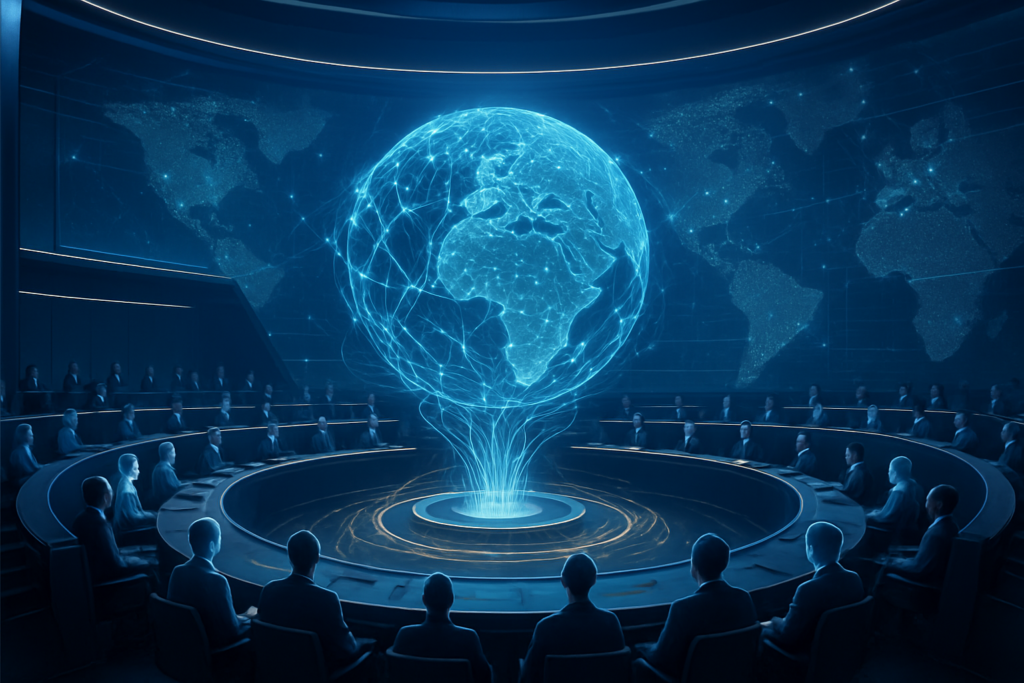
In a historic move to assert international oversight over the rapidly accelerating field of artificial intelligence, United Nations Secretary-General António Guterres officially launched the Independent International Scientific Panel on AI (IISPAI) on February 4, 2026. The panel, comprised of 40 world-renowned experts, is designed to serve as a "world-class evidence engine," providing a rigorous, scientific foundation for global AI governance and helping the international community separate "fact from fakes, and science from slop."
The formation of the IISPAI marks a pivotal shift in how the global community approaches AI, moving beyond fragmented national regulations toward a unified, evidence-based framework similar to the Intergovernmental Panel on Climate Change (IPCC). As the world grapples with the transformative potential and systemic risks of generative and agentic AI, Guterres’s vision focuses on closing the widening "AI knowledge gap" between the Global North and South, ensuring that the benefits of the technological revolution are equitably distributed rather than concentrated in a handful of corporate boardrooms.
A Scientific Early-Warning System for the AI Era
The IISPAI is not merely a consultative body but a robust technical apparatus tasked with providing annual, peer-reviewed assessments of AI's risks, opportunities, and socioeconomic impacts. The panel's 40 members—drawn from over 2,600 applicants—serve in their personal capacities, ensuring independence from government and corporate influence. The membership is strictly balanced for gender and geography, featuring 19 women and 21 men, including deep learning pioneer Yoshua Bengio, Nobel Peace Prize laureate Maria Ressa, and prominent technical experts like Balaraman Ravindran from the Indian Institute of Technology Madras and Yutaka Matsuo of the University of Tokyo.
Technically, the panel is mandated to function as an "early-warning system" for emerging AI capabilities. Unlike previous UN initiatives, the IISPAI has the authority to issue "thematic briefs" and establish ad-hoc working groups to address rapid shifts in technology, such as the rise of Agentic AI—systems capable of autonomous reasoning and multi-step execution. The panel’s methodology involves high-frequency data gathering and cross-border research collaboration, specifically targeting sectors like public health, cybersecurity, and energy management to provide a granular view of how AI is reshaping infrastructure.
The IISPAI differs from existing organizations like the Global Partnership on AI (GPAI) by its direct integration into the UN’s multilateral architecture. Established under General Assembly Resolution A/RES/79/325, it follows the recommendations of the 2024 High-Level Advisory Body on AI. Initial reactions from the research community have been largely positive, with experts praising the inclusion of diverse voices from the Global South who have historically been sidelined in discussions regarding compute-heavy AI development. However, some researchers have questioned whether the panel can maintain its pace with the private sector's "closed-door" innovations.
Market Implications: Industry Giants and the Governance Push
The launch of the IISPAI has sent ripples through the tech industry, forcing major players to recalibrate their global strategies. Microsoft (NASDAQ: MSFT), whose President Brad Smith has been a vocal advocate for "equitable diffusion," expressed support for the panel’s goal of bridging the capacity gap. However, the corporate response remains nuanced; while tech giants appreciate a predictable international framework, they are also wary of bureaucratic overreach that could stifle innovation. Microsoft and Alphabet Inc. (NASDAQ: GOOGL) have already begun releasing their own "diffusion reports" to shape the narrative around AI's positive socioeconomic impact.
Competitive implications are significant for major AI labs. OpenAI and Meta Platforms, Inc. (NASDAQ: META) are increasingly under the spotlight as the UN panel seeks more transparency regarding the "black box" nature of large-scale foundation models. The IISPAI’s emphasis on assessing the "infrastructure layer"—including the massive compute resources required for training—could lead to new international standards for data center transparency and energy consumption. This development may benefit startups that focus on "small language models" or energy-efficient AI, potentially disrupting the market dominance of companies that rely on brute-force scaling.
Strategic advantages may now shift toward companies that align their ESG (Environmental, Social, and Governance) goals with the IISPAI’s findings. For instance, Amazon (NASDAQ: AMZN) and Google have recently joined the industry-led Agentic AI Foundation to set their own technical standards. The tension between these industry-led groups and the UN’s scientific panel suggests a coming battle over who truly defines "safe" and "ethical" AI. Market analysts predict that the first IISPAI report, due in July 2026, could influence future trade agreements and export controls on advanced semiconductors.
Bridging the Global Divide and Mitigating Systemic Risk
The formation of the IISPAI fits into a broader trend of "digital sovereignty," where nations and international bodies are attempting to reclaim control over the digital landscape. By modeling the panel after the IPCC, the UN is acknowledging that AI, like climate change, is a cross-border challenge that no single nation can manage alone. The panel’s focus on the Global South is particularly significant; it seeks to ensure that developing nations are not just consumers of AI but active participants in its scientific assessment and governance.
There are, however, significant concerns. Critics from think-tanks and some U.S. officials have expressed skepticism that the UN bureaucracy can keep up with the "speed of light" development of AI. There is also the risk of geopolitical friction within the panel itself, as experts from rival nations may disagree on the definition of "misinformation" or "security risks." Comparisons to previous milestones, like the 1975 Asilomar Conference on Recombinant DNA, highlight the difficulty of achieving a global consensus in a field where the economic stakes are in the trillions of dollars.
Despite these challenges, the IISPAI represents the most serious attempt to date to create a shared reality for AI. For years, the global discourse on AI has been characterized by "slop"—a mixture of hype, fearmongering, and corporate PR. The IISPAI aims to replace this with a baseline of verified data, providing a common language for regulators in Brussels, Washington, and Beijing. This focus on "scientific consensus" is a necessary prerequisite for any future international treaty on AI safety.
The Horizon: Agentic AI and the First July 2026 Report
Looking ahead, the IISPAI’s first major test will be its comprehensive report scheduled for presentation at the Global Dialogue on AI Governance in Geneva in July 2026. This report is expected to provide the first globally sanctioned assessment of the risks posed by Agentic AI—systems that can act on behalf of users to manage finances, write code, and interact with other AI agents. Experts predict that the panel will call for new "red-teaming" standards and stricter disclosure requirements for autonomous systems that interact with critical infrastructure.
In the long term, we can expect the IISPAI to drive the creation of a UN-backed AI Capacity Building Fund. This would help developing nations build the necessary compute power and data sets to develop local AI solutions, directly addressing Guterres’s goal of closing the knowledge gap. Challenges remain, particularly regarding the enforcement of the panel’s recommendations; as a scientific body, the IISPAI has the power of the "pulpit" but not the power of the "police." Its influence will depend on how effectively its data is integrated into national laws and international trade pacts.
The next few months will see the panel establishing its various working groups and finalizing its data-sharing protocols. As AI systems become more autonomous and integrated into the global economy, the IISPAI’s ability to provide real-time foresight will be critical. The tech industry will be watching closely to see if the panel’s definitions of "high-risk" AI align with current corporate development roadmaps or if they will necessitate a major pivot in how AI is built and deployed.
A New Chapter in Global Technology Governance
The establishment of the Independent International Scientific Panel on AI marks a definitive end to the era of "permissionless innovation" on a global scale. By bringing 40 of the world’s brightest minds under the UN umbrella, Secretary-General Guterres has signaled that AI is now a matter of global public interest, transcending the interests of individual corporations or nation-states. It is a milestone that acknowledges the profound power of AI to reshape human society, for better or worse.
The significance of this development in AI history cannot be overstated. Just as the IPCC became the authoritative voice on the climate crisis, the IISPAI has the potential to become the ultimate arbiter of truth in the AI era. Whether it can succeed in the face of intense geopolitical competition and the breakneck speed of technological change remains to be seen, but its formation is a necessary step toward a more stable and equitable digital future.
In the coming weeks, the industry should watch for the announcement of the IISPAI’s specific thematic priorities and the appointment of additional technical liaisons. The dialogue between the UN and the private sector is about to enter its most intense phase yet, as the world prepares for the panel's first authoritative look at the state of artificial intelligence in mid-2026.
This content is intended for informational purposes only and represents analysis of current AI developments.
TokenRing AI delivers enterprise-grade solutions for multi-agent AI workflow orchestration, AI-powered development tools, and seamless remote collaboration platforms.
For more information, visit https://www.tokenring.ai/.